

"AI consulting" gets sold as one thing. What a finance team needs from it, what HR needs, and what a two-person marketing team needs are three different engagements.


"We should talk to an AI consultant" is usually said by someone who owns one function, not the whole company, and what they actually need varies enormously by which function that is. A finance team asking about AI consulting wants something closer to automated reconciliation and forecasting; an HR team wants something closer to resume screening and onboarding workflows; a two-person marketing team wants content and campaign automation on a budget that wouldn't cover a single enterprise engagement's kickoff meeting. Selling all three the same engagement is how a lot of AI consulting money gets wasted on a generic maturity assessment nobody acts on.
We cover what a good engagement should deliver regardless of function in our AI automation consultant guide. This one is about matching the engagement shape to the function asking for it.
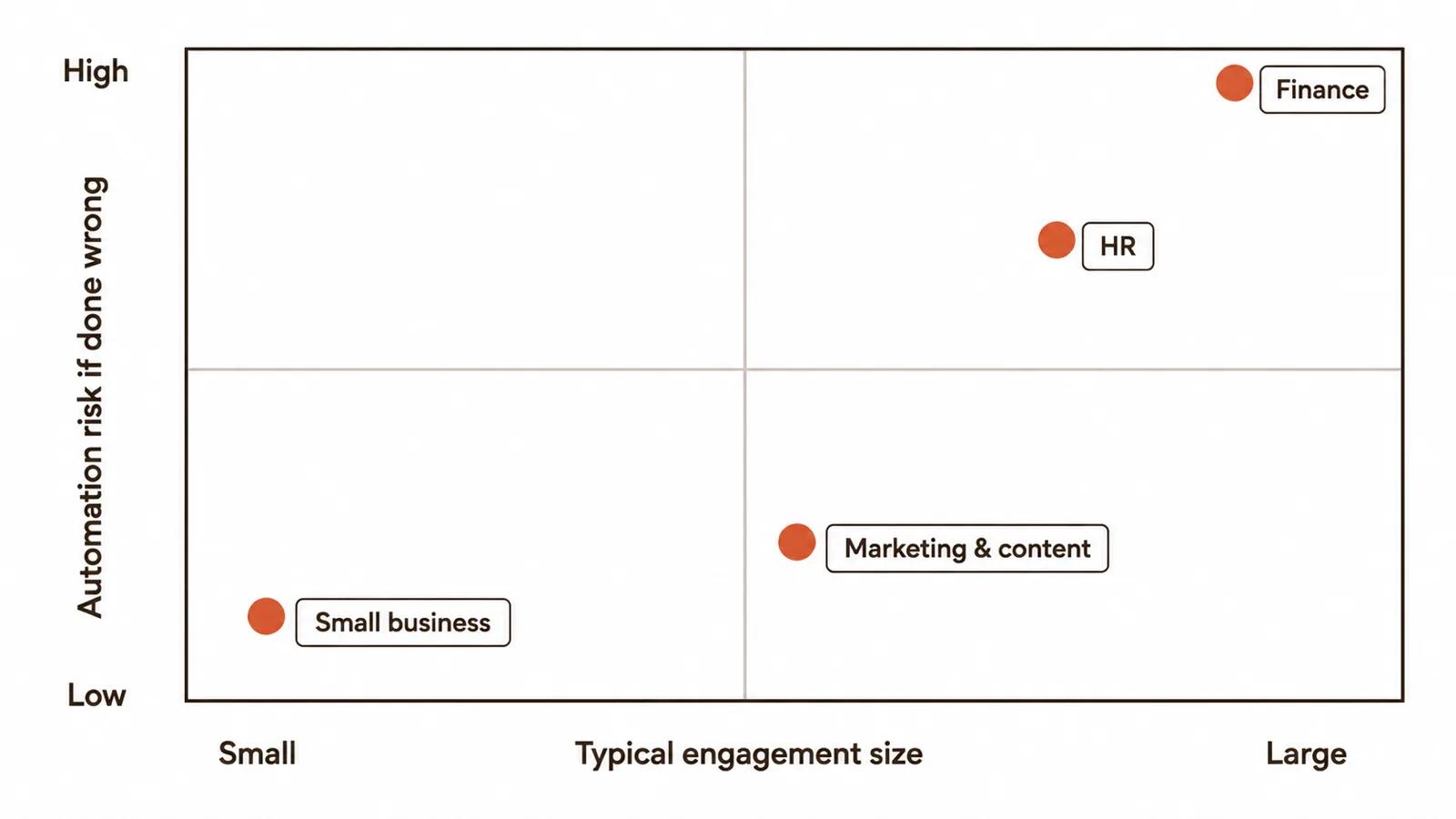
A small business asking about AI consulting almost never needs a strategy phase. They need one workflow automated well, on a budget under $20,000, in under a month, because that's usually the whole discretionary spend for the initiative. The mistake we see most often here isn't picking the wrong workflow, it's picking three at once because the consultant sold a "transformation" instead of a single-purpose build. We take single-purpose engagements ($4,000-$10,000, 3-4 weeks) specifically because a small business needs proof it works before it commits more budget, not a roadmap for five future phases it may never fund.
HR-adjacent AI consulting tends to concentrate on two things: resume/application screening and onboarding workflow automation. Both are legitimate, high-volume, structurally consistent workflows, exactly the profile that automates well. The line that matters here is the same one that shows up in healthcare: automation should narrow a pool or route a task, not make a final judgment call on a candidate or an employee. A resume screener that filters obviously-unqualified applications to save reviewer time is a defensible build. One that scores candidates and hands a hiring manager a ranked list with no visibility into why needs a much more careful, auditable design, and in some jurisdictions has real legal exposure around automated decision-making in hiring. We covered the broader onboarding/payroll automation case in our HR process automation guide.
Finance functions asking about AI consulting are usually looking at reconciliation, invoice processing, or basic forecasting. The pattern that separates a good engagement from a risky one is where verification sits. A model that flags a likely reconciliation match for a human to confirm is safe. A model that auto-posts a match without a human check is a different risk category entirely, and most finance teams underestimate how much that single design choice changes the build, the audit trail requirements, and the sign-off needed from whoever owns financial controls. Our custom financial software development piece goes deeper on where the real engineering cost sits in this vertical.
Content and campaign automation is where AI consulting engagements are least risky and most likely to show ROI fast, which is also why it's the most crowded, noisiest part of the market. The actual differentiator isn't the model, it's whether the system is grounded in real brand voice and real data (your product, your customers, your numbers) instead of generating generic copy that reads like everyone else's generic copy. HrefStack, one of our own products, is the clearest example we can point to: an autonomous SEO content agent that cut customer acquisition cost 60% versus paid channels and generates 300+ leads a month, running without manual uploads. That's the bar a content automation engagement should be measured against, not "can it write a blog post."
Regardless of which function is asking, the same discipline applies: measure the workflow before automating it, not after. We track our own SEO indexing pipeline daily across 219 sitemap URLs specifically because "it's probably working" isn't a number, and the same habit belongs in every one of the engagements above, whether the thing being measured is reconciliation accuracy, screening false-negative rate, or content lead volume. An engagement that can't tell you what it's measuring, before it starts, isn't ready to start.
No. Small businesses generally need one narrow, well-scoped workflow automated on a tight budget and timeline. Enterprise engagements can justify a longer strategy phase because the eventual build is bigger; a small business rarely has the budget or the patience for that phase and shouldn't be sold one.
It can be, depending on jurisdiction and how much of the final decision the system makes versus how much it only narrows a pool for human review. A screening tool that filters and a scoring tool that ranks candidates for a final decision carry different legal exposure, and that distinction should be designed in from the start, not discovered later.
Verification requirements. A marketing automation mistake costs you a bad post; a finance automation mistake that auto-posts an incorrect reconciliation can cost real money and create an audit problem. The engineering and sign-off process scales with that difference, even if the underlying model technology looks similar.
Start with whichever function has the clearest, highest-volume, most consistent workflow and the lowest cost of a mistake while you're still learning. That's usually not finance or HR first; it's often support or content, where the stakes of an early miss are lower.
A generalist can scope all four, but the actual build for each needs different guardrails and often different technical approaches. Be wary of a consultant proposing the identical engagement shape for reconciliation, hiring, and content in the same pitch deck.
Written by the Codestreaks team, drafted with AI assistance and edited by a human against our own engagement history across these four functions. The HrefStack numbers (60% CAC reduction, 300+ leads/month) and the 219-URL indexing tracking are real, currently-measured figures from our own products and operations, not industry benchmarks. No client names are used for the HR, finance, or small-business examples, which describe patterns across multiple engagements.
Not sure which function to start with? Book a free 30-minute scoping call or read more about our AI consulting work. Two business day response, no obligation.
A serial maker of SaaS products and AI agents, I’ve built and launched 10+ tools, grown products to thousands of users, and taken multiple ventures. I share the process what works, what breaks, and how builders can ship faster and smarter. Previously a data scientist at a Big Four consulting firm.


