

Custom financial software development takes 4 to 8 weeks and $4,000 to $30,000 with us. The four things that move the quote, and what to buy instead of build.
Codestreaks Team

Custom financial software development means building the ledgers, payment flows, reconciliation and reporting tools that sit around your own business rules. With us, a first live version takes 4 to 8 weeks and costs $4,000 to $30,000 fixed price, and financial work usually lands in the upper half of that range. Four things move the number: how many outside systems you connect, whether money moves or is only recorded, reporting, and who the users are.
Custom financial software costs more than an equivalent-looking application in almost any other sector, and the reason is not compliance paperwork. It is that money software has to be correct in a way most software does not. A social feed that drops an item annoys someone. A ledger that drops a transaction creates a number that two systems will disagree about forever, and someone will find it during an audit eighteen months later.
That single requirement, being provably right rather than mostly right, is what drives the budget. Everything else people worry about when scoping fintech work is downstream of it.
We have shipped 30+ projects to production since 2024, including work in banking operations and insurance. What follows is where financial builds actually differ, which parts are worth paying for, and where teams routinely overspend on the wrong thing.
Most of the financial builds we scope are one of five things, often two of them together:
The sections below cover where each of these gets expensive and where it does not.
Start with the least glamorous thing that will hurt you. Storing money as a floating point number produces small errors that compound and never resolve cleanly. The classic demonstration is that 0.1 plus 0.2 does not equal 0.3 in most languages, and the difference is tiny until you run it across four million transactions and reconcile against a bank statement.
The fix is not complicated. Store amounts as integers in the smallest currency unit, or use a decimal type your database actually supports, and never let a float touch a monetary value anywhere in the pipeline. The reason this still shows up in production systems is that it usually enters through the side door: a reporting query, a CSV export, a third-party library that helpfully converts types, a JavaScript frontend doing a subtotal.
We check for this early in every financial engagement because retrofitting it is genuinely expensive. Changing the type is a migration. Finding every place a value was already rounded wrong is archaeology.
The instinct from ordinary application development is to update a record when something changes. In financial software, that instinct is the problem.
If a transaction was wrong, you do not edit it. You write a second entry that reverses it and a third that records the correct amount. The wrong entry stays, permanently, because the question an auditor asks is not "what is the balance" but "what happened, in what order, and who did it". A system that overwrites cannot answer that.
This is append-only ledger design, and it has a practical consequence people underestimate: your database grows monotonically and your queries get more interesting. Current balance stops being a column you read and becomes either a computation over history or a cached value you have to keep honest. Both are fine. Choosing neither, and updating a balance column directly, is how you end up with a number nobody can explain.
Every financial system talks to at least one other financial system, and those two systems will disagree. Not might. Will. A payment provider settles on a different schedule, a webhook arrives twice, a transfer fails after your side recorded it as pending, a currency conversion uses a rate from a different second.
The expensive mistake is treating this as something the operations team handles in a spreadsheet. It works at fifty transactions a day and collapses somewhere around a thousand, at which point you are hiring people to do what software should have done from the start.
Building reconciliation in means the system pulls the counterparty's record of the day, compares it to its own, and surfaces the differences as a worked queue with enough context to resolve each one. It is unglamorous, it is usually 15% to 20% of a financial build's scope, and it is the single feature that most reliably pays for itself. Teams cut it to hit a launch date and hire two people the following year.
The pattern we see most often in operations-heavy clients is people doing triage by hand at night because the tool does not talk to the other tool. Financial operations is where this gets worst, because the work cannot wait until morning and the person doing it is usually reading two dashboards and a bank portal side by side.
One engagement in banking back-office work started exactly there. The team was not asking for a platform. They were asking for the failed-payment queue to stop requiring someone to check three systems to understand why a payment failed. The build that followed was mostly integration and a decision log, and it removed a nightly manual process entirely.
That gap, between two systems that hold pieces of the same truth, is usually one integration and one well-scoped workflow away from gone. Most teams do not need a financial transformation programme. They need three boring workflows automated well. We wrote about the broader version of this pattern in our banking automation system guide.
The common scoping error is treating regulatory requirements as something you address before launch. In practice the requirements that matter dictate architecture, and retrofitting them is what turns a reasonable project into an expensive one.
Audit logging is the clearest example. If every state change needs an attributable record of who changed what and when, that is not a logging library you add in month four. It is a property of how writes happen throughout the system. Same with data residency: where data physically lives shapes your infrastructure choices from day one. Same with access control, which needs to be granular enough that an auditor can see that the person who initiated a payment could not also approve it.
None of this is exotic engineering. It is just cheap to design in and expensive to add later, which is exactly the sort of decision that gets deferred because it does not demo. Insurance work has the same shape, and we covered how it plays out in automated insurance solutions.
When we price financial work, four things move the number more than anything else.
The first is how many external systems are in scope. Each integration carries its own authentication, its own failure modes, its own sandbox that behaves differently from production, and its own reconciliation surface. Going from one payment provider to three is not three times the work, but it is not close to the same work either.
The second is whether money moves or is only recorded. A system that reports on transactions is meaningfully cheaper than one that initiates them, because initiating means idempotency, retries that cannot double-charge, and a failure path for every step.
The third is reporting. "We need to export to the accounting system" is a sentence that hides anywhere from two days to six weeks depending on whether anyone has agreed what the format is.
The fourth is who the users are. Internal operations tooling can be plain. Anything customer-facing carries a design and support burden that internal tools do not.
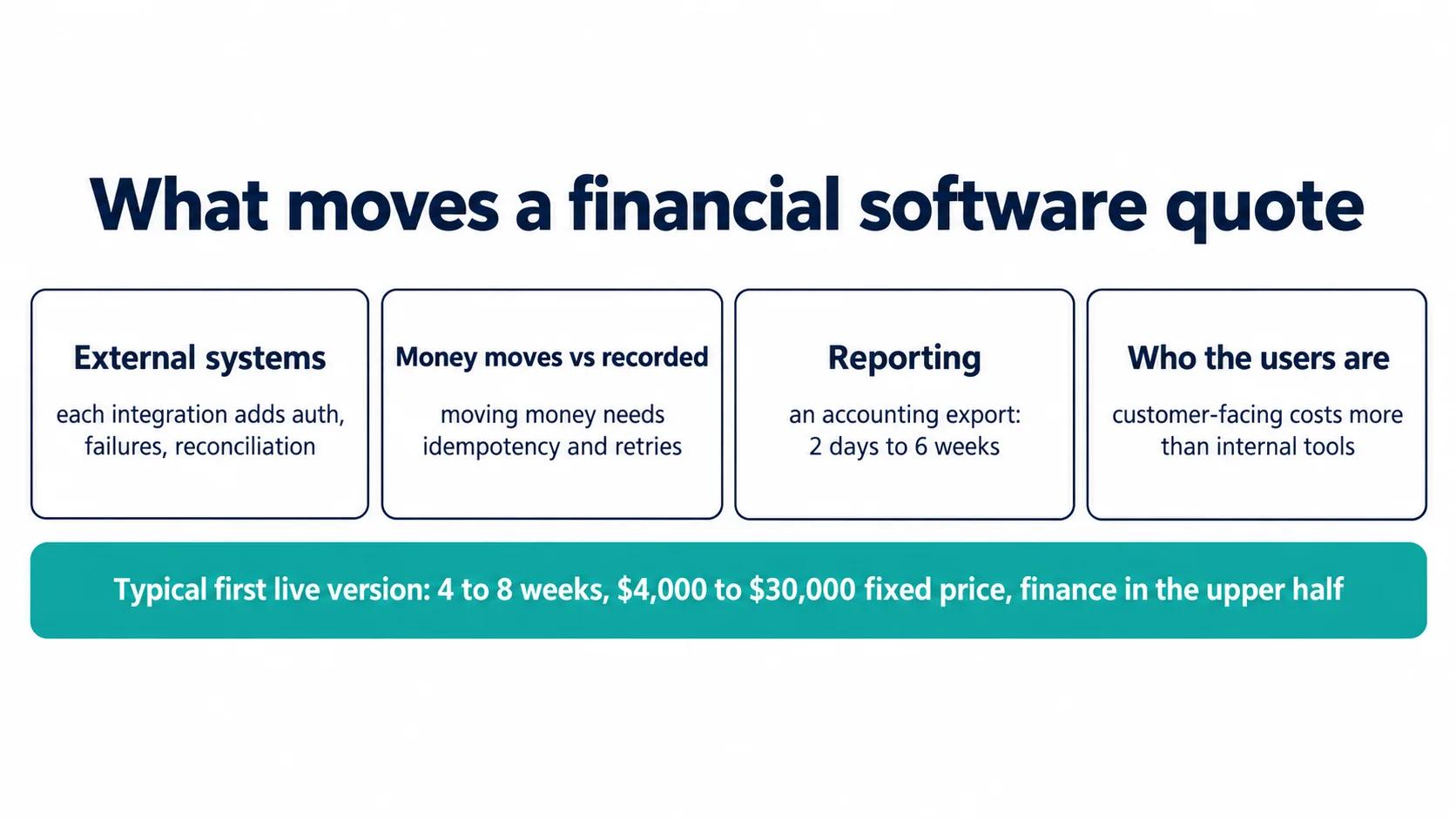
Our engagements run $4,000 to $30,000 fixed price, and financial work tends to sit in the upper half of that range for the reasons above, with a typical timeline of 4 to 8 weeks to a live first version.
A reasonable rule for fintech scoping: do not build anything that a regulated vendor already sells, unless that thing is your product.
Card processing, identity verification, bank connectivity, tax calculation, and statement generation all have mature providers. Building your own version means inheriting their compliance burden without their scale. The custom work belongs in the layer above, where your business logic actually differs from everyone else's.
The corollary is that no-code automation stacks are fine for the edges and dangerous in the middle. They are great until they become load-bearing, and then nobody can debug them, and the person who built the workflow has left. A finance process running on a chain of automations nobody can read is a liability with a nice interface.
Written by the Codestreaks team, drafted with AI assistance and edited by a human against our own delivery history. The price range and the timeline of 4 to 8 weeks are our published engagement terms, and the four quote drivers are the ones we use when we scope financial work. We have shipped 30+ projects to production since 2024, including banking operations and insurance work. The diagram is ours, and no client is named.
Any software built specifically for handling money or financial records rather than bought off the shelf. In practice that covers internal ledgers, reconciliation tooling, payment orchestration, lending and underwriting workflows, treasury dashboards, and back-office operations systems. It usually does not mean building your own payment processor, which is almost never the right call.
Because correctness is the product. Auditability, reconciliation, idempotent money movement, and granular access control are structural requirements rather than features, and they shape the architecture from the first week. A system that merely reports on financial data is substantially cheaper than one that moves money.
Our typical engagement runs 4 to 8 weeks from kickoff to live deployment for a well-scoped first version. Financial projects sit at the longer end when multiple external integrations are involved, since each provider brings its own sandbox behavior and failure modes to work through.
You need to know which requirements apply before you design, which is not the same as being certified before you write code. Audit logging, access separation, and data residency all shape architecture, so they belong in the scoping conversation. Certification itself usually runs in parallel with the build.
Buy it. Card processing, bank connectivity, and identity verification all have regulated providers whose compliance burden you do not want to take on. Build the layer above, where your actual business logic lives, and treat the regulated plumbing as something you integrate rather than own.
If you are scoping a financial build and want a direct read on cost, sequence, and which parts you should not build at all, book a free 30-minute scoping call. We will say so plainly if a vendor already solves most of it.
Every enquiry gets a reply within two business days. You can see how we work on our SaaS development service page, or start a project with a short note about the workflow you are trying to fix.


