

A page of ours held position 8.7 across 733 impressions and took no clicks. Here are the four causes, and how to tell which one is yours.

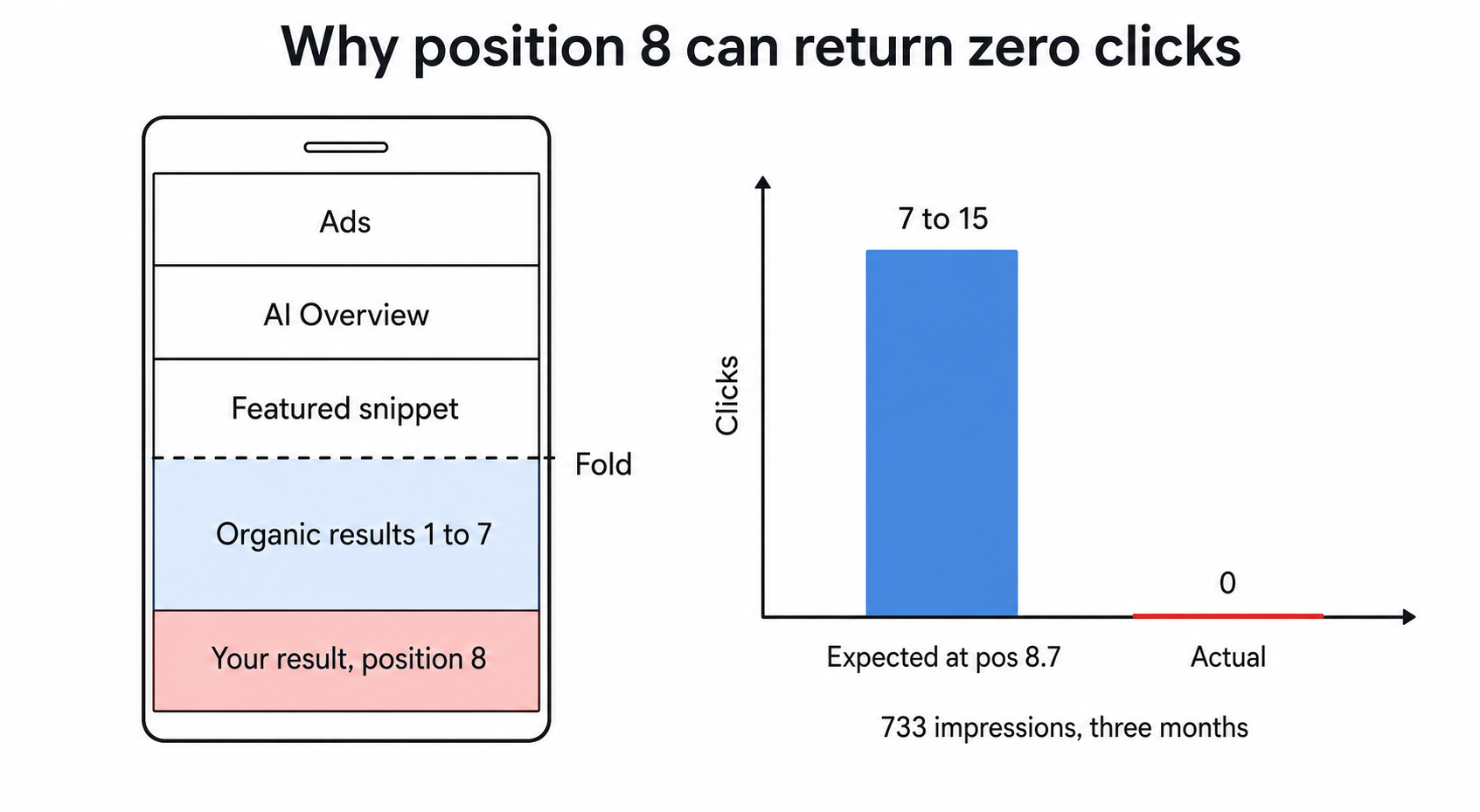
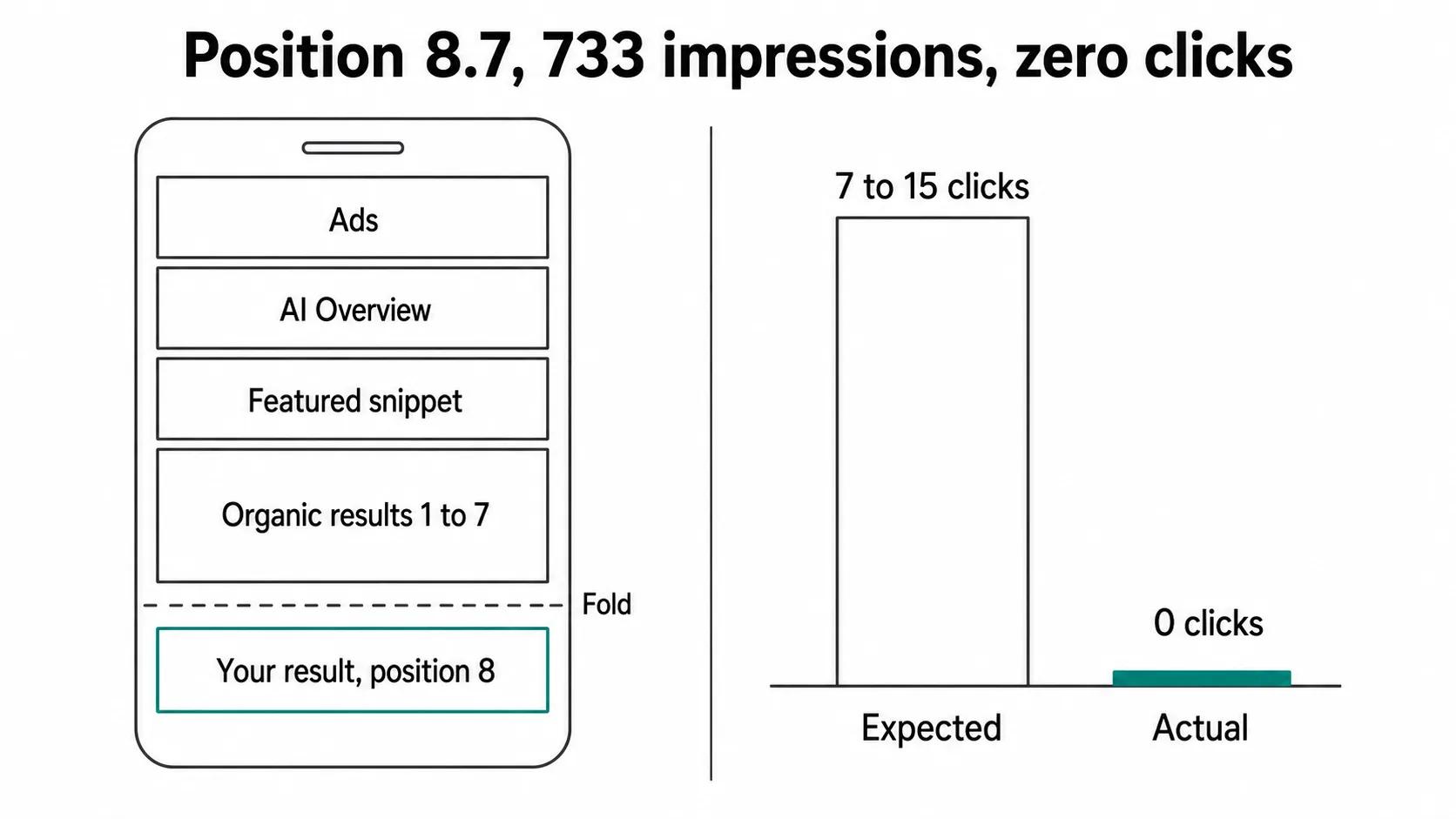
We pulled three months of Google Search Console data for our own site last week and found a single query sending us 733 impressions at an average position of 8.7, with zero clicks. Not a low number of clicks. Zero.
Position 8.7 is the bottom of page one. The usual click-through rate at that position is somewhere around 1% to 2%, which should have produced roughly seven to fifteen visits. Getting none is not variance. It is a signal, and it took us a while to work out what it was saying.
If you are tracking rankings and assuming traffic follows, this is the failure mode to check for. Ranking and traffic have come apart considerably in the last two years, and the gap is now large enough that position is a poor proxy for anything.
We found 23 separate queries in that three-month window sitting at an average position of 10 or better, each with at least 15 impressions, that produced no clicks at all. Together they accounted for 1,691 impressions.
There are only four explanations worth investigating, and they are distinguishable.
The result is on page one but not on the screen. Average position counts your place among the organic results. It does not account for what sits above them. An AI Overview, a featured snippet, a product carousel, a map pack, and four ads can push position 8 well below the fold on a laptop and off the first screen entirely on a phone. You rank on page one. Nobody sees page one.
The query is answered before the click. If someone searches a definition and an AI Overview or snippet gives it to them, the click never needed to happen. Impressions accrue, traffic does not. This is not a fixable problem for that query, it is a reason to stop targeting it.
The title and description do not match what was asked. A page can be genuinely relevant and still lose to seven results that phrase their promise more precisely. This is the cause people jump to first and it is often not the main one.
Nobody recognises the name. At position 8, competing with names a buyer has heard of, an unfamiliar domain is at a real disadvantage. That is an authority problem wearing a click-through-rate costume, and no amount of title rewriting solves it.
Filter Performance by the specific query. Note impressions, clicks, and average position. Then search the query yourself in an incognito window on a phone, because most of these searches happen on phones, and count what sits above the first organic result.
If the answer is "an AI Overview and three ads", you have your explanation, and the useful response is to target queries where that is less true rather than to rewrite the tag. Commercial and comparison queries retain their clicks far better than definitional ones. This is one reason we have moved our own writing toward decision questions and away from what-is questions.
If the space above the organic results is clear and you still take no clicks, then the title and description are worth real attention, and the position in the ranking is not your problem.
Most title advice is about keyword placement. At this point the more useful question is whether your title makes a promise that is different from the seven around it.
Open the results page and read your title alongside its neighbours. If six of them say roughly the same thing with the words in a different order, adding a seventh does nothing at position 8. Specificity is what separates a click from a scroll: a number, a named constraint, an outcome, a stated opinion. Our own better-performing titles are the ones that say something arguable rather than something descriptive.
The description matters less than people think for ranking and more than people think for clicks, because Google frequently rewrites it and the version it rewrites into is drawn from your page. A page whose opening paragraph answers the query directly gives Google something good to use. A page that opens with two sentences of preamble gives it something bad.
We stopped treating average position as a health metric. It is now reported alongside clicks for the same query, and a position that produces no clicks over a meaningful number of impressions is treated as a finding to investigate rather than a win to record.
We check the results page for the query before writing anything new for it. If an AI Overview owns the answer, we either target a narrower decision-stage question or accept that the page is being written for citation rather than for traffic, which is a legitimate goal but a different one with a different measure of success.
And we hold titles to the same standard as the writing. If the title could sit on any of six competitors' pages without looking out of place, it is not finished.
None of this substitutes for authority. Our own backlink count has been flat for twenty-one consecutive readings, and that is a much bigger constraint on this site than any tag. A page that nobody links to, on a domain nobody has heard of, will underperform its position no matter how the title is phrased.
So treat the click-through investigation as what it is: a way to stop losing the traffic your existing rankings should already produce. It recovers what you have earned. It does not earn more. The work that earns more is slower, and it looks like being cited by other people rather than being tuned by you.
We would rather say that plainly than sell a title-tag audit as a growth strategy.
Broadly 1% to 2% for a standard organic result, though it varies enormously by query type. The number matters less than the comparison: if you are getting materially less than that across a few hundred impressions, something specific is happening and it is worth identifying rather than averaging away.
Not always, but frequently, and most on informational queries where the overview can fully answer the question. Commercial and comparison queries hold their clicks much better, because the searcher wants to evaluate options rather than learn a definition. This is the practical reason to weight your content toward decision-stage questions.
Only after checking what sits above your result. If the page is being pushed below the fold by ads and an AI Overview, the title is not the constraint and rewriting it wastes the effort. If the space above is clear, then yes, and prioritise the pages with the highest impressions first since that is where the recoverable traffic is.
Usually one to three weeks, once the page is recrawled. Compare the same query's click-through rate before and after over equal windows rather than looking at totals, because impressions fluctuate for reasons unrelated to your change.
Written by the Codestreaks team. The measurements here come from our own Google Search Console property for codestreaks.com over a three-month window ending 26 August 2026: the 733-impression page at average position 8.7 with no clicks, and the 23 queries at average position 10 or better totalling 1,691 impressions with no clicks, are both from that pull. The backlink figure is from our own tracking log. We are publishing an unflattering measurement of our own site because the alternative is writing this from someone else's case study. Drafting is AI-assisted with a human editing pass over our own data.
If you have rankings that do not turn into traffic and you want a second pair of eyes on why, we will look at the actual results pages with you rather than sending a tool export. Free 30 minutes, reply within two business days.
More on how we approach this on our web development service page, or start a project.
Related reading: preparing your content for AI search, why the split between development and marketing costs you traffic, and how we scope a build.
A serial maker of SaaS products and AI agents, I’ve built and launched 10+ tools, grown products to thousands of users, and taken multiple ventures. I share the process what works, what breaks, and how builders can ship faster and smarter. Previously a data scientist at a Big Four consulting firm.


