

Custom cloud application development takes 4 to 8 weeks and $4,000 to $30,000 with us. What changes: state, failure, scaling, and a bill that moves with usage.
Codestreaks Team
Custom cloud application development means building software that assumes its infrastructure is rented, shared, and occasionally unavailable. That single assumption changes your architecture more than any framework choice will. A cloud application has to survive a machine disappearing mid-request, has to scale sideways instead of upward, and has to account for a bill that moves with usage rather than sitting fixed in a server closet. With us, a first production version takes 4 to 8 weeks and $4,000 to $30,000 fixed price.
Most teams asking about cloud development have already picked a provider. That was never the hard part. The hard part is that the design decisions which felt free on a single server now have a monthly price attached, and the ones you defer show up as a pager alert eight months later.
We have shipped 30+ projects to production since 2024, and the cloud builds fail in a narrower set of ways than people expect. Below is what actually differs, where budgets go, and when a custom cloud build is the wrong answer.
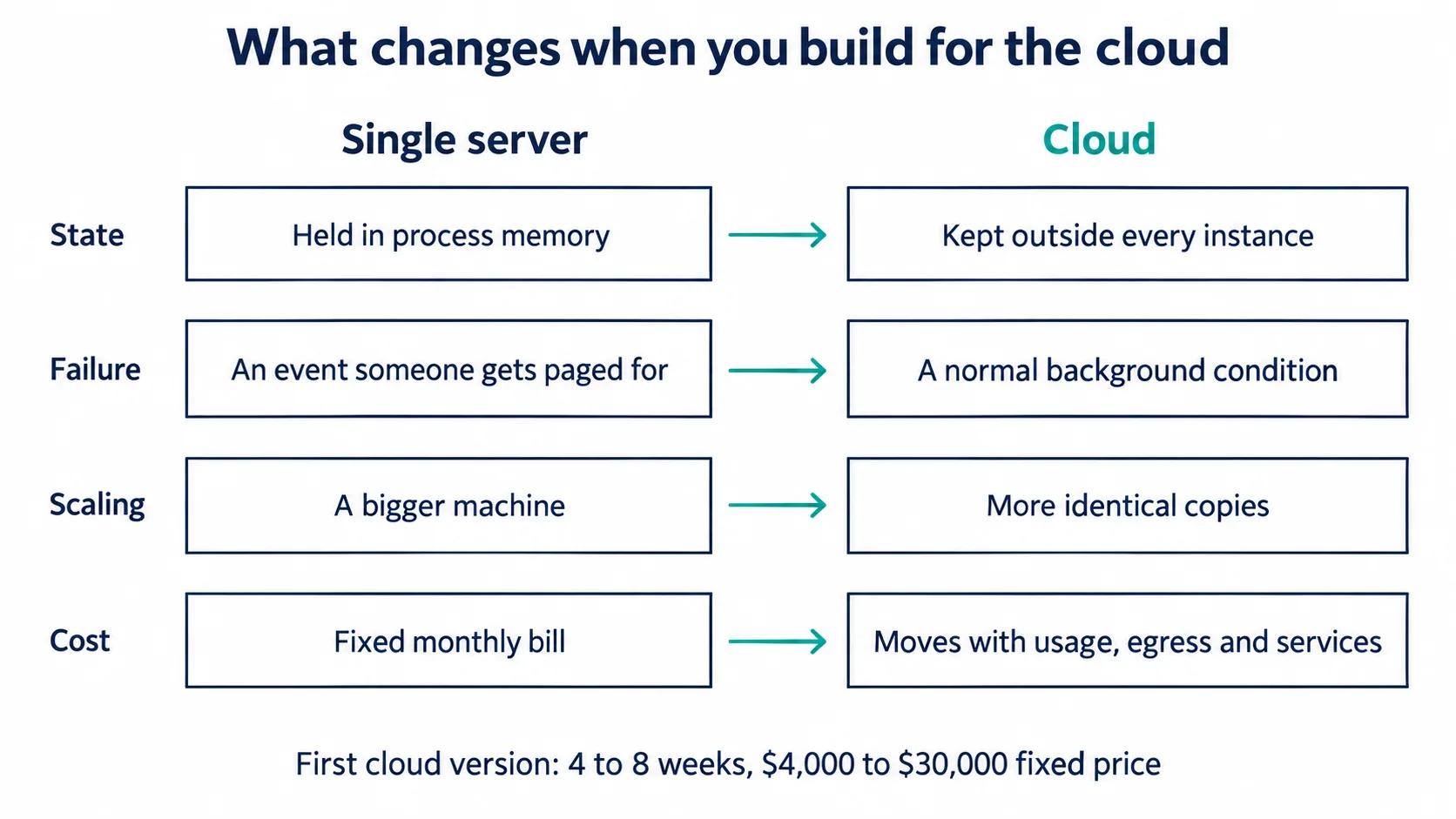
Four decisions carry most of the work: where state lives, how the app behaves when an instance disappears, how it scales, and which services end up on the monthly bill. Get those right at design time and the framework choice barely matters. Each section below takes one of them.
On a single rented server, failure is an event. Something broke, someone gets paged, the box comes back. On cloud infrastructure, failure is a background condition. Instances get recycled. Availability zones have bad afternoons. A managed database fails over and your connection pool holds dead sockets for ninety seconds because nobody configured a timeout.
This is the part that surprises teams migrating an existing product. They move the same code onto managed services, and reliability gets worse for the first quarter. Not because the cloud is less reliable, but because the old code assumed a stable machine underneath it and the new environment stopped providing one.
The practical implication is that retries, idempotency, and timeouts stop being nice-to-have engineering hygiene. A payment endpoint that runs twice because a load balancer retried a request is a real problem with real money attached. Idempotency keys are not an advanced topic in cloud work, they are table stakes.
Plenty of teams containerize an application, deploy it, and discover it only works when exactly one copy is running. The container was never the point. The point is that any request can land on any instance, and no instance is allowed to remember anything important.
The usual offenders are boring: session data held in process memory, uploaded files written to local disk, a scheduled job that runs in the web process, an in-memory cache that different instances disagree about. Each one is a twenty-minute fix during design and a genuinely miserable week to unpick after launch.
A useful test during scoping: if you killed a random instance right now, would any user notice beyond a retried request? If the answer involves "well, if they were mid-upload", that is a design gap, not an edge case.
Cloud cost surprises are rarely about compute. Compute is visible, and someone is watching it. The bills that shock people come from the parts nobody drew on the architecture diagram.
Data egress is the classic one. Moving data out of a provider costs money, and a well-meaning analytics pipeline that ships raw events to a third party can quietly cost more than the servers running the product. Cross-zone traffic between your own services counts too, which catches teams who spread components across zones for redundancy without checking the transfer pricing.
Managed services are the other. Each one is reasonable in isolation. Twelve of them, each with a baseline monthly charge, becomes a fixed cost floor that a small product cannot carry. We have seen a pre-revenue product paying for a managed search cluster, a managed queue, a managed cache, and a data warehouse, all serving a few hundred daily users, all of which a single database could have handled for another two years.
Our typical engagements run $4,000 to $30,000 fixed price, and in cloud builds the architecture conversation is usually a cost conversation wearing different clothes. Choosing three services instead of nine is often worth more to a client than any code we write.
The recurring pattern in our client work is a team arriving with a demo that impressed everyone in a meeting and then fell apart on real data. Cloud work has its own version of this. The prototype runs beautifully because it is one instance, one region, one developer clicking through it, and a database with four hundred rows.
One engagement stands out. The application worked perfectly in staging and degraded badly under real traffic, and the cause was not load. It was a background job that ran on every instance rather than once across the fleet. With one instance in staging it ran once. With six instances in production it ran six times, and each run competed with the others for the same database rows. Nothing in the code was wrong in a way a code review would catch. The environment changed the meaning of the code.
Prototypes lie. A demo that works on five hand-picked examples tells you nothing about the five thousand real ones, and moving from 90% to 99% reliability is where the engineering actually lives.
The honest default is to use the managed version of anything that is not your product. You are not going to run a better database than a provider whose entire business is running databases. That is not a close call.
The exception is when the managed service constrains a thing you genuinely need to control. If your product's differentiator is how it indexes and ranks documents, a managed search product that does not expose the scoring behavior you need is not a shortcut, it is a ceiling. Owning that component is worth the operational cost because it is the actual product.
Everything else, take the managed option and spend the saved engineering time on the part customers pay for. Buy the outcome, not the model. Infrastructure fashions change every few years, and owned application software compounds.
These get quoted together and they should not be. Building a new application on cloud infrastructure is a greenfield exercise where you control every assumption. Moving an existing application is an archaeology exercise where you inherit assumptions nobody wrote down.
Migration work spends most of its time on things that are not code. Which of these scheduled tasks still matters. Why does this service need a static IP address. Who owns the certificate that expires in March. What breaks if this file path stops existing. The code changes are usually the smallest part of the estimate.
If you are weighing a rebuild against a migration, the deciding question is usually whether the existing system's behavior is documented anywhere other than in the running system. If it is not, a migration is a rewrite with extra steps and worse visibility. We cover how architectural decisions like this shape delivery timelines in our web application development process guide.
A sane first version on cloud infrastructure is smaller than most architecture diagrams suggest. One application service that can run as several identical copies. One managed relational database. One object store for files. One queue, if and only if you have work that genuinely must happen outside a request. Logs and metrics going somewhere you will actually look.
That is enough to run a real product with real users. It scales further than teams expect, it costs little, and every component in it is one you can explain to a new engineer in a morning. Multi-region, service meshes, and event-driven architecture are answers to problems you will recognize when you have them, and paying for them in advance mostly buys complexity.
Our typical engagement runs 4 to 8 weeks from kickoff to live deployment, and a first cloud version fits comfortably in that window when the scope stays this honest. It stops fitting the moment the diagram grows a second database for reasons nobody can articulate. The same discipline applies to picking a stack in the first place, which we broke down in our comparison of Python, Node.js, and PHP for web work.
If an off-the-shelf product does 80% of what you need and the remaining 20% is preference rather than differentiation, buy the product. Custom development earns its cost when the software is the thing customers pay for, or when it removes work that currently consumes real hours every week.
Most teams do not need a bespoke platform. They need three boring workflows automated well, and a lot of what gets scoped as a cloud application is really an integration problem in a costume. That is worth checking honestly before anyone writes an architecture document, and it is the first thing we test in a scoping call. If your situation is closer to connecting existing tools than building new software, our guide on digital process automation is the more useful starting point.
Written by the Codestreaks team, drafted with AI assistance and edited by a human against our own delivery history. The price range and the 4 to 8 week timeline are our published engagement terms. The background-job incident is from a real engagement, described without naming the client. We have shipped 30+ projects to production since 2024. The diagram is ours.
It is building software specifically for cloud infrastructure rather than deploying existing software onto it. In practice that means the application is designed to run as multiple interchangeable copies, to survive any single one of them disappearing, and to use managed services for storage, queues, and databases instead of managing those itself.
The application logic is often similar. What differs is that state cannot live in the process, failure has to be handled as a normal path rather than an exception, and infrastructure decisions carry a recurring cost. A web application built for a single server will usually run in the cloud and will usually behave badly there under load.
Our fixed-price engagements run $4,000 to $30,000 depending on scope, with a first production version typically landing in 4 to 8 weeks. Ongoing infrastructure cost varies far more than build cost, and the architecture choices made during scoping usually matter more to that monthly number than anything else.
Use managed services for anything that is not your product's differentiator. Run it yourself only when the managed option constrains behavior you genuinely need to control. The operational cost of self-hosting is real and recurring, and it is almost never worth paying for a component your customers never think about.
Often, yes, and it is a different project with a different shape. Migration work is dominated by discovering undocumented assumptions in the existing system rather than by writing new code. The first step is a short assessment of what the current system actually depends on, which usually tells you quickly whether migrating or rebuilding is cheaper.
If you are weighing a cloud build and want a straight answer about scope, cost, and whether custom development is even the right call, book a free 30-minute scoping call. We will tell you if an off-the-shelf tool solves it instead, because a project that should not exist is a bad project for both of us.
We reply to every enquiry within two business days. You can see how we approach this kind of work on our web development service page, or start a project with a short description of what you are trying to build.


