

Most AI readiness assessments score your org against a checklist. The checklist isn't wrong, it's just measuring the wrong thing for most companies asking.


We get asked to run an "AI readiness assessment" a few times a quarter, usually from a team that's read three vendor whitepapers and wants to know if they're behind. The honest answer is that most readiness frameworks measure the wrong thing. They score data quality, tooling, and executive buy-in on a 1-5 scale and hand back a number. The number feels objective. It isn't, because none of it tells you whether the specific workflow you're trying to automate has enough real, structured signal in it to be worth automating at all.
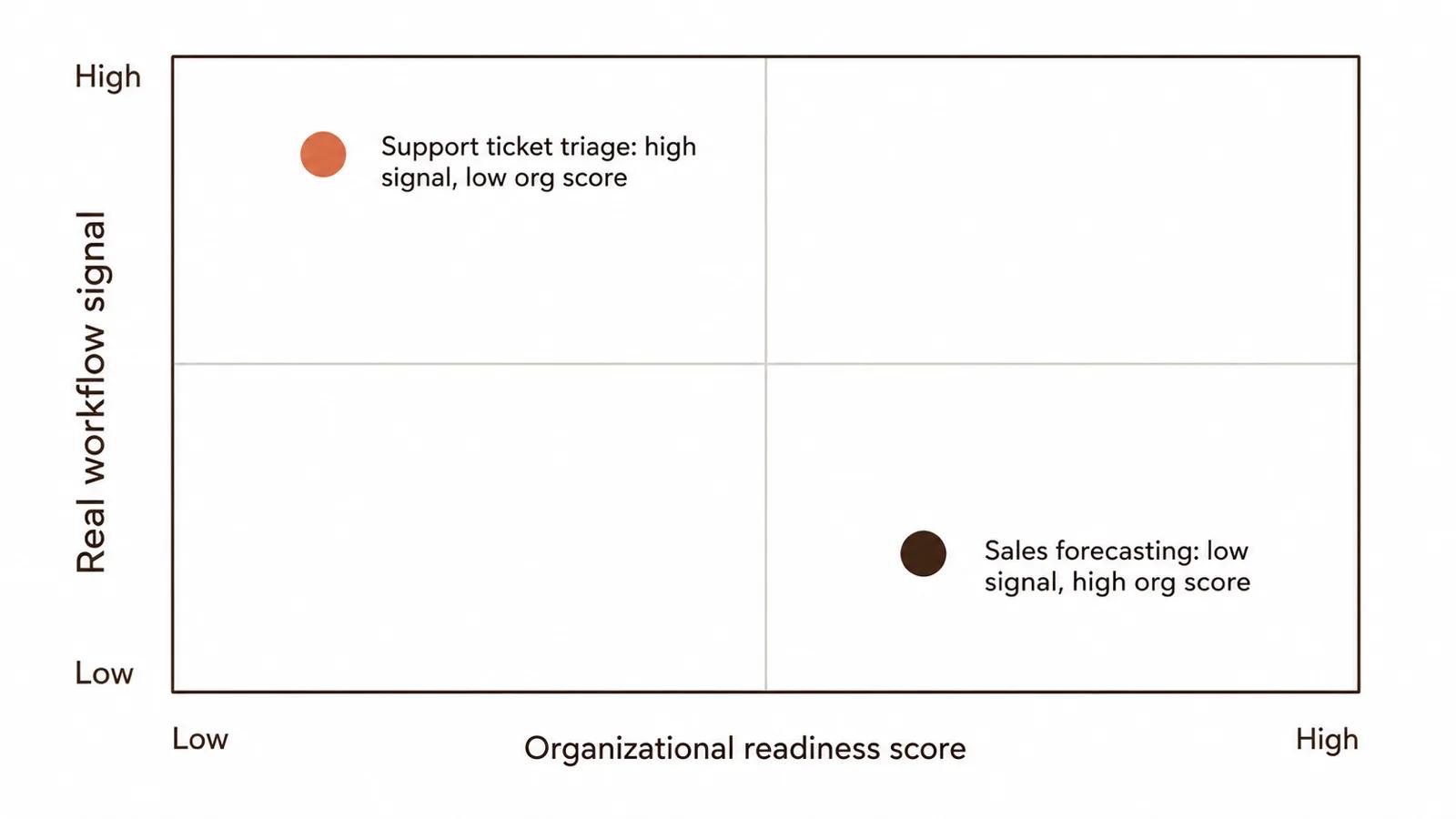
Most frameworks you'll find (and most consultants selling one) walk through the same five categories: data infrastructure, team AI literacy, existing tooling, executive sponsorship, and a vague "use case clarity" score. None of that is useless. A company with no data warehouse and no one who's touched an API genuinely has more groundwork to do than one that already ships internal tools. But the checklist treats readiness as an organizational trait, like a maturity level you graduate through, when in practice readiness is workflow-specific. A company can be completely unready to automate its sales forecasting and completely ready to automate its support ticket triage, in the same quarter, with the same team.
The single best predictor of whether an automation project will work isn't your team's AI literacy score. It's whether the workflow you want to automate has a large enough volume of past examples, with a consistent enough structure, for a model (or a simpler rules system) to actually learn the pattern from. We've turned down engagements where the client scored well on every readiness dimension except this one: they had 40 historical examples of the exact decision they wanted automated. Forty examples isn't a dataset, it's an anecdote. No amount of executive sponsorship fixes that.
The opposite case is just as common. A team with weak AI literacy and no existing tooling but a genuinely high-volume, consistent workflow (say, categorizing 400 support tickets a week into 12 known buckets) is often a better candidate than a team that scores well on paper but wants to automate something that happens 15 times a month and is different every time.
We run the same indexing infrastructure across a handful of our own web properties, same API key, same integration. On paper, that's identical capacity. In practice, one property's daily submission quota through Bing's Webmaster API sits at 100 URLs a day; another, under the exact same account and key, gets 10,000. Nothing in either dashboard flags the difference until you actually hit the wall on the smaller one and go looking. We bring that same instinct to a readiness assessment: don't trust that two workflows are equally "ready" just because they sit in the same department or use the same tools. Go measure the actual thing, not the label on it.
Before we scope anything, we ask for a real sample: at least 200-300 recent, real instances of the decision or task in question, not a description of it. If a client can't produce that sample, that's the finding, not a footnote. We also ask what happens today when the process fails or hits an edge case, because the failure path usually reveals more about true complexity than the happy path does. A workflow that has three documented exception types is a different project than one where "it depends" is the honest answer every time.
The most common mistake we see isn't picking an unautomatable workflow, it's running the readiness assessment on the whole company before anyone has agreed on which single workflow to start with. That produces a report with dozens of recommendations and no forcing function to actually pick one. Flip the order: pick one candidate workflow first, based on volume and a rough sense of consistency, then run the readiness check against that one thing. You'll get a real yes-or-no answer in days instead of a 40-page document that reads well and changes nothing. The same discipline applies to timing: a team that waits for a perfect readiness score before starting anything usually waits past the point where a competitor with a scrappier, smaller-scope pilot has already learned what actually breaks in production.
We scope single-purpose automations in the $4,000-$10,000 range over 3-4 weeks specifically because that forces the signal question early: a workflow either has enough real structure to hit that timeline, or it doesn't, and finding out in week one beats finding out in month three of a larger engagement. Our AI automation consultant guide covers what a consultant should actually deliver once you've cleared this bar; our AI agents 101 piece is a good next read if you're still deciding what to automate first.
A real one, including pulling and reviewing an actual sample of the target workflow, takes 1-2 weeks. Anything that produces a score in a single call without seeing real data is scoring your team's confidence, not your workflow's readiness.
We look for at least 200-300 recent real examples with consistent structure. Below that, you don't have enough signal to know if a pattern exists, let alone to train or validate an automated system against it.
Yes, if the target workflow itself has high volume and consistent structure. Team literacy affects how smoothly the rollout goes, not whether the underlying task is automatable. Those are separate variables that most checklists collapse into one score.
No. It tells you the groundwork is likely in place, not that the specific workflow you pick will pan out. Every workflow still needs its own signal check before you commit budget.
Fix the specific gap it found, usually data structure or sample volume, rather than treating a low score as a reason to wait a year and "build AI maturity" in the abstract. Readiness is closer to a per-project checklist than an organizational trait you build up over time.
Written by the Codestreaks team, drafted with AI assistance and edited by a human against our own scoping history: the 200-300 sample threshold, the workflow-versus-organization distinction, and the Bing quota variance are all things we've measured directly, not industry benchmarks. No client names are used; the 40-example and 400-ticket examples describe patterns we've seen across multiple engagements, not one identifiable client.
Want a real readiness check on a specific workflow, not a generic score? Book a free 30-minute scoping call or read more about our AI consulting work. Two business day response, no obligation.
A serial maker of SaaS products and AI agents, I’ve built and launched 10+ tools, grown products to thousands of users, and taken multiple ventures. I share the process what works, what breaks, and how builders can ship faster and smarter. Previously a data scientist at a Big Four consulting firm.


