

A rising ticket deflection rate looks like progress. Sometimes it is. Sometimes it's the same problem showing up as a reopened ticket three days later.


Every help desk automation pitch leads with the deflection rate. "We cut ticket volume 40%." It's the easiest number to show and the easiest one to inflate, because a ticket that gets auto-closed and reopened three days later still counts as deflected in most dashboards. We've reviewed automation setups, including ones we didn't build, where the deflection number looked great and the actual resolution rate, measured by whether the customer came back with the same problem, told a completely different story.
The workflows that automate cleanly share a pattern: high volume, known categories, low ambiguity. Password resets, order status lookups, basic account changes, routing a ticket to the right queue based on keywords in the subject line. These aren't glamorous, but they're where a service desk automation project should start, because the failure cost of a mistake is low and the volume makes the ROI obvious fast. If a quarter of your ticket volume falls into five or six categories like this, that's the first thing to automate, not the hardest thing.
The realistic range we see across engagements: 40-60% of ticket volume can be handled by a well-built automation layer for the categories described above. That leaves 40-60% that genuinely needs a human, either because the problem is ambiguous, because it requires judgment, or because it's the kind of multi-system troubleshooting that a rules engine or a narrow model can't reliably do yet. A vendor promising to automate 90%+ of a general-purpose help desk is describing a demo, not a production system. We've built both the scripted, narrow version and the more capable conversational version of this pattern; the general tradeoff between them is covered in our AI customer service automation guide.
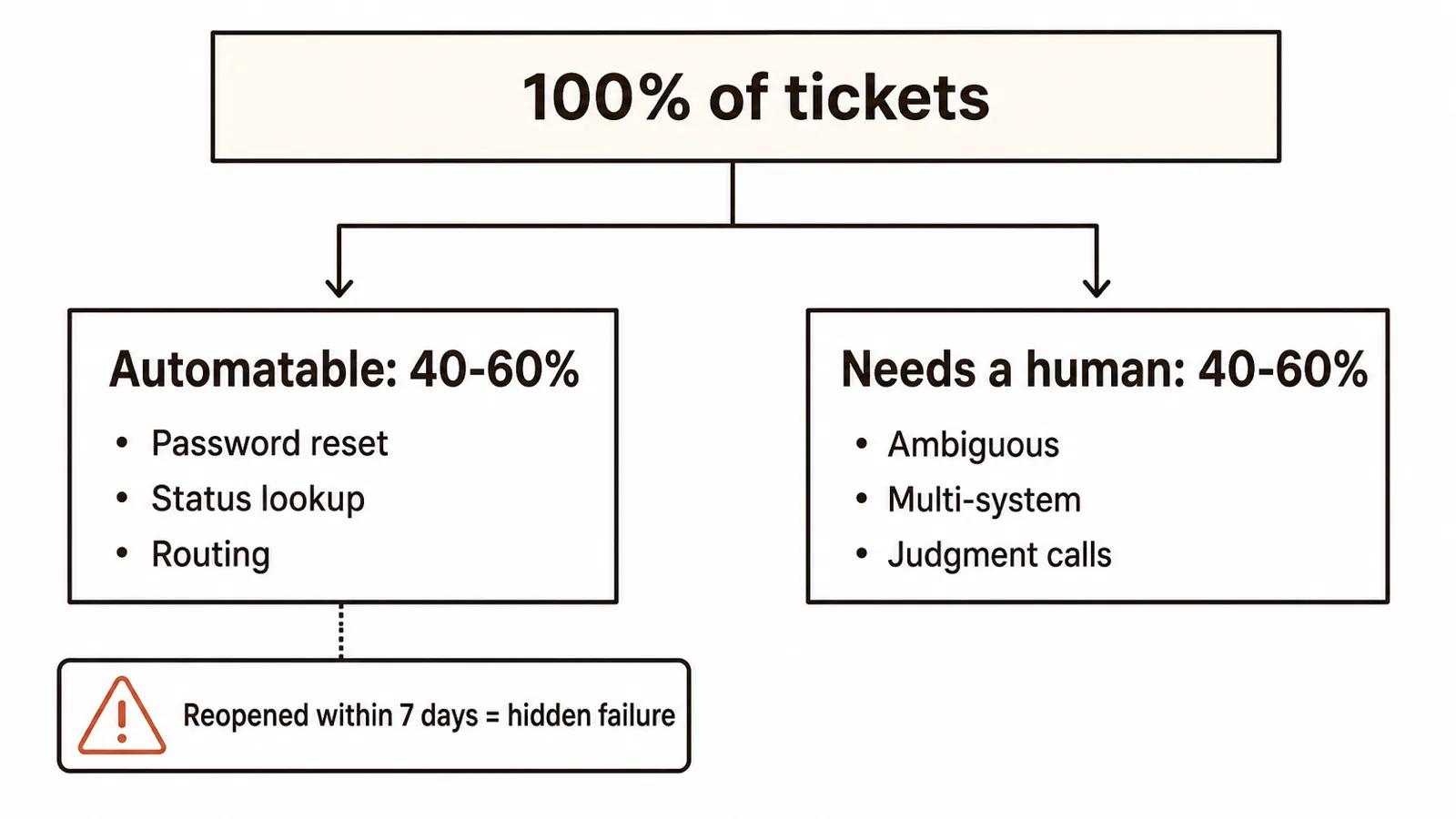
Deflection rate answers "did the ticket close without a human." It doesn't answer "did the problem actually get solved." The metric we push every client toward instead is reopen rate within 7 days, specifically for tickets the automation closed. A help desk automation system with a 50% deflection rate and a 2% reopen rate on those deflected tickets is doing real work. One with a 70% deflection rate and a 15% reopen rate is quietly shifting labor from first-contact resolution to a second, angrier contact, and the dashboard won't show you that unless you build the tracking for it specifically, because most out-of-the-box help desk tools don't connect a reopened ticket back to the automated closure that preceded it.
We watch this exact failure mode in our own SEO work too. Our Semrush Authority Score moved from 2 to 5 over several months while our actual count of real, referring backlinks stayed flat at 4 the entire time. The score improved; nothing that actually drives ranking changed. Deflection rate is the same trap in a help desk context: a number that can rise for reasons that have nothing to do with the underlying problem getting solved. The fix in both cases is the same, track the thing the score is supposed to be a proxy for, not the score itself.
For an MSP managing multiple clients' help desks, the temptation is to build one automation layer and template it across every client's ticket categories. That fails because ticket category mix varies enormously between clients (a healthcare client's queue looks nothing like a retail client's), and a templated automation layer either over-automates the wrong categories for one client or under-automates for another. The fix isn't more configuration options, it's starting each client engagement with an actual audit of their last 90 days of tickets, categorized by hand, before deciding what to automate. That audit typically takes a few days and saves months of tuning a system built on assumptions instead of real ticket data. Our agent assist software guide covers the adjacent pattern of helping a human agent work faster rather than replacing the interaction entirely, which is often the better first build for categories that don't cleanly automate.
40-60% for a well-scoped first build covering high-volume, low-ambiguity categories like password resets and status lookups. Anything promised above that for a general-purpose desk is likely counting reopened tickets as successes.
Track reopen rate within 7 days specifically for tickets your automation closed. If most help desk tools don't connect a reopened ticket back to its automated closure by default, that connection needs to be built deliberately, because it's the number that actually validates the deflection metric.
No. Ticket category mix varies too much client to client. A short audit of each client's actual recent ticket history, before deciding what to automate, produces a better result than a templated setup tuned on assumptions.
Anything ambiguous, anything requiring cross-system troubleshooting a rules engine can't see into, and anything where a wrong automated answer costs more than the time saved. Start with the highest-volume, lowest-ambiguity categories and expand only after the reopen-rate number proves the first batch actually worked.
A single-purpose automation covering a handful of ticket categories typically ships in 3-4 weeks. A broader, multi-category system with routing logic and escalation paths runs longer, usually 6-8 weeks, depending on how many backend systems it needs to check ticket state against.
Written by the Codestreaks team, drafted with AI assistance and edited by a human against our own build history and the same measurement discipline we apply to our own SEO metrics. The Semrush Authority Score figure (2 to 5, real backlinks flat at 4) is a real, currently-measured number from our own operations. No client names are used; the MSP and reopen-rate examples describe patterns across multiple engagements, not one identifiable client.
Want a real audit of what's automatable in your ticket queue before you commit to a build? Book a free 30-minute scoping call or read more about our AI agent development work. Two business day response, no obligation.
A serial maker of SaaS products and AI agents, I’ve built and launched 10+ tools, grown products to thousands of users, and taken multiple ventures. I share the process what works, what breaks, and how builders can ship faster and smarter. Previously a data scientist at a Big Four consulting firm.


