

Healthcare is the one vertical where a generic AI consulting engagement can hurt you. Here's what changes when the client is a clinic, a payer, or a health tech platform.


Every healthcare team that calls us has already talked to at least one generic AI consultant. The pitch is usually the same: a maturity assessment, a roadmap deck, a list of "use cases" copied from a vendor whitepaper. Then the client asks the one question that separates healthcare from every other vertical we work in: who signs off on this when it touches a patient record. Most generic AI consulting firms don't have a good answer, because most of their playbook was written for marketing teams and sales ops, not HIPAA.
We cover the general version of the deck-versus-build problem in our AI automation consultant guide. This one is about what changes specifically in a clinical, payer, or health tech setting, because the differences aren't cosmetic.
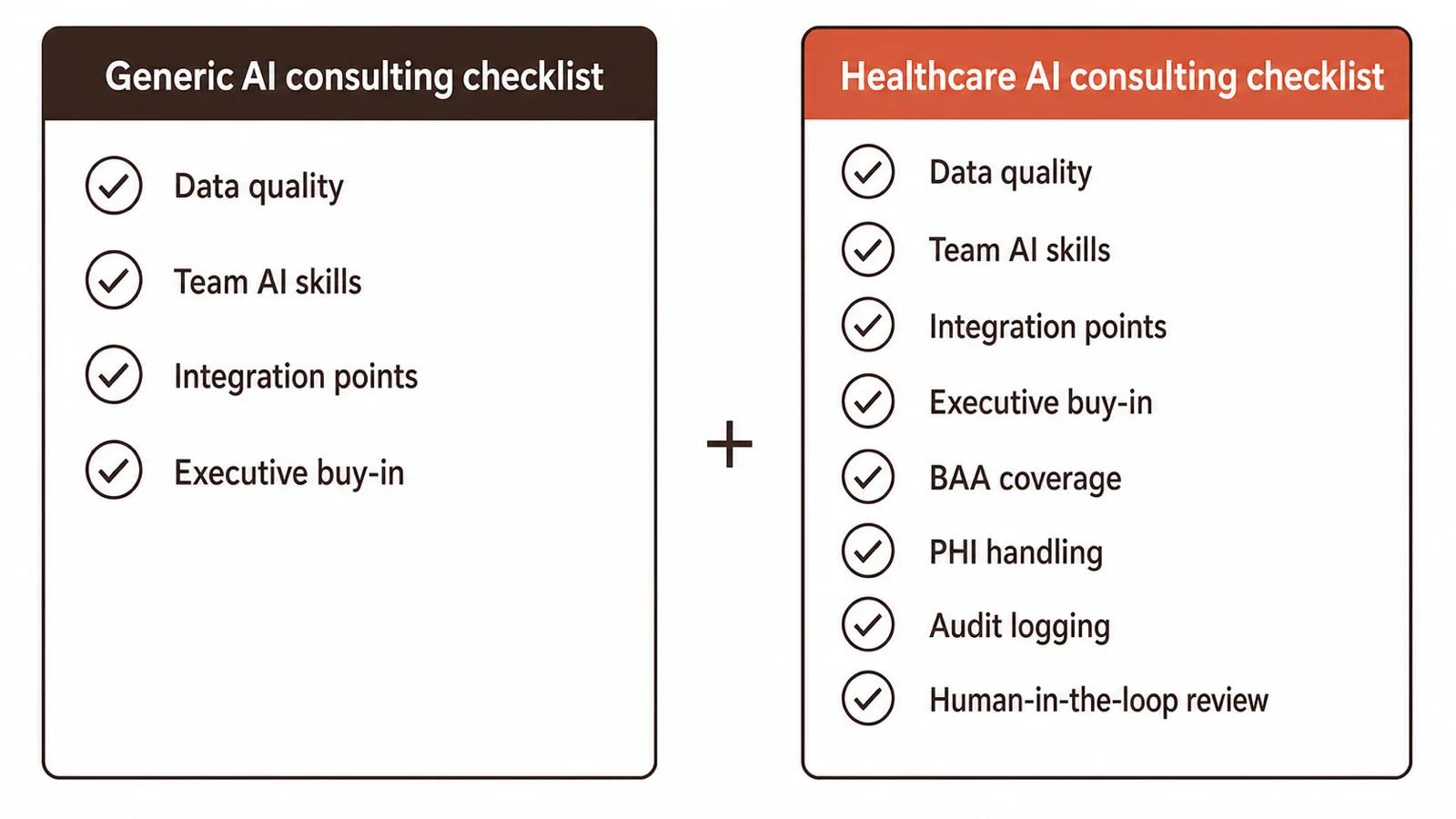
A standard AI readiness assessment asks about data quality, team skills, and integration points. In healthcare, that list is missing the two questions that actually determine whether a project can ship: who is the covered entity or business associate under HIPAA, and does the proposed system ever touch protected health information (PHI) directly, or only aggregate/de-identified data. Those two answers change the entire technical approach. A consultant who doesn't ask them first hasn't scoped a healthcare project, they've scoped a generic one and are about to find out the hard way six weeks in.
We've sat in on calls where a vendor demoed a clinical documentation assistant against a synthetic dataset, got sign-off from the ops team, and only discovered the BAA (Business Associate Agreement) requirement when legal got looped in during procurement. That's not a technical failure, it's a scoping failure, and it costs the client a full quarter.
A few things that a general AI consultant will not raise unprompted:
We were brought in to review a prior engagement for a multi-location clinic group after their first AI vendor's pilot stalled. The vendor had built a genuinely good patient intake summarization tool, tested clean on a sample of anonymized charts, and presented strong accuracy numbers. What killed the project wasn't the model. It was that the vendor's logging stack ran through a third-party observability tool with no BAA in place, meaning every real patient interaction the tool processed after go-live would have been an unauthorized PHI disclosure. The fix took another six weeks and a full re-architecture of the logging path. None of that risk was visible in the demo, because demos run on synthetic data that never touches the parts of the stack that actually matter in production.
We apply the same discipline to our own infrastructure that we'd want applied here: we track things like our GSC manual indexing quota (roughly 6-7 requests a day, and it turned out to be tied to the Google account, not the property, which nobody documents anywhere) because assuming a system's limits instead of verifying them is exactly the habit that causes the kind of six-week surprise a healthcare client can least afford.
A useful first conversation for a healthcare AI engagement covers, in order: what data the system will touch and whether it's PHI, who the covered entity or business associate is, what every vendor in the technical chain needs signed before a single real record flows through it, and what the escalation path looks like when the model is uncertain. If a consultant skips straight to a roadmap slide without covering those four things, that's a signal, not a compliment to their speed.
We take on two engagements a quarter, and every client keeps 100% code ownership and gets 30 days of post-launch support. For a healthcare build specifically, that ownership matters more than usual: a compliance review two years from now needs to be able to see exactly what the system does, not take a vendor's word for it. If you're weighing build versus buy for a clinical or health tech AI tool, our data strategy consulting work covers the broader question of what needs to be true about your data before any of this is worth building.
It applies whenever the system touches protected health information, directly or through a vendor in the chain. A tool built entirely on de-identified, aggregate data can sit outside HIPAA's BAA requirements, but the de-identification has to meet the Safe Harbor or Expert Determination standard, not just have names removed.
No. Each vendor in the chain that touches PHI needs its own signed BAA with the covered entity. A consultant can help you identify which vendors need one and negotiate the terms, but the agreement itself is between you and each party.
It has to start with two questions a generic assessment skips: whether the proposed system touches PHI, and who the covered entity or business associate is. Everything else, including the technical roadmap, follows from those answers.
For anything that could influence a diagnosis or treatment decision, no. Summarization and documentation assistance can run with lighter review; anything closer to clinical judgment needs a human in the loop by design, reviewed with your compliance team before build starts, not after a pilot.
A compliance gap discovered after a technical pilot already succeeded, usually involving a vendor in the logging or infrastructure chain that nobody thought to check for a BAA requirement. Scoping that upfront is slower than skipping it, and it's the difference between a project that ships and one that stalls in procurement.
Written by the Codestreaks team, drafted with AI assistance and edited by a human against our own engagement history and public HIPAA guidance (BAA requirements, Safe Harbor de-identification categories). The GSC indexing-quota detail is a real, currently-measured number from our own SEO operations, included as an example of the same verify-don't-assume discipline we apply to compliance scoping. No client names are used; the clinic-group example is described without identifying details per our client confidentiality practice.
If you're scoping a healthcare AI project and want a second opinion before signing anything, book a free 30-minute scoping call or read more about our AI consulting work. Two business day response, no obligation.
A serial maker of SaaS products and AI agents, I’ve built and launched 10+ tools, grown products to thousands of users, and taken multiple ventures. I share the process what works, what breaks, and how builders can ship faster and smarter. Previously a data scientist at a Big Four consulting firm.


