

Data strategy consulting should end with engineering changes, not a deck. What a real engagement delivers, and the failure modes to avoid.
Codestreaks Team

Most data strategy engagements end the same way: a deck, a workshop, applause, and nothing changes about what engineering ships next quarter. That's the failure mode worth naming up front, because it's the one we see most when we get called in after someone else's strategy work has stalled.
A data strategy is not a document. It's a decision about which systems get built, which metrics get instrumented, and which reports get killed. If a strategy engagement doesn't end with a list of specific engineering changes, backed by a specific reason each one matters, it wasn't a strategy. It was a survey of the current state with opinions attached.
Here's the test we use: could someone hand the output of this engagement to an engineering team on Monday morning and know what to build differently? If the answer is "not really, it's more directional," the engagement failed at its one job.
A real data strategy specifies:
Notice what's missing from that list: a taxonomy of buzzwords, a maturity model with five stages, or a slide about "becoming data-driven." Those things fill a deck. They don't change a sprint board.

The most common way a data strategy dies is quiet: it gets written by people who never talk to the engineers who'd have to build against it. The strategy assumes a real-time streaming layer the team has no budget to build. It assumes a data warehouse migration that competes with three other roadmap items and loses. It recommends a metric that requires event-level tracking nobody has instrumented, and the recommendation sits in a doc while the team keeps shipping without it.
This is why data strategy consulting has to be done by people who've also built the systems the strategy depends on, not just studied them. Arsalan Amin, Codestreaks' co-founder, spent years as a data scientist doing Big Four consulting work before moving into building product. That combination matters here: the strategy only holds up if the person writing it has sat in the room where an engineering team decides whether a recommendation is buildable next sprint or a fantasy for next year.
A strategy that ignores engineering capacity isn't wrong on paper. It's just never going to happen, which in practice is the same thing as wrong.
Prototypes lie, and so do a lot of data strategy demos. A dashboard that looks clean with three months of curated sample data tells you nothing about whether it survives production data with missing fields, duplicate events, and undocumented schema changes. The distance between a strategy that sounds right in a workshop and one that survives contact with the real pipeline is where most of the work lives, and it's exactly the gap that gets skipped when the strategy team and the build team never sat in the same room.

This is the part of data strategy work that gets talked about constantly and practiced rarely: not every number that goes up is a number worth tracking. A metric is only useful if a decision actually changes based on where it lands. If nobody would do anything differently whether a number is 40 or 80, it's not a strategy metric. It's a vanity metric with a chart next to it.
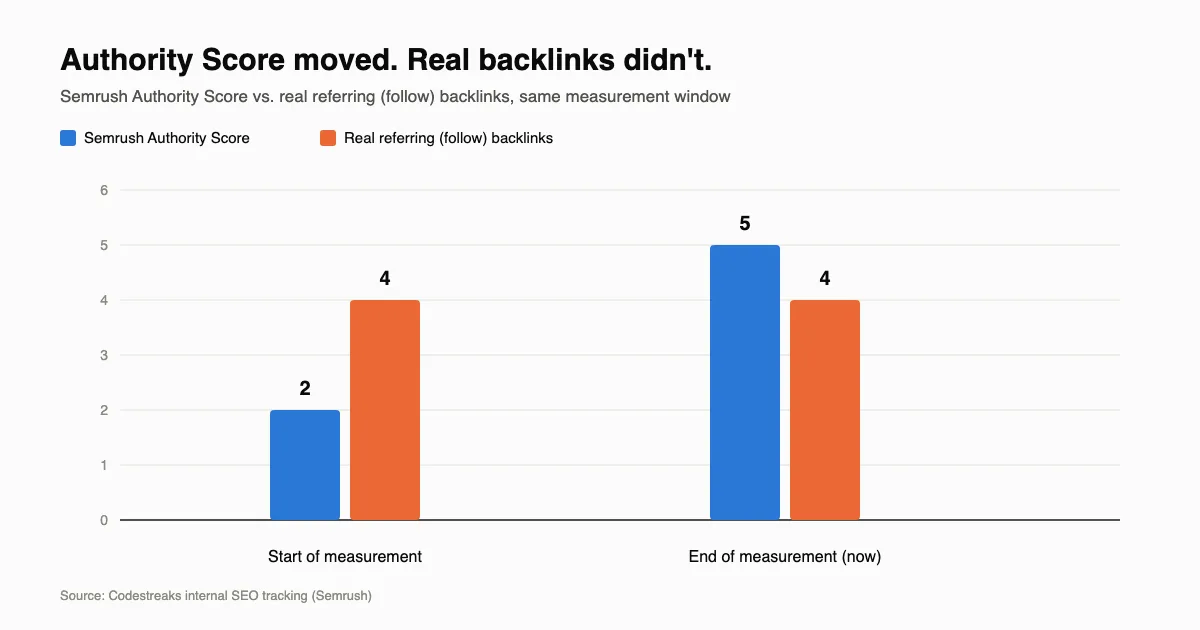
We have a direct example of this from our own work, not a hypothetical. Earlier this year we were tracking our SEO authority using Semrush's Authority Score, a composite metric the tool calculates from a mix of signals. Over a stretch of measurement, our Authority Score moved from 2 to 5, more than doubling. Read on its own, that looks like real progress.
Then someone went back to the raw data behind it, because the number moving didn't line up with anything we could point to. Our actual referring, follow backlinks (the real underlying signal that composite score is supposed to be approximating) had stayed flat at 4 the entire time. Zero new links. The score had moved on inputs we weren't tracking and couldn't directly act on, while the thing that actually predicts search authority hadn't budged at all.
That's the exact failure mode a competent data strategy is supposed to catch before it wastes a quarter. A composite or vanity metric can move for reasons that have nothing to do with the underlying thing you care about, and if your reporting only surfaces the composite number, you can report "progress" for months while the real signal sits still. We caught it because someone with a data background went back to the raw numbers instead of trusting the dashboard. That's not a process most teams have built in, and it's the specific gap Arsalan's data science background is built to close: not just picking metrics, but knowing which ones are proxies and which ones are the real thing.
The fix wasn't complicated once we saw it. We stopped reporting Authority Score as a headline number internally and started tracking referring domains and follow link counts directly, alongside indexed page counts, because those are the numbers that actually predict whether search visibility improves. The lesson generalizes past SEO: any time a strategy leans on a metric supplied by a third-party tool without checking what it's actually built from, there's a real chance you're managing a proxy instead of the thing you meant to manage.
An engagement that ends at the recommendation stage has produced research, not strategy. The reason so many data strategy projects stop there isn't laziness, it's usually structural: the firm that wrote the strategy doesn't build software, so implementation was never part of the deal. The client's engineering team inherits a document with no context for why each recommendation exists and a backlog that's already full. The strategy loses that fight almost every time.
The from-the-field pattern we see constantly, across data work and product work both, is a team arriving with something that impressed everyone in a meeting and then falling apart on real production data. A data strategy pitch deck with clean example numbers is the same pattern in a different outfit. Most of the actual work isn't picking the right metrics in a workshop, it's the unglamorous engineering of getting real, messy, incomplete production data to populate those metrics reliably, day after day, without someone manually patching it every week.
That's also why we don't treat data strategy as a standalone deliverable separate from the build. If the strategy and the implementation are handled by different vendors, there's no accountability loop forcing the recommendations to stay realistic. When the same team writing the strategy also has to build against it, the strategy gets a lot more honest about what's buildable in the timeframe available. Data strategy work sits close enough to AI and automation consulting that we treat it as part of the same conversation as our AI consulting work: a lot of the systems a good data strategy recommends (event pipelines, decision-support dashboards, automated reporting) are the same infrastructure an AI or automation initiative needs anyway, so scoping them together produces a more coherent plan.
If your team hasn't settled on what to build first, we've written before about what process automation actually means day to day, a useful starting point before a data strategy engagement, since a lot of "we need better data" problems are actually "we need to automate the process that generates that data" problems in disguise. And if the strategy work touches marketing measurement specifically, it's worth reading what an AI marketing strategist tool actually does and where it stops, because marketing dashboards are one of the most common places we find vanity metrics hiding in plain sight.
A typical single-purpose engagement, scoped around one decision area, runs $4,000 to $10,000 over three to four weeks. A broader engagement spanning multiple decision workflows and new instrumentation runs $10,000 to $22,000 over five to seven weeks. Enterprise-scale work, phased across a data platform and multiple business units, runs $22,000 and up over eight to twelve weeks. Those are the same bands we use across our engineering work generally, because data strategy at Codestreaks isn't priced as a separate consulting product, it's priced as the engineering work it actually is.
What it doesn't include, and what we'd flag as a warning sign if a consultant offered it, is a promise to have every data problem solved by the time the engagement ends. Thirty-plus production projects in, the consistent lesson is that moving from "mostly working" to "reliably working" is where almost all the real time goes, on data pipelines as much as anywhere else. A strategy promising a finished, mature data function in four weeks is selling something that doesn't exist.
This post was written by the Codestreaks team. Drafting was AI-assisted, with a human editing pass on top, and the Semrush Authority Score example above (moving from 2 to 5 while our real referring backlinks stayed flat at 4) is a real measurement from our own SEO tracking, not an illustrative example built for this post. We're citing it here for the same reason we caught it internally: it's a clean, verifiable case of a vanity metric moving while the real signal didn't.
A specific list of decisions the business makes regularly, the data those decisions should use, the systems needed to close the gap between current and needed data, and which existing metrics or reports should be retired because nobody acts on them. If the deliverable is a slide deck with no engineering-ready specifics, it's not a complete engagement.
In practice, not much, the terms overlap. "Data strategy services" sometimes implies an ongoing relationship (quarterly reviews, evolving the strategy as the business changes) rather than a single fixed-scope engagement. Ask directly what's included either way, since the label alone won't tell you.
It should scale with how many systems and decision workflows are in scope, not with how long the report is. At Codestreaks, a focused single-decision engagement runs $4,000 to $10,000, broader multi-system work runs $10,000 to $22,000, and enterprise-scale phased engagements start around $22,000.
No. A strategy engagement should tell you whether you need one, and in what order to build it, not assume it as a prerequisite. Plenty of teams get real value from instrumenting two or three decision workflows properly before touching platform-level infrastructure at all.
Treating strategy and implementation as separate projects handled by separate people. When the group writing the recommendations has no responsibility for building against them, the recommendations drift away from what's actually buildable, and the strategy document ends up sitting unused while engineering keeps shipping around it.
If you want a second opinion on whether your current metrics actually predict the decisions they're supposed to support, we offer a free 30-minute scoping call with a two business day response. Start a project or take a look at how this overlaps with our AI consulting services if the strategy work is likely to touch automation or agent infrastructure too.

