

Zero trust mobile app security best practices: token handling, device attestation, cert pinning, RASP, and identity controls for AI agents in your app.

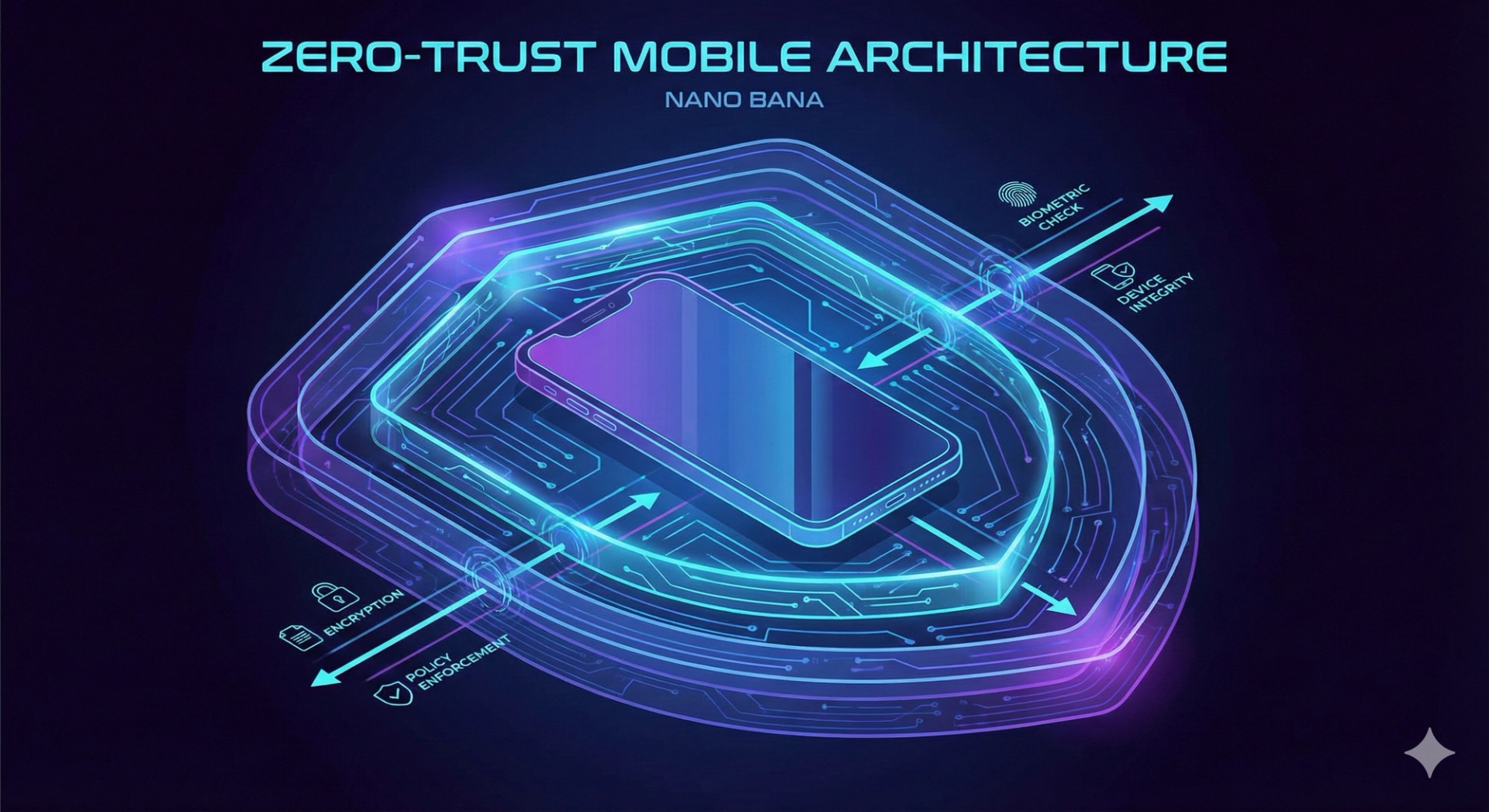
Zero trust security for mobile means your app never assumes the network, the device, or the session is safe. Every request is verified with short-lived tokens, device attestation, and mutual TLS, and every sensitive action is re-checked at runtime. Here is how to build that architecture without wrecking your UX.
The old model drew a perimeter: everything inside the corporate network was trusted, everything outside was not. Mobile apps never fit that model. Your app runs on hardware you don't control, over networks you can't inspect, next to whatever else the user installed last week.
Zero trust, formalized in NIST SP 800-207, replaces the perimeter with a simple rule: never trust, always verify. Applied to mobile app security, that translates into four working principles.
| NIST 800-207 principle | What it means in a mobile app |
|---|---|
| Verify explicitly | Short-lived access tokens, rotating refresh tokens, step-up biometrics for sensitive actions |
| Assume breach | Certificate pinning, runtime protection, jailbreak and root detection |
| Least privilege | Scoped tokens per feature, separate identities for AI agents acting inside the app |
| Continuous evaluation | Device attestation checked on sensitive calls, not just at login |
None of this is exotic. Every control in this article maps to a requirement in the OWASP Mobile Application Security Verification Standard (MASVS), which is the checklist serious security reviewers will grade your app against anyway. If you're building for enterprise buyers, expect their security team to bring it to the first call. We cover the procurement side of that in our guide to enterprise mobile app development.

Ask where an app stores its auth token and you learn most of what you need to know about its security posture. The common failure mode is a long-lived JWT dropped into AsyncStorage or SharedPreferences, readable by anything that can read the app's sandbox on a compromised device.
The zero trust version:
Biometrics backed by hardware are the baseline now, not a premium feature. Enterprise clients in finance and healthcare treat them as table stakes, and the frameworks they answer to (SOC 2 Type II, HIPAA) expect you to prove it.
TLS alone assumes the certificate authority system is trustworthy. Zero trust does not. Two controls close the gap.
Certificate pinning. Your app ships with the expected public key (or its hash) for your API and refuses any other certificate, even one signed by a "valid" CA. That kills the classic man-in-the-middle setup on public Wi-Fi, and it also defeats casual API scraping through proxy tools. Pin the key, not the leaf certificate, and ship a backup pin so a routine certificate rotation doesn't brick every install in the field.
Mutual TLS (mTLS). Standard TLS verifies the server to the app. mTLS makes the app prove itself to the server too, with a client certificate provisioned into hardware-backed storage. For high-value APIs (payments, health records, anything an attacker would script against) it means a stolen token alone is not enough; the request must also come from a provisioned client.
Layer device attestation on top. Apple's App Attest and Google's Play Integrity API let your backend verify that a request comes from your genuine, unmodified app on a real device, not an emulator farm or a repackaged clone. The Play Integrity documentation is worth reading in full; most teams check integrity once at login when they should be checking it on every sensitive call.

Everything above protects data in transit. Runtime Application Self-Protection (RASP) protects the app while it runs on a device you must assume is compromised.
In practice that means the app detects jailbroken or rooted devices, attached debuggers, hooking frameworks like Frida, and tampered binaries. Your response should be proportional, not theatrical. Blocking every rooted device kills real users who root for legitimate reasons; a better posture is to degrade: allow browsing, block transactions, and flag the session server-side so the risk engine sees it.
For apps holding regulated data, add remote wipe of local caches and the ability to invalidate a device's credentials the moment attestation fails. This is standard scope in the fintech mobile app work we do, where the threat model includes motivated, funded attackers rather than curious teenagers.
From the field. The recurring pattern we see across 30+ delivered projects: a team arrives with a demo that impressed everyone in a meeting and fell apart on real conditions. Security is the sharpest version of that gap. The demo auth flow works fine on five clean test devices; the questions that matter are what happens on the rooted one, the emulator, and the phone that lost network mid-refresh. Most of our work is that hardening, not the first happy path.
Here is the 2026 twist: users are no longer the only actors inside your mobile app. AI agents now draft orders, file claims, and trigger workflows. If an agent misfires and orders $50,000 of steel, "the AI did it" will not survive an audit. Identity has to expand from "who logged in" to "who authorized this action".
Three controls make agentic features compatible with zero trust:
Separate agent identities. The agent gets its own scoped credentials, never the user's session token. Least privilege applies to software actors exactly as it does to humans, and revoking a misbehaving agent shouldn't log the user out.
Human-in-the-loop release. The agent prepares the action; a human releases it. For high-value operations, that release is a hardware-backed biometric confirmation, so the audit trail shows a specific person approved a specific payload at a specific time.
Risk-tiered checks. Security that fires on everything trains users to click through it. Tier the friction instead:
| Action risk | Example | Check |
|---|---|---|
| Low | Agent drafts a $50 reorder | Silent: valid scoped token + device attestation |
| Medium | Agent updates a vendor record | Session re-auth |
| High | Agent releases a $5,000+ payment | Biometric confirmation + immutable audit log entry |
Immutable audit logs tie it together. Every agent action records which agent acted, under which human's authorization, with what inputs, in an append-only store. In regulated industries this log is not a nice-to-have; it is the artifact your client's compliance team will actually ask for. Our opinion, held firmly: an agent without an authorization trail is a liability with a chat interface, and enterprises are right to refuse it.
Less than a breach, and less than a failed enterprise deal. The honest math:
Compliance frameworks are the forcing function here. SOC 2 Type II, HIPAA, and PCI DSS do not name "zero trust" as a checkbox, but the controls above are how you satisfy their access-control and audit requirements on mobile. Security stopped being an IT problem; it is an architectural requirement for any app selling into the US market.
Short-lived scoped tokens in hardware-backed storage, certificate pinning with backup pins, device attestation via App Attest or Play Integrity, runtime protection with proportional responses, biometric step-up for sensitive actions, and immutable audit logs. Grade yourself against OWASP MASVS; it is the standard enterprise reviewers use, and it turns "are we secure" into a concrete checklist.
Yes, for any app moving money or regulated data. The failure stories almost always trace to pinning the leaf certificate instead of the public key and shipping no backup pin. Done correctly, rotation is a non-event and you have closed the most common interception path on public networks. For a low-stakes content app, attestation plus TLS may be enough.
Give each agent its own scoped identity rather than borrowing the user's session, require human biometric confirmation before high-value actions execute, and write every agent action to an append-only audit log with the authorizing human attached. Tier the checks by risk so low-value actions stay silent and users don't learn to rubber-stamp prompts.
Only if you implement it as constant prompts. Done well, most verification is invisible: attestation, token rotation, and mTLS all happen without user interaction. The user only feels friction at genuinely sensitive moments, a FaceID check before a large transfer, which most users read as reassurance rather than annoyance.
If an enterprise security questionnaire is sitting in your inbox, or you're designing auth for an app that will face one, we can help you scope the work honestly. Book a free 30-minute scoping call through /start-project and we'll respond within two business days with a concrete read on where your architecture stands and what actually needs hardening. We take on two engagements per quarter, every client gets 100% code ownership, and security is scoped into our mobile app development services from day one, not bolted on after the pen test.
A serial maker of SaaS products and AI agents, I’ve built and launched 10+ tools, grown products to thousands of users, and taken multiple ventures. I share the process what works, what breaks, and how builders can ship faster and smarter. Previously a data scientist at a Big Four consulting firm.


