

"Intelligent contact center" covers a wide range of very different builds. Here's what actually gets automated in a real call flow, and what still needs a human on the line.


"Intelligent contact center" shows up in nearly every vendor pitch we sit through, and it means something different in each one. Sometimes it's a full voice-AI agent handling entire calls. Sometimes it's a live-transcription tool whispering suggested responses to a human agent. Sometimes it's just better call routing with a machine-learning label attached. Before scoping any contact center automation project, the first real question is which of these you're actually asking for, because the build, the cost, and the risk profile are completely different for each.
Routing automation decides which agent or queue a call goes to, using signals like customer tier, stated intent (from a short IVR prompt or initial utterance), and current wait times across teams. This is the lowest-risk, fastest-to-ship layer, because it never talks to the customer directly, it just makes a better dispatch decision than a fixed queue. We've shipped versions of this in under three weeks when the routing logic is well-defined.
Agent-assist automation listens to a live call (with consent, disclosed per your jurisdiction's requirements) and surfaces relevant information to the human agent in real time: account history, a suggested next step, a policy the agent might not remember exactly. It never speaks to the customer. This is the layer with the best cost-to-risk ratio right now, because a human stays in the loop on every word the customer actually hears, and the automation is purely about giving that human better information faster. It's close in spirit to the confidence-based escalation pattern we use in self-service chat, covered in our AI customer self-service guide, just applied to voice.
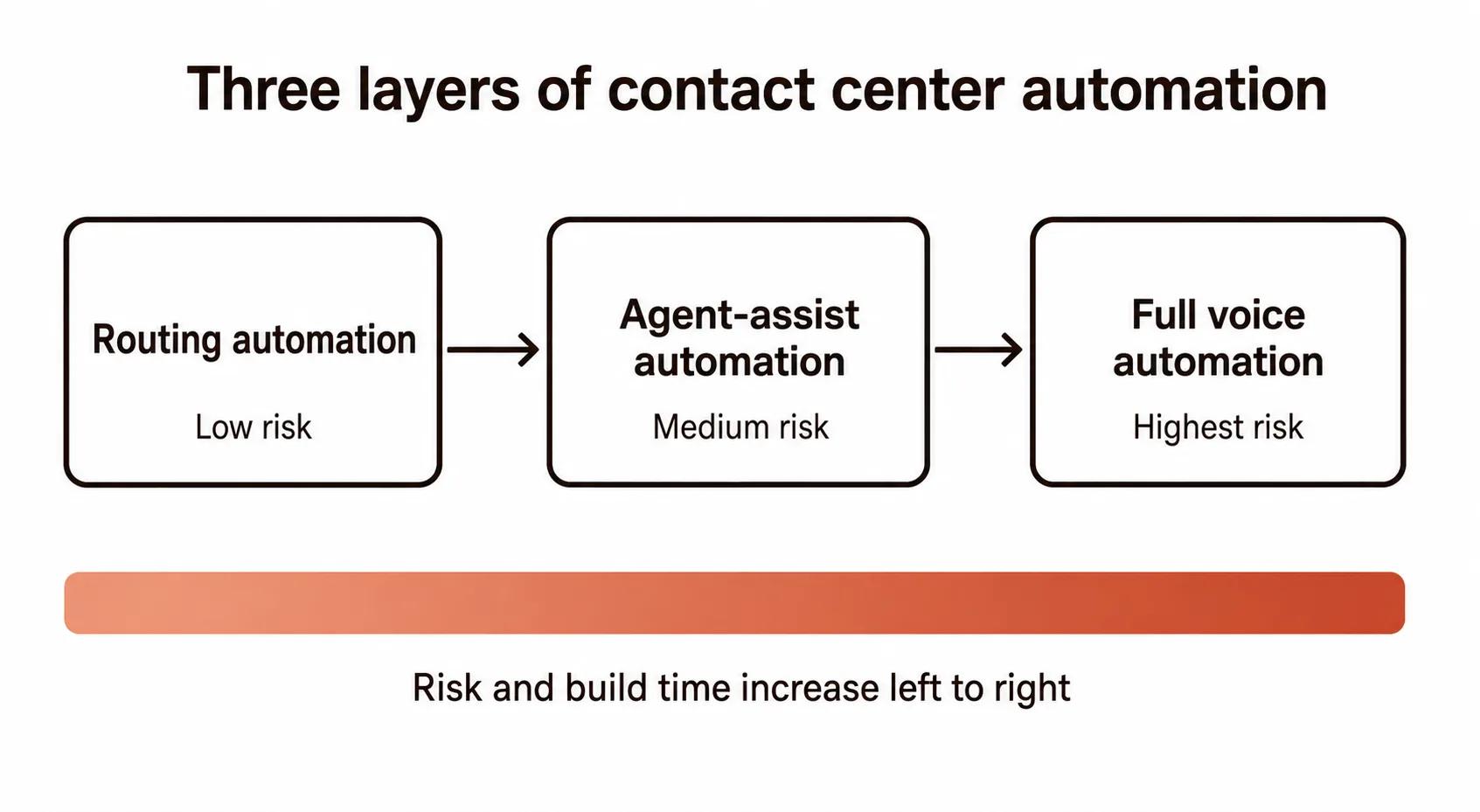
Full voice automation handles the call end to end, no human on the line unless it escalates. This is what most people picture when they hear "AI contact center," and it's also the layer with the narrowest reliable use case today: high-volume, low-variance calls (appointment confirmation, order status, simple account changes) where the range of things a caller might say is genuinely bounded. Outside that range, full automation on live phone calls is still the hardest reliability problem in this category, because a phone call has no visual context to fall back on and a caller can say anything.
Most contact centers we've scoped are underinvesting in agent-assist and overreaching on full voice automation, because agent-assist is less exciting to demo but delivers more reliable value per dollar spent. Surfacing the right account context to a human agent in the first three seconds of a call, instead of them scrolling a CRM while the customer waits, is a smaller build with a bigger, more measurable impact on average handle time than a fully autonomous voice agent that needs months of tuning before it's trustworthy on live calls.
We've said this before about AI projects generally, and it applies directly here: most teams don't need "AI transformation" of their contact center, they need three specific workflows automated well. Routing, agent-assist context, and after-call summarization (auto-generating the call notes an agent currently types by hand) cover most of the realistic near-term automation opportunity, and none of them require putting an AI voice directly in front of a live caller. After-call summarization in particular pairs well with structured call analytics; we cover the analytics side in our AI conversation intelligence guide.
If full voice automation is genuinely the right build for your call volume and variance, the engineering that separates a safe production system from a demo that impressed everyone in a meeting is almost entirely about the failure path: a hard, fast handoff to a human when the system's confidence drops, a transcript and audit trail on every call, and testing against real call variance, not the five clean example calls used in the sales demo. Moving a voice system from "works in the demo" to "safe on 99% of real calls" is where most of the actual engineering time goes, and it's the part vendors rarely show.
The contact centers that get this rollout right don't buy a platform and flip a switch. They pick one narrow, well-bounded call type, usually appointment confirmations or order status, and run it as a real pilot against a real queue for four to six weeks before deciding whether to expand. That pilot period is where you find out things a vendor demo won't show you: how often callers say something outside the expected range, how the escalation path actually performs under real call volume instead of a scripted test, and whether average handle time genuinely drops or just shifts the work to the agents handling the escalated calls.
We've seen contact centers skip this step and commit to a full platform rollout based on a vendor demo alone, then spend months unwinding a system that technically works but doesn't fit their actual call mix. A narrow pilot costs less, takes less time to evaluate honestly, and gives you real numbers, not vendor numbers, to decide what to automate next. If the pilot call type shows strong contained resolution and low false-escalation rates, expanding to a second call type is a much smaller, better-informed decision than the first one was.
Agent-assist gives a human agent real-time information and suggestions while they handle the call themselves. Full voice automation has the AI system talk to the customer directly, with a human only involved on escalation.
For most contact centers, agent-assist and better routing deliver more reliable value faster than full voice automation, and carry much less risk since a human stays on every call.
It's reliable for high-volume, low-variance call types (confirmations, status checks, simple changes). For open-ended calls, it's still the hardest reliability problem in the category, and needs a fast, well-tested escalation path.
Typically 3-5 weeks for a focused build (surfacing account context and a suggested next step during live calls), depending on how many backend systems it needs to pull from.
Any system listening to or recording live calls needs consent handling appropriate to your jurisdiction. This should be part of the scope from day one, not an afterthought before launch.
Written by the Codestreaks team, drafted with AI assistance and edited by a human against our own contact-center automation project history. The three-layer breakdown (routing, agent-assist, full voice) and the specific observation that agent-assist delivers the best cost-to-risk ratio come from scoping calls where clients arrived asking for full voice automation and, after seeing the actual reliability tradeoffs, chose agent-assist first.
Not sure which layer fits your call center's actual volume and variance? Book a free 30-minute scoping call or see our AI agent development work. Two business day response.
A serial maker of SaaS products and AI agents, I’ve built and launched 10+ tools, grown products to thousands of users, and taken multiple ventures. I share the process what works, what breaks, and how builders can ship faster and smarter. Previously a data scientist at a Big Four consulting firm.


