

Self-service tools promise fewer tickets. Here's what an AI self-service layer actually deflects, what it can't, and how to measure whether it's working.


"Deflection rate" is the number every self-service vendor leads with, and it's the wrong number to optimize first. A self-service tool can deflect 80% of incoming questions from reaching a human and still leave customers worse off, if that 80% is mostly people who gave up rather than people who actually got an answer. We've audited support stacks where the self-service widget looked like a success story on a dashboard and was quietly driving repeat contacts, because customers were closing the chat unresolved and calling in an hour later. Deflection without resolution is just a delay.
A working self-service system does three things well: answers a real question correctly using the customer's own account context, tells the customer clearly when it can't help and routes them fast, and gets measured on resolution, not just deflection. Most off-the-shelf help-center chatbots do the first one narrowly (matching a question to a help article) and skip the second entirely, silently returning a low-confidence answer instead of admitting it doesn't know.
The self-service builds that actually reduce ticket volume, not just hide it, pull real account state into the answer. "How do I cancel" answered generically from a help article is a worse experience than the same question answered with the customer's actual plan, renewal date, and a direct cancellation link, because the second version doesn't require a follow-up question to act on.
Self-service works best on high-volume, low-variance questions: order status, password resets, basic account changes, plan details. These are questions with a small number of correct answers that vary only by account data, which is exactly the pattern an AI system handles reliably when it's grounded in real account lookups rather than generating an answer from a training-time guess.
It works worst on genuinely novel problems: a bug specific to one customer's setup, a billing dispute that needs judgment, anything where the right answer depends on context the system wasn't built to reason about. Building a self-service system that tries to handle everything usually produces one that handles nothing well, because the model has no reliable way to tell the difference between a question it's confident about and one it should escalate.
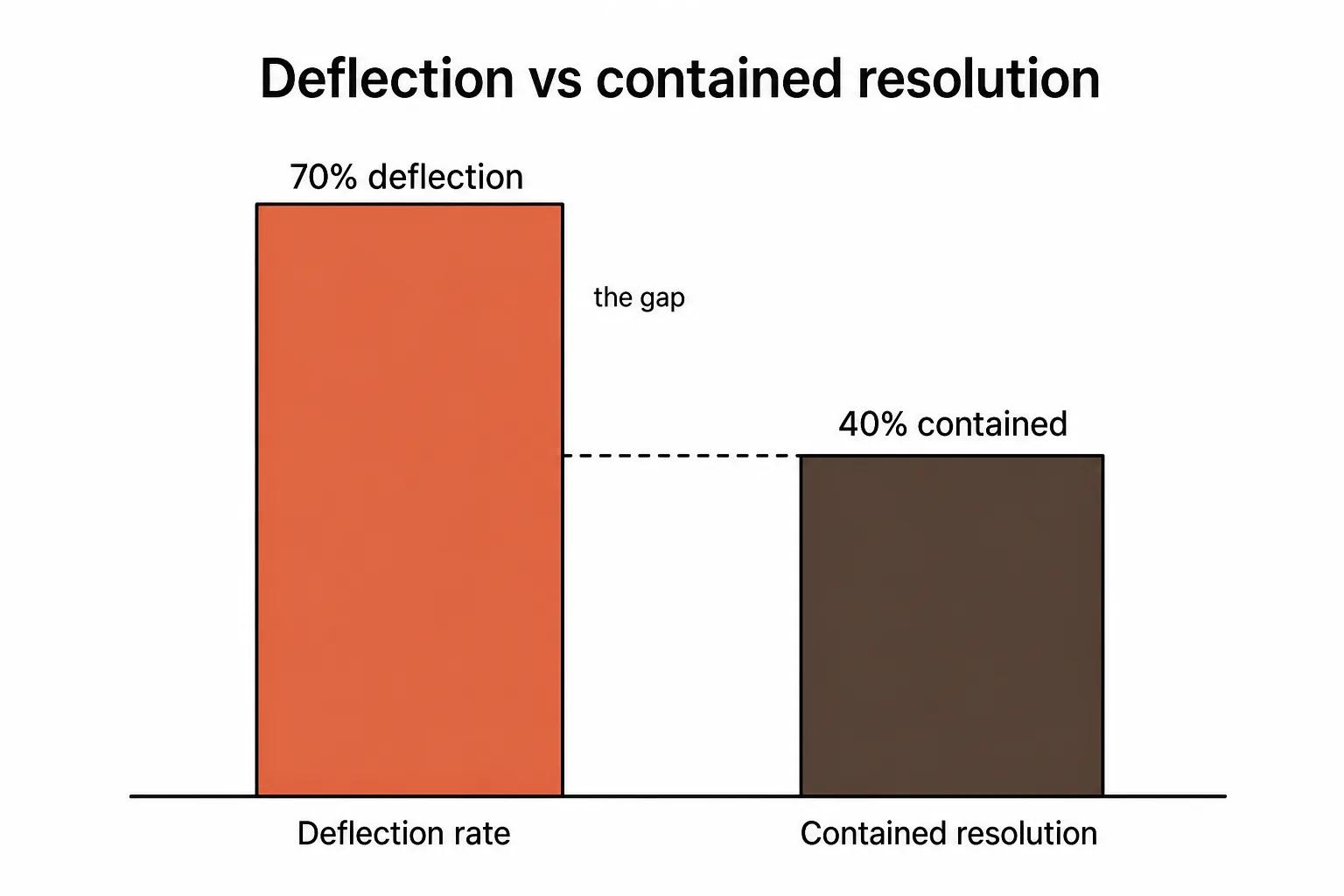
Deflection rate tells you how many people didn't reach a human. Contained resolution rate, the share of self-service sessions that end with the customer's problem actually solved without a follow-up contact within some window (we use 48 hours), tells you whether that was good or bad. A tool with 70% deflection and 40% contained resolution is quietly generating repeat contacts and frustrated customers. A tool with 50% deflection and 90% contained resolution is doing its job on a narrower, well-chosen set of questions. The second number is harder to get vendors to report, because it's less flattering, and it's the one that actually predicts whether support headcount pressure goes down.
Most of the self-service work we do isn't a new chatbot from scratch, it's fixing the escalation boundary on an existing one: adding a confidence check that routes low-confidence answers to a human instead of guessing, pulling in the account context the widget currently lacks, and instrumenting contained resolution so the team can see whether the tool is actually working, not just whether it's being used. That's usually a smaller, faster project than a full rebuild, and it's the fix that moves the number that matters. We go deeper on the escalation and confidence-check pattern in our AI customer service automation guide, and on the underlying virtual-assistant layer that most self-service widgets are built on top of in our AI virtual assistant tools guide.
Even a well-built self-service tool fails if it launches at full volume with no ramp. The teams that get this right route a small, monitored percentage of traffic to the new tool first, watch contained resolution and escalation accuracy for a real sample size, then expand. The teams that get it wrong flip 100% of traffic over on launch day because the demo looked good, and only discover the gap between demo performance and real-world variance after a spike in repeat contacts has already damaged trust in the tool internally. Support leads who watched an earlier self-service rollout fail this way are usually the hardest audience to convince the second time, even when the second build is genuinely better, which is its own cost of getting the rollout wrong once.
The fix is boring and it works: ramp from 5% to 25% to 100% of eligible traffic over two to three weeks, with a clear rollback trigger defined before launch, not improvised after a bad week.
There isn't one in isolation. A high deflection rate with a low contained-resolution rate means the tool is hiding contacts, not solving them. Track both, and treat contained resolution as the number that actually matters.
Yes, if it's built to pull live account data through a system call rather than answering from a generic help article. That's the difference between a genuinely useful answer and a technically-correct-but-useless one.
Anything requiring judgment on a case-by-case basis (billing disputes, account-specific bugs, anything with legal or compliance weight) should have a fast, clean path to a human, not a forced self-service attempt first.
Instrument contained resolution rate, the share of sessions that don't generate a follow-up contact within 48 hours, alongside deflection rate. If the gap between the two is large, the tool is deflecting without resolving.
Most of the fixes we make (confidence-based escalation, account context pull-through, resolution instrumentation) run 2-4 weeks, since they're improving an existing system rather than building one from scratch.
Written by the Codestreaks team, drafted with AI assistance and edited by a human against real support-stack audits we've run. The deflection-versus-contained-resolution distinction and the specific pattern of self-service tools hiding rather than solving contacts both come from client audits where that gap was the actual root cause behind a support-cost problem the client had misdiagnosed.
Want an honest read on whether your self-service tool is deflecting or actually resolving? Book a free 30-minute scoping call or see our AI agent development work. Two business day response.
A serial maker of SaaS products and AI agents, I’ve built and launched 10+ tools, grown products to thousands of users, and taken multiple ventures. I share the process what works, what breaks, and how builders can ship faster and smarter. Previously a data scientist at a Big Four consulting firm.


