

What a SaaS development agency does, what it costs ($8k-$60k), and how to vet one. A buyer's guide with real timelines and agency vs in-house math.

A SaaS development agency designs, builds, and launches your software product for a fixed price, typically $4,000-$30,000 over 4-8 weeks. The good ones hand you the full codebase, wire billing and multi-tenant architecture correctly the first time, and stay through launch. Here is what they do, what they cost, and how to choose one.
A SaaS development agency is a small product team you rent for one focused engagement. In a typical project, that team covers four jobs that usually take three separate hires to cover in-house:
That last point matters more than founders expect. We have delivered 30+ projects to production since 2024, and the pattern we see in rescue work is consistent: the previous team built the visible screens and skipped the plumbing. The demo looked finished. The product was maybe 40% done.
One opinion we hold strongly: if an agency won't give you the repo, walk away. Code ownership is not a feature to negotiate. It's the deal. Every Codestreaks client gets 100% code ownership, because a SaaS product you don't own is a subscription to your own idea.

For a first version, the math usually favors a SaaS development agency. For the long haul, it usually favors a team you own. The honest answer is sequencing: agency for version 1, in-house once revenue proves the product deserves permanent headcount.
Here is the comparison for a typical B2B SaaS MVP:
| Factor | SaaS development agency | In-house team | Solo freelancer |
|---|---|---|---|
| Cost to first launch | $4,000-$30,000 fixed | $150,000-$300,000+ per year in salaries | $10,000-$40,000, high variance |
| Time to hire | Days | 2-4 months to recruit | 1-4 weeks |
| Time to launch | 4-8 weeks | 4-6 months (hiring + ramp) | 2-6 months |
| SaaS plumbing experience | Should be proven across many builds | Depends entirely on who you hire | Usually strong in one area, thin elsewhere |
| Bus factor | Team, documented handoff | Yours to manage | One person |
| Best for | Version 1 through early revenue | Post-revenue scaling | Narrow, well-defined additions |
Two things the table can't show. First, an in-house engineer building their first billing system will make the same mistakes an agency already made and fixed on someone else's project. Second, benchmark data from OpenView's SaaS benchmarks has shown for years that early-stage SaaS companies live or die on capital efficiency. Burning six months of payroll before you learn whether anyone will pay is the least efficient move available.
The trap to avoid is the middle path: hiring one junior developer to "save money" on an agency. You get in-house prices at freelancer reliability, and you become the project manager.
Founders often budget for a web app and get surprised by SaaS-specific complexity. Three areas do most of the damage.
Every customer's data lives in the same system but must behave as if it doesn't. That means row-level isolation, tenant-scoped queries on every single read, and an architecture that stays fast when one customer grows 100x faster than the rest. Retrofitting tenancy onto a single-user codebase is one of the most expensive rewrites in software. It has to be right on day one.
Billing sounds like "add Stripe" until you meet reality: multiple pricing tiers, proration on upgrades, usage metering, failed payment retries, dunning emails, tax handling, and refunds. Stripe's billing documentation is excellent, but wiring it into your product's entitlement logic (who can access what, exactly when a card fails) is real engineering. Payment edge cases are where revenue quietly leaks.
B2B SaaS is bought by teams. That means workspaces, invitations, role-based permissions, admin controls, and audit trails. A "user" is never just a user; it's a member of an organization with a role, a seat, and a billing relationship.
None of this is exotic. It's all solved. But it's solved by teams who have shipped it before, which is the actual reason to hire a SaaS development company instead of learning billing edge cases on your own runway.

At Codestreaks we publish fixed prices, because "it depends" is a negotiating tactic, not an answer. Our tiers, which track closely with the wider US agency market for senior remote teams:
| Scope | Price | Timeline | What fits here |
|---|---|---|---|
| Focused single-purpose product | $4,000-$10,000 | 3-4 weeks | One core workflow, auth, Stripe billing, a clean dashboard |
| Full SaaS MVP | $10,000-$22,000 | 5-7 weeks | Multi-tenant workspaces, roles, integrations, admin panel |
| Platform-grade build | $22,000-$30,000+ | 8-12 weeks, phased | Complex domain logic, compliance needs, AI features, migrations |
Three cost notes worth knowing before you compare quotes:
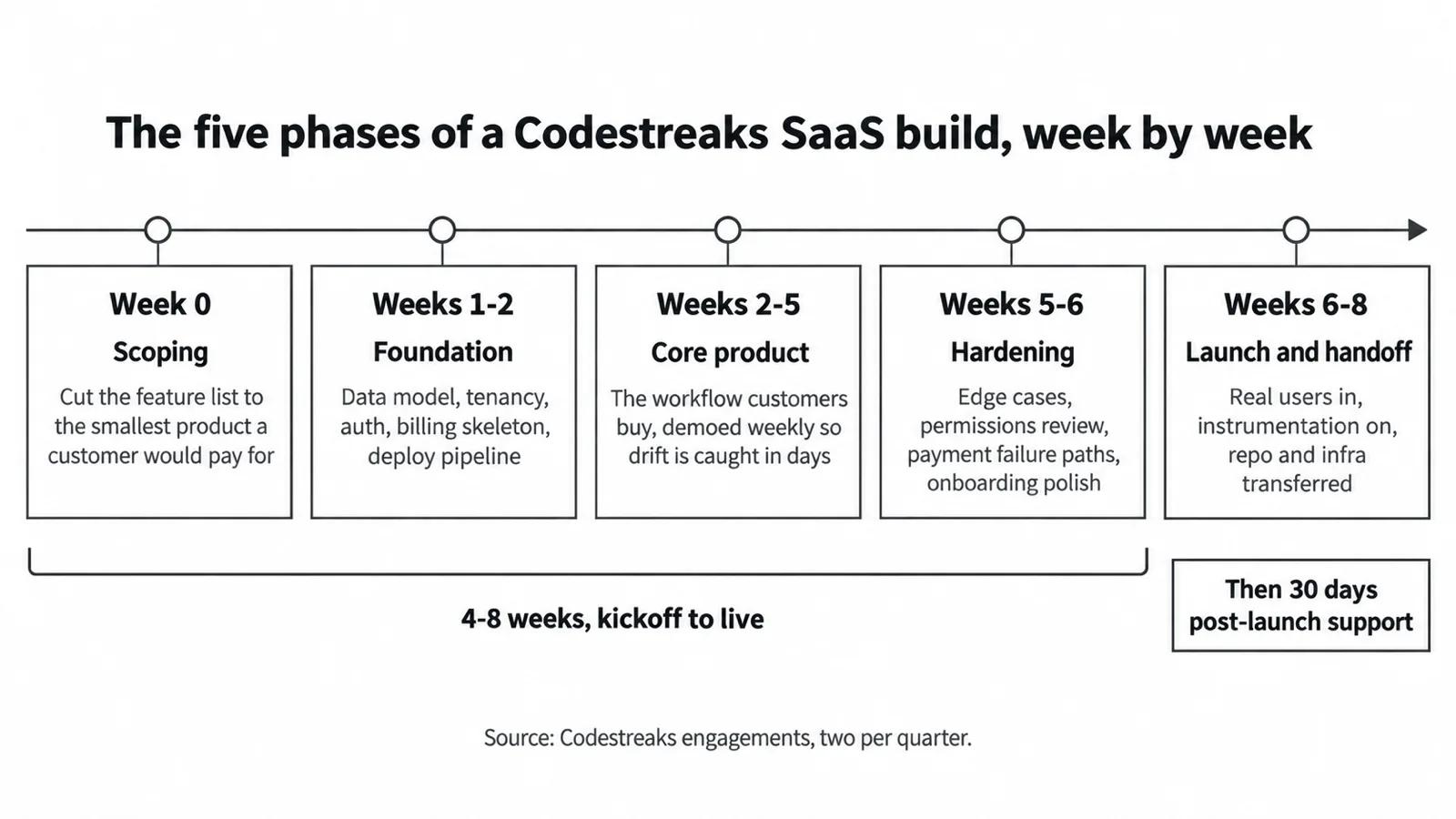
A competent agency engagement follows a predictable arc. Ours looks like this across a typical 4-8 week build:
From the field: Chad Dubuisson came to us with a rough idea for Rope Access Logbook, a digital logbook replacing paper records in industrial safety. We shipped it in 8 weeks. His words afterward: "Codestreaks took our rough idea and turned it into a real product in just 8 weeks. The way they built it saved us months of headaches down the road." The headaches he means are the plumbing decisions from weeks 1-2, the ones nobody notices until they're wrong.
Launch is a starting line, not a finish line. The full journey from validation to growth is longer than one engagement, and we mapped it in our guide to building a successful SaaS product in 2026.
Full disclosure: we are one, so read this checklist as the criteria we think we should be judged on.
Red flags: no senior engineer on the sales call, portfolios full of templates, hourly-only pricing, and any hesitation on the repo question.
For a well-scoped MVP, 4-8 weeks from kickoff to live deployment is a realistic senior-team timeline. Single-purpose products land in 3-4 weeks; multi-tenant platforms with roles and integrations take 5-7. If a bidder quotes 6+ months for a first version, the scope is bloated. If they quote 2 weeks, the plumbing is missing.
Boring, proven, and hireable. We build on Next.js with TypeScript, PostgreSQL, and Stripe for billing, deployed on managed infrastructure. That stack covers multi-tenancy, subscription logic, and scale without exotic dependencies, and any future in-house hire can pick it up in a week. Model names and frameworks change quarterly; owned, conventional code compounds.
For version 1, an agency is almost always cheaper: $4,000-$30,000 fixed versus $150,000+ in annual payroll before your first hire writes a line of code. In-house wins after revenue, when continuous product work justifies permanent headcount. The efficient sequence is agency-built MVP first, then hire against a product that's earning.
Three things: the problem in one paragraph, who pays to solve it, and your budget range. You do not need wireframes, a spec document, or a technical co-founder. A good agency's scoping process exists precisely to convert a rough idea into a buildable plan, and it should sharpen your thinking, not just transcribe it.
You should, completely and from the start. Insist on full repository access during the build and a written IP-transfer clause, not a promise of "handoff at the end". At Codestreaks, 100% code ownership is standard on every engagement. Any agency that resists this is building a hold over you, not software for you.
Written by the Codestreaks team and edited by Arsalan Amin. The prices, timelines and phases here are our own published tiers and our actual engagement shape, not industry survey data: 4-8 weeks from kickoff to live, two engagements per quarter, 30 days of post-launch support, 100% code ownership from day one. The diagram above is built from those same phases. The client work named in this post is real and quoted from our delivery records, Rope Access Logbook shipped in 8 weeks and HrefStack built in 10.
Two figures here are not ours to claim. The $50-$2,000 a month range for production AI inference is a market observation drawn from the published pricing of the model providers we build on, not a metered average across our own clients. And the line that our tiers track closely with the wider US agency market is a judgement formed from competing on real bids, not a survey we ran.
Drafting is AI-assisted and every draft gets a human editing pass against numbers we can back. This post was updated in September 2026 to add the diagram above and this note. Where we had no measured figure, we left the claim out rather than estimating one.
If you have a product idea and want a straight answer on whether it fits a 4-8 week build, book a free 30-minute scoping call. We'll tell you what version 1 should include, what it will cost, and whether we're the right fit. If we're not, we'll say so. Every inquiry gets a response within two business days, and every engagement comes with 100% code ownership.
Start your project or see how we work on our SaaS development services page.
A serial maker of SaaS products and AI agents, I’ve built and launched 10+ tools, grown products to thousands of users, and taken multiple ventures. I share the process what works, what breaks, and how builders can ship faster and smarter. Previously a data scientist at a Big Four consulting firm.


