

MVP development cost in 2026 runs $1,000-$5,000 no-code, $5,000-$40,000 freelance, $15,000-$60,000 agency. Real tiers, drivers, and how to cut scope.


MVP development cost in 2026 typically runs $1,000-$5,000 with no-code tools, $5,000-$40,000 with freelancers, and $15,000-$60,000 with an MVP development agency. Most funded founders building a real SaaS or mobile MVP land between $4,000 and $30,000 on a fixed-price contract, delivered in 4-8 weeks.
That range is wide because "MVP" means very different things to different teams. A landing page with a Stripe checkout is an MVP. So is a two-sided marketplace with payments, messaging, and an AI layer. This guide breaks the range down into real tiers, shows you what actually moves the price, and walks through the agency vs freelancer vs in-house math so you can budget with numbers instead of vibes.
We build MVPs for a living, so read the pricing sections knowing where we sit. The math still holds if you never talk to us.
Here is the honest breakdown by build approach and product complexity. These figures reflect what we quote, what clients tell us competitors quoted, and what freelance platforms actually invoice.
| MVP type | No-code | Freelancer | Agency (fixed price) |
|---|---|---|---|
| Simple web app (CRUD, one user type) | $1,000-$5,000 | $5,000-$15,000 | $15,000-$30,000 |
| Standard SaaS (auth, billing, dashboard) | $5,000-$15,000 | $15,000-$40,000 | $30,000-$60,000 |
| Mobile app (single platform) | $3,000-$10,000 | $20,000-$50,000 | $30,000-$60,000 |
| Mobile app (cross-platform) | not realistic | $30,000-$70,000 | $35,000-$70,000 |
Our own fixed-price custom MVP software development engagements run $4,000-$30,000 depending on scope, with 4-8 weeks from kickoff to live deployment. A single-purpose product (one core workflow, one user type) sits at the low end. A multi-workflow SaaS with billing, roles, and integrations sits in the middle. Enterprise-grade platforms with compliance requirements push toward $60,000 and beyond, usually phased.
If a quote lands far outside these bands in either direction, ask why. A $150,000 MVP quote usually means the vendor is building for scale you do not have yet. A $3,000 "full SaaS" quote usually means you are buying a demo, not a product.

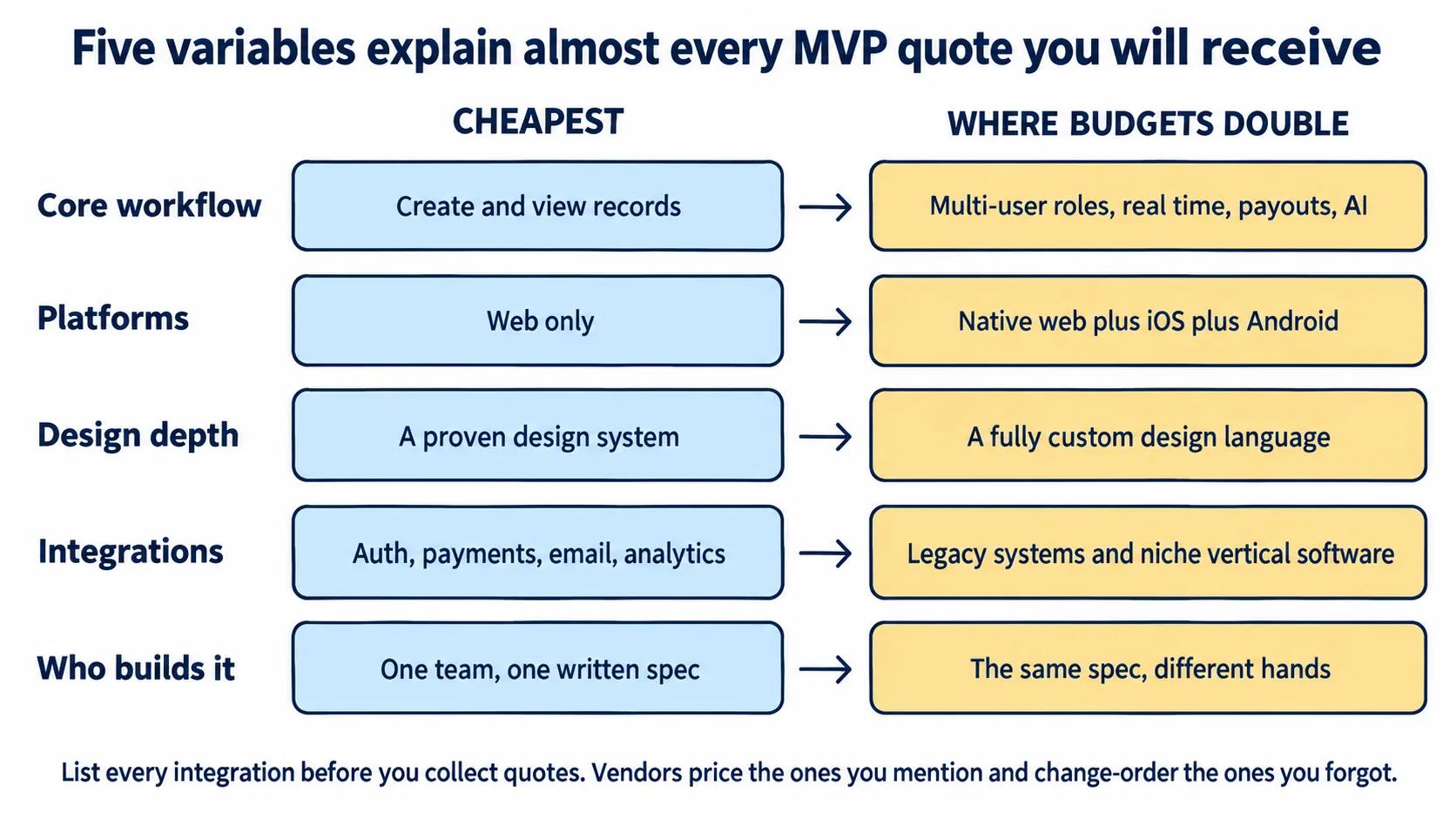
MVP development cost is not a mystery. Five variables explain almost every quote you will receive.
A CRUD app where users create and view records is the cheapest thing in software. Every step past that adds cost: multi-user roles, real-time features, payments with payouts (marketplaces are expensive for this reason), and anything involving AI. If your MVP includes an AI feature, budget for inference too. Production AI features typically run $50-$2,000 per month in model costs, and good engineering (caching, model routing, prompt design) cuts that 3-10x.
Web only is the cheapest launch. Web plus iOS plus Android can double the price if built natively. Cross-platform frameworks close most of that gap, which is why we usually recommend founders start with web or one mobile platform. Our guide on how to build a mobile app MVP covers the platform decision in detail.
A clean build on a proven design system costs a fraction of a fully custom design language. For an MVP, custom design is almost always the wrong purchase. Your first hundred users care whether the product solves their problem, not whether your empty states are bespoke.
Auth, payments, email, analytics, and one or two third-party APIs are standard and cheap. Deep integrations with legacy systems, healthcare records, or niche vertical software are where budgets quietly double. List every integration before you collect quotes, because vendors price the ones you mention and change-order the ones you forgot.
The same spec costs different amounts depending on the hands. That deserves its own section.
Non-technical founders in the US usually face three options, and the sticker price on each is misleading.
A senior React/Next.js developer in the US costs roughly $130,000-$160,000 per year in salary alone, and the Bureau of Labor Statistics wage data for software developers shows why: demand keeps median pay high across the country. Add recruiting fees of 15-20% of first-year salary, benefits, equity, and 1-3 months of interviewing before anyone writes a line of code. Getting to V1 this way realistically costs $40,000+ in salary and overhead, and you carry that burn every month afterward whether or not the product finds traction.
In-house makes sense after validation, when the product is your company and you need someone living in the codebase daily. It is a poor way to buy your first version.
Freelancers are the right call for small, well-defined tasks. For a full MVP, two structural problems show up. First, hourly billing points the incentives the wrong way: the longer the build takes, the more the builder earns. Second, the bus factor. If your one freelancer gets sick, burns out, or takes a better gig mid-project, your build stalls with no handover. The $15,000 freelance quote and the $30,000 agency quote are often not the same product; one includes project management, design, QA, and deployment, and one does not.
A fixed-price contract moves the scope risk from you to the builder. You know the number before work starts, and the vendor is incentivized to ship efficiently rather than bill hours. The trade-off is that scope must be defined honestly up front, which is why any serious agency will spend real time scoping before quoting. Our take on the broader build partnership question lives in the SaaS development agency guide.
One test applies to all three options: whoever builds it, you must own the repository from day one. If a vendor won't give you the repo, walk away. Code ownership is not a feature, it's the deal.

Chad Dubuisson came to us with a rough idea: replace the paper logbooks that rope access technicians carry on industrial sites with a digital logbook. No wireframes, no spec document, just a real problem he knew firsthand. We scoped it to one core workflow, cut everything that wasn't logging and verification, and shipped to production in 8 weeks. His words afterward: "Codestreaks took our rough idea and turned it into a real product in just 8 weeks. The way they built it saved us months of headaches down the road."
The lesson for your budget is that the scoping conversation is where the money is saved. The build was cheap because the scope was honest, not because anyone worked faster.
Cut scope, not quality. Those are different axes, and confusing them is the most expensive mistake founders make.
Cutting scope means fewer features, fully built. Cutting quality means the same feature list, built badly. The second option feels cheaper and never is, because you pay again to rebuild it once real users arrive. Y Combinator's advice on planning an MVP says the same thing from the investor side: launch something small that solves a real problem for a few users, fast. Their startup library is worth an afternoon before you write a spec.
Practical moves that cut real money:
What you should not cut: error handling, data backups, and basic security. Prototypes lie. A demo that works on five hand-picked examples tells you nothing about five thousand real users, and the gap between a demo and a product is exactly the part that keeps your launch week from becoming a support crisis.
When you compare quotes, compare line items, not totals. A production MVP includes discovery and scoping, design on a system, the build itself, QA on real devices, deployment with monitoring, and post-launch support. Cheap quotes usually cover only the build. Everything else arrives later as change orders, or worse, never arrives and you discover the gap in production.
Ask every vendor these questions: Who owns the repository? What happens in the 30 days after launch? What is the change process when scope shifts mid-build? Is the price fixed or estimated? The answers separate a $25,000 product from a $25,000 lesson. For a deeper look at what a full engagement covers, see our SaaS development services page.
Between $1,000 and $70,000 depending on approach and complexity. No-code tools cover simple validation for $1,000-$5,000. Freelancers build standard SaaS MVPs for $15,000-$40,000. Agencies charge $15,000-$60,000 fixed price for production-grade builds. Most funded founders spend $4,000-$30,000 for a product that can survive real users.
A well-scoped MVP ships in 4-8 weeks with a dedicated team. Timelines stretch when scope is undefined, when feedback loops are slow, or when the feature list grows mid-build. If a vendor quotes six months for a first version, the scope is too big for an MVP.
For validating demand with a landing page, a form, or a simple workflow, yes, and it is the cheapest path. No-code becomes a liability once the product is load-bearing: debugging gets hard, per-seat costs stack up, and migrations are painful. Plan to rebuild the core in real code once revenue proves the idea.
Because "the same MVP" rarely is. Quotes differ on what's included (design, QA, deployment, support), on team seniority, and on whether the price is fixed or an hourly estimate. Compare line items and ask each vendor what happens when scope changes. The cheapest total often excludes the most.
Hosting and infrastructure typically run $50-$500 per month at MVP scale. AI features add $50-$2,000 per month in inference, which good engineering cuts 3-10x. Budget for maintenance and iteration too, because the MVP is the start of the roadmap, not the end of spending.
Compare line items, not totals. Serious MVP development services for startups include scoping, design, QA, deployment, and post-launch support, and the price is fixed before work starts. Ask who writes the code, confirm you own the repository from day one, and check what happens in the 30 days after launch. A US-based team adds shared hours and enforceable contracts.
Usually not as a standalone purchase. Most of the value of MVP development consulting is the scoping conversation, and any serious builder does that before quoting. We run it as a free 30-minute scoping call: you leave with a tighter scope and a fixed number, whether or not you build with us.
Arsalan Amin drafted this guide with AI assistance, edited against Codestreaks' own quoted and delivered pricing: $4,000-$30,000 fixed-price MVP engagements, 4-8 week delivery, including the Chad Dubuisson rope-access logbook project referenced above. The pricing tiers reflect what we quote and what we've seen freelance platforms and other agencies actually invoice, not industry averages.
The fastest way to know your actual MVP development cost is a scoping conversation with someone who ships. We offer a free 30-minute scoping call where we help you cut scope to what validation actually requires, then quote a fixed price against it. We respond within two business days, we take on two engagements per quarter, and every client gets 100% code ownership and 30 days of post-launch support.
Start your project or read more about how we build on our SaaS development page. Worst case, you leave the call with a sharper scope and a real budget number.
A serial maker of SaaS products and AI agents, I’ve built and launched 10+ tools, grown products to thousands of users, and taken multiple ventures. I share the process what works, what breaks, and how builders can ship faster and smarter. Previously a data scientist at a Big Four consulting firm.


