

Want to build a SaaS product that customers actually pay for? This practical guide walks through the entire process from validation to launch, with real examples and actionable strategies for 2026.

Every successful SaaS product starts with someone noticing a problem. Not just any problem, but one that's painful enough that people will actually pay money to solve it.
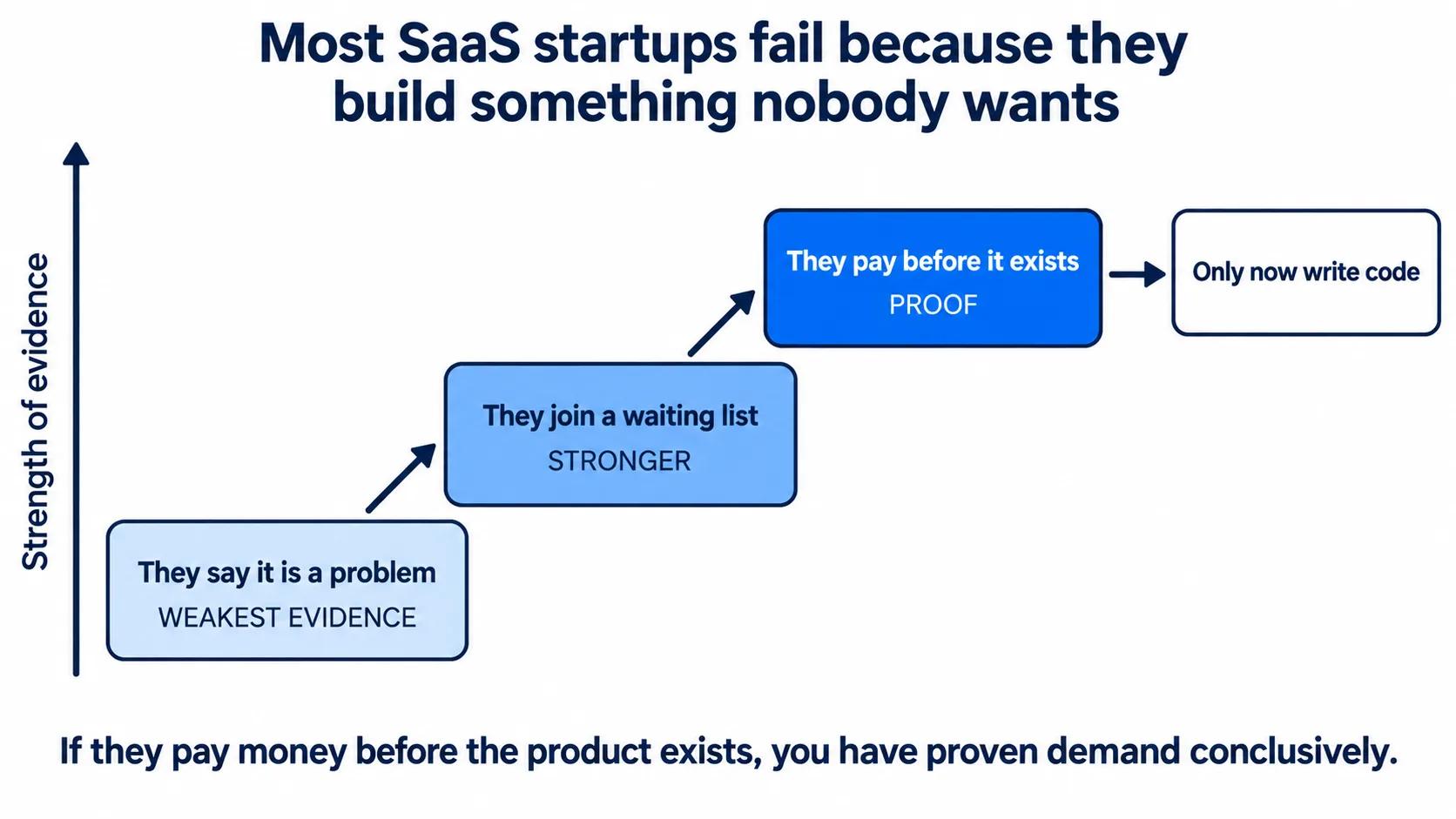
The SaaS market reached $315 billion in 2026, but this growth doesn't mean every idea succeeds. Most SaaS startups fail not because of bad engineering but because they build something nobody wants.
This guide shares what actually works when building SaaS products in 2026, drawn from real founders who've launched profitable businesses.
Before diving into building, you need to understand what makes SaaS different from traditional software.
Customers pay monthly or annually for continued access. This creates predictable revenue but also means you need to keep delivering value month after month.
Unlike selling licenses where you get paid once, SaaS requires ongoing customer satisfaction. Churn is your enemy. Every customer who cancels represents lost revenue and increased acquisition costs.
You ship features and fixes constantly. Customers always use the latest version. This eliminates compatibility issues but requires strong development processes and testing.
Your business depends on customers succeeding with your product. If they don't get value, they cancel. This shifts mindset from sales-focused to retention-focused.
SaaS businesses live and die by specific metrics:
Understanding these numbers helps you make informed decisions about product development and growth strategies.
For organizations exploring how technology choices affect development costs, SaaS products require different planning than traditional software projects.

Successful SaaS products solve real, urgent problems. Not nice-to-have features. Not things that would be cool. Actual pain points that cost people time, money, or stress.
Look at your own work. What frustrates you? What takes longer than it should? What do you or your colleagues complain about regularly?
Pay attention when people say things like:
These statements indicate pain worth solving.
Once you identify a problem, evaluate whether it's worth building a business around.
Market Size How many people have this problem? Are they concentrated in specific industries? Can you reach them?
Smaller markets aren't necessarily bad. Serving 1,000 customers paying $200 monthly generates $200,000 in MRR. Many successful SaaS businesses serve niche markets very well.
Willingness to Pay Would people actually pay to solve this problem, or do they just wish it were easier? This distinction matters enormously.
People pay for solutions that save time, make money, reduce risk, or eliminate frustration. They don't pay for slight improvements to things that already work okay.
Competition Analysis Who else serves this market? Competition isn't necessarily bad. It proves market demand exists. The question is whether you can differentiate meaningfully.
Study competitors carefully. What do their customers complain about? Where are the gaps? What would make someone switch?
Regulatory Environment Some markets have heavy regulations (healthcare, finance, education). These create barriers to entry but also opportunities for specialized solutions.
Horizontal SaaS serves broad markets with general solutions. Think project management or email marketing tools. These have larger potential markets but fierce competition.
Vertical SaaS serves specific industries with tailored solutions. Think dental practice management or construction job tracking. Smaller markets but less competition and higher prices.
In 2026, vertical SaaS is particularly attractive. The vertical SaaS market approaches $3 billion, growing rapidly as businesses seek solutions built specifically for their industry.
For founders exploring AI integration, vertical markets often have unique data and workflows that generic AI tools don't address well.
Don't build anything yet. Talk to people who have the problem you're solving.
Not friends and family who'll be nice to you. Actual potential customers who don't know you and have no reason to encourage you unless they genuinely see value.
Find them through:
Ask Open Questions
Don't pitch your solution. Understand their problem.
Listen more than you talk. Take notes. Look for patterns across multiple conversations.
Test Willingness to Pay
Toward the end of conversations, gauge interest.
"If I built something that solved this, would you be interested in trying it?"
Then follow up with pricing.
"What would you expect something like this to cost per month?"
If people hesitate or quote very low numbers, the pain might not be severe enough to build a business around.
Before writing code, see if you can get people to sign up for early access.
Create a simple landing page explaining the problem you're solving and the solution you're building. Add an email signup form.
Drive traffic through:
If you can't get 50-100 signups, your idea might not resonate strongly enough.
Some founders take validation further by pre-selling before building anything.
Offer founding member discounts to people willing to commit early. If they pay money before the product exists, you've proven demand conclusively.
This also provides capital to fund initial development.

What's the single most important problem you're solving? Your MVP should solve this one thing exceptionally well.
Strip everything else away. No nice-to-have features. No impressive but unnecessary functionality. Just the absolute core value.
For example, if you're building project management software, your core might be task assignment and tracking. Skip time tracking, resource management, reporting, and integrations for version one.
Your tech stack affects development speed, costs, and future flexibility.
Frontend Frameworks
React remains the most popular choice for SaaS applications. Massive ecosystem, extensive libraries, strong developer availability.
Vue.js offers simplicity and gentle learning curve. Great for teams prioritizing speed.
Next.js adds server-side rendering to React, improving initial load times and SEO.
Backend Options
Node.js with Express or NestJS provides JavaScript across your entire stack. Good for teams with primarily frontend expertise.
Python with Django or FastAPI is excellent for data-heavy applications or those incorporating AI features.
For businesses exploring cross-platform frameworks, the backend choices remain similar whether building web or mobile-first.
Databases
PostgreSQL serves most SaaS needs well. Robust, reliable, feature-rich.
MongoDB works for applications with flexible schemas that evolve rapidly.
Redis adds caching and real-time features.
Infrastructure
AWS provides the most comprehensive services but has complexity.
Google Cloud offers excellent AI/ML tools and developer experience.
Digital Ocean or Railway provide simplicity and predictable pricing for early stages.
Authentication and Payments
Don't build these from scratch. Use Auth0 or Clerk for authentication. Stripe for payments.
Focus development effort on your unique value, not commodity functionality.
SaaS products succeed through excellent user experience. Your UI doesn't need to be groundbreaking, but it must be clear, intuitive, and fast.
Onboarding Matters Most
Users decide within minutes whether your product delivers value. Invest heavily in onboarding that gets them to their first success quickly.
Show don't tell. Guide users through actual product usage instead of lengthy tutorials.
Responsive and Mobile-Friendly
Even for desktop-focused SaaS, mobile responsiveness matters. Users check dashboards on phones and tablets.
Performance is a Feature
Slow applications frustrate users. Every second of delay increases abandonment. Optimize aggressively.
Building an MVP takes longer than you think.
A simple SaaS MVP with core features might take 3-4 months with a small team. More complex applications require 6 months or more.
Don't rush. Shipping broken software hurts more than launching a month later with quality.
Before writing code, map how users accomplish their goals in your product. Create wireframes or prototypes showing key screens and interactions.
This identifies unclear areas and missing pieces before committing to implementation.
Ship small working features frequently rather than building everything before showing anyone.
Get feedback early and often. You'll discover misunderstandings and missing requirements before investing too heavily in wrong directions.
Security isn't something to add later. Build it in from the start.
For applications handling sensitive data, consider security audits before launch.
Your MVP doesn't need to handle millions of users, but avoid obvious bottlenecks.
These practices don't cost extra upfront but make scaling much easier later.
Write automated tests for critical functionality. This prevents regressions as you add features.
Manually test all user flows before releasing. Actually use your product as a customer would.
Pricing is as much strategy as it is math. Your price positions your product and affects who you attract.
Price based on value delivered, not costs incurred.
If your product saves customers $5,000 monthly, you can charge $500 monthly and still provide 10x ROI. Don't charge $50 just because your hosting costs $10.
Most SaaS products offer multiple tiers:
Tiers should differ in features, limits, or support level. Make it clear why someone would pay for higher tiers.
Offer both but incentivize annual plans with 20-25% discounts. Annual plans improve cash flow and reduce churn.
Many 2026 SaaS products adopt usage-based pricing where customers pay for what they use. This aligns costs with value and can accelerate growth.
Examples: Pay per user, per transaction, per GB stored, per API call.
Usage-based models work well when usage correlates with customer success.
New founders often underprice dramatically. It's easier to lower prices than raise them.
You can always add a cheaper tier later. Starting too low attracts price-sensitive customers who churn easily and provides little revenue to reinvest in product.
Launch to a small group first. Your waiting list provides ideal beta users.
Beta users are more forgiving of rough edges while providing crucial feedback. Give them special pricing in exchange for detailed input.
Don't just wait for feedback. Actively collect it through:
Look for patterns. One person's feedback might be an outlier. Multiple people reporting similar issues signals something important.
You'll know you have product-market fit when:
Until you see these signals, keep iterating on your core value proposition.
SaaS companies grow effectively through content marketing. Write about problems your target customers face.
Publish articles, guides, case studies, and tutorials that demonstrate expertise. This attracts organic traffic and positions you as a trusted resource.
Optimize content for search engines to capture people actively looking for solutions.
Build community where your customers naturally gather:
Active communities reduce churn through peer support and create brand advocates.
For businesses considering different development approaches, community feedback often guides platform decisions.
Outstanding support differentiates early-stage SaaS products. Respond quickly, solve problems completely, and turn support conversations into product improvements.
Use tools like Intercom, Help Scout, or Zendesk to manage support effectively.
Track essential SaaS metrics religiously:
Monthly Recurring Revenue (MRR) Total monthly revenue from subscriptions. Primary health metric.
Churn Rate Percentage of customers canceling monthly. Aim for under 5% monthly churn.
Customer Acquisition Cost (CAC) Total sales and marketing costs divided by new customers acquired.
Lifetime Value (LTV) Average revenue generated from a customer over their entire relationship.
Healthy SaaS businesses maintain LTV:CAC ratios above 3:1.
Net Revenue Retention (NRR) Revenue retained from existing customers after accounting for churn and expansion. Over 100% means you're growing revenue from existing customers faster than losing it to churn.
Let usage data and feedback guide development. Build what customers need, not what seems cool.
Prioritize features that increase activation, engagement, or reduce churn over those that might attract new customers.
As you gain traction:
Growth creates new challenges. Stay focused on sustainable, profitable growth rather than growth at any cost.
Ship early with core features. Perfect is the enemy of good enough. You'll learn more from real users in one month than six months of planning.
Your vision matters, but customer needs matter more. If multiple customers request something, it's probably important.
If users don't understand your product quickly, they leave. Invest heavily in clear, effective onboarding.
Charging too little attracts wrong customers and starves you of resources to improve the product. Price based on value delivered.
Acquisition without retention just fills a leaky bucket. Focus equally on keeping customers happy as on acquiring new ones.
Don't optimize for scale you don't have yet. Simple infrastructure serves early-stage SaaS perfectly well.
A solo founder built practice management software specifically for mental health therapists. Instead of competing with generic healthcare software, they focused exclusively on therapist workflows.
They validated by interviewing 50 therapists, built an MVP in 4 months, and charged $80 monthly. Within 18 months, they reached 200 paying customers generating $16,000 MRR with minimal marketing.
The key: Deep understanding of a specific niche, solving their exact problems better than generic alternatives.
Two founders noticed marketing agencies struggled with client reporting. They built automated report generation connected to various marketing platforms.
Pre-sold to 10 agencies at $200 monthly each before building anything. Launched MVP in 3 months. Grew to $50,000 MRR in first year through word-of-mouth and content marketing.
The key: Pre-validation through pre-sales, rapid MVP, and excellent product that delivered immediate value.
Written by the Codestreaks team, drafted with AI assistance and edited by a human against our own delivery history. We have shipped 30+ projects to production since 2024, take on two engagements per quarter, and our builds run 4 to 8 weeks from kickoff to live, so the timeline and scoping advice here reflects what we actually see rather than a general template. The $315 billion market figure is a published industry estimate, not our measurement, and is labelled as such in the text. The validation ladder in the diagram is ours. No client names appear here, and the two success-story examples are described without identifying details per our client confidentiality practice.
Building successful SaaS products in 2026 requires:
The opportunity is massive. The SaaS market continues growing rapidly, and new niches emerge constantly. Businesses increasingly prefer specialized solutions over generic tools.
You don't need to be the biggest. Serving 500 customers at $200 monthly generates $100,000 MRR, providing a sustainable business for a small team.
Start small, validate thoroughly, build excellently, and grow deliberately. The market rewards products that genuinely help customers succeed.
A serial maker of SaaS products and AI agents, I’ve built and launched 10+ tools, grown products to thousands of users, and taken multiple ventures. I share the process what works, what breaks, and how builders can ship faster and smarter. Previously a data scientist at a Big Four consulting firm.


