

What an ERP AI chatbot actually does: a plain-English front door to SAP, NetSuite, and Dynamics, permission-aware answers, and real costs from 30+ shipped projects.


It's 9:40 on a Tuesday and a customer wants to know when their order ships. The answer is in NetSuite. Getting it means finding the sales order, opening the fulfillment record, checking item availability across three locations, and maybe chasing the related purchase order. The one person who can do all of that in under a minute is in a meeting. So the customer waits, or someone guesses.
Multiply that by every "quick question" your ERP answers in a week. Stock on hand, PO status, invoice aging, credit holds, landed cost on last month's containers. The data is all there. The interface is the problem. ERPs are built for the fifty transactions a power user runs all day, not the five hundred questions everyone else has.
That gap is what an ERP AI chatbot closes. It is not a new ERP, and it is not a model that memorized your database. It is a natural-language front door: ask a question in plain English, get an answer pulled live from SAP, NetSuite, or Dynamics, scoped to exactly what your role is allowed to see. We've shipped 30+ AI projects to production since 2024, and this guide covers what these bots actually do, why permissions are the whole game, and what one costs.
ERP interfaces reward the specialist. A seasoned NetSuite admin flies through saved searches; everyone else clicks through six screens and gives up. So teams route around the system. Someone exports a spreadsheet on Monday that is stale by Wednesday. Someone messages the ops manager on Slack. Someone answers from memory.
Two things go wrong. First, the power user becomes a human API, answering the same twenty questions all week instead of doing their actual job. Second, decisions get made on stale exports, and the single source of truth you bought the ERP to be stops being the source of anything.
Our honest read after doing this work for a while: most teams asking about AI and their ERP don't need an AI transformation. They need three boring workflows automated well, and "answer routine ERP questions without a specialist" is almost always one of the three.

The mechanism matters, because it is what separates a useful tool from a liability.
All three major systems expose real APIs. SAP publishes OData services on its Business Accelerator Hub, NetSuite has SuiteTalk REST and SuiteQL, and Dynamics 365 sits on Dataverse with a documented Web API. The chatbot's job is translation: it turns "how many units of SKU 4417 do we have in Dallas?" into the right API call or saved query, runs it live, and returns the answer with a link to the underlying record.
Note what is not happening. The model is not trained on your ERP data and does not memorize it. Every answer is fetched at question time, so it is current, and it can be checked, because the record link is right there.
On the read side, the workhorse queries are the ones above: inventory, order status, PO and invoice status, customer history. On the write side, a bot can draft a sales order, log a goods receipt, or flag a credit hold for release. We will get to why those should start as proposals, not autonomous actions.
The chat surface is wherever your team already lives, usually Slack or Teams. Adoption dies when the answer requires opening yet another tool.
This is the part most demos skip, and the part that decides whether your security team ever signs off.
An ERP is full of data with sharply different sensitivity. Quantities on hand are one thing. Costed inventory, margins, payroll journals, and customer credit terms are another. If a warehouse associate asks the bot for stock on SKU 4417, it should answer. If the same associate asks for the margin on that SKU, it should decline, because their ERP role cannot see costed inventory, and the bot must inherit that role.
Mechanically, that means the bot authenticates each user and queries the ERP as that user (per-user OAuth tokens), or enforces the same role map before answering. What it must never be is a shared admin credential with a chat interface. That design leaks the CFO's view of the business to anyone who can type.
Two more pieces belong in the same bucket. Every question and answer gets logged with who asked, and the log stays readable by a non-engineer. When an auditor or a manager asks what the bot told whom, the answer is a query, not a shrug.
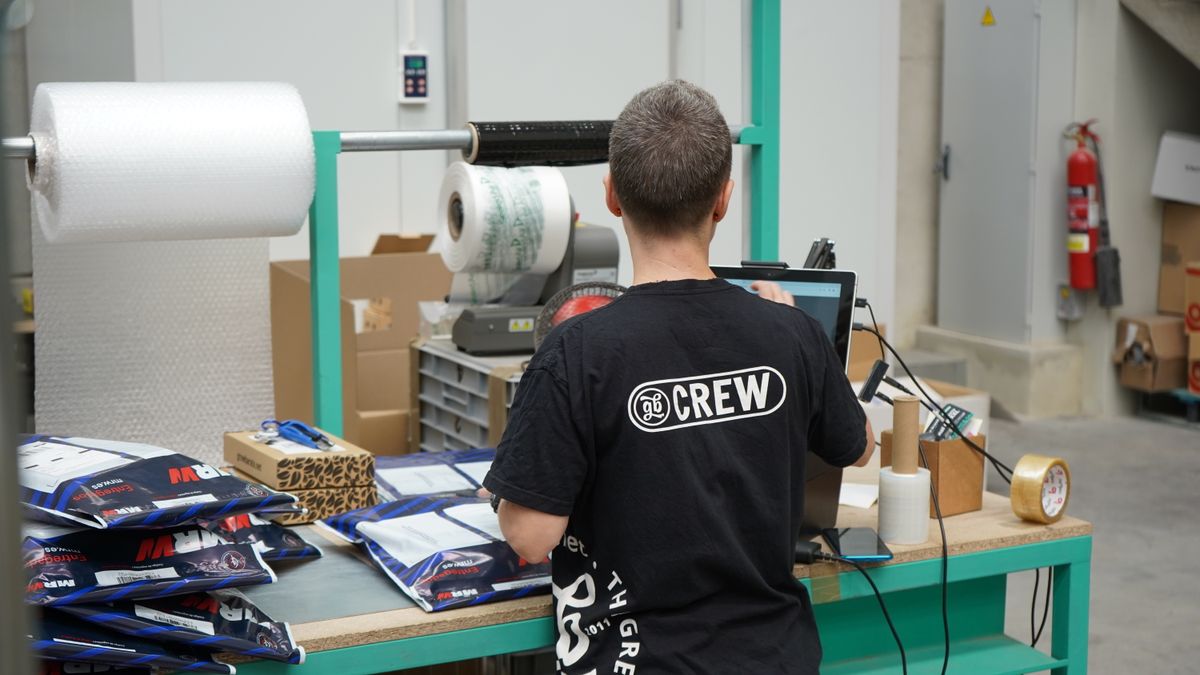
The engagement pattern we see most often around ERPs is not a failed chatbot. It is an ops person at 2am doing triage by hand because the tool doesn't talk to the other tool. Orders land in a storefront or a shared inbox, and someone retypes them into the ERP overnight so the morning shift can pick and pack. Every retype is a typo waiting to happen, and the person doing it is your most burned-out employee. That gap is usually one integration and one agent away from gone: the same plumbing that lets a chatbot read your ERP lets an agent write the routine entries, with a human approving exceptions instead of typing everything.
The rollout ladder we use on every ERP engagement:
What moves an action up the ladder is evidence, and evidence means an evaluation suite: a set of real historical questions and entries with known correct outcomes, run against every prompt change and model swap. An agent without an evaluation suite is a liability with a chat interface, and that is doubly true when the interface can post journal entries.
SAP ships Joule, Microsoft is embedding Copilot across Dynamics 365, and NetSuite keeps adding AI features of its own. If your instance is close to vanilla and your questions stay inside one system, try the native copilot first. It is the cheapest experiment you can run.
Custom earns its keep in three situations. Your instance is heavily customized, so generic copilots stumble over your fields and workflows. Your questions cross systems, ERP plus WMS plus storefront plus a shared inbox, which no single vendor's copilot will ever see end to end. Or you need the permission and audit behavior described above to match your policies exactly, not the vendor's defaults.
One principle either way: buy the outcome, not the model. Model names change quarterly. The integration layer, the permission map, and the evaluation suite are the assets that compound, and you should own them. If an agency won't give you the repo, walk away.
Real numbers from our own pricing:
Ongoing inference typically lands between $50 and $2,000 a month depending on volume. ERP bots sit at the cheap end more often than most, because routine questions repeat heavily, and caching plus model routing cuts the bill 3-10x. Every engagement includes 30 days of post-launch support and 100% code ownership.
Connecting anything to an ERP is an enterprise project first. The enterprise software development process guide explains how to sequence the integration and the sign offs.
Yes. All three expose supported APIs (OData for SAP, SuiteTalk REST and SuiteQL for NetSuite, the Dataverse Web API for Dynamics 365), and the bot works through those. Heavily customized instances take more mapping work, not a different architecture.
Not if it is built correctly. The bot should authenticate each user and inherit their ERP role, either by querying as that user or by enforcing the same role map. Treat any design built on a shared admin credential as a failed security review waiting to happen.
No. The bot fetches answers live through the API at question time. Nothing is memorized by a model, answers are always current, and every answer links back to the source record.
Both, but writes should start as proposals a human approves. Action types earn autonomy through an approval track record and an evaluation suite, and they run inside explicit bounds once they do.
Typically $50-$2,000 a month in inference depending on volume. Caching and model routing matter more than the model choice; done well, they cut the bill 3-10x.
We take on two engagements per quarter, so we scope carefully and say no when the fit isn't right. If your team is drowning in "quick questions" or retyping orders at 2am, book a free 30-minute scoping call. You'll get a straight read on whether you need a read-only bot, a workflow agent, or nothing custom at all. We reply within two business days.
Book a scoping call or see how we build these at chatbot development.
A serial maker of SaaS products and AI agents, I’ve built and launched 10+ tools, grown products to thousands of users, and taken multiple ventures. I share the process what works, what breaks, and how builders can ship faster and smarter. Previously a data scientist at a Big Four consulting firm.


