

Enterprise software development differs from a standard build in two structural ways: legacy system integration and multi-stakeholder governance. Here's how to sequence both.
Codestreaks Team

An enterprise software development process differs from a standard build in exactly two structural ways, not the dozen a typical framework diagram implies: how the new software integrates with (or replaces) existing legacy systems, and how change gets approved across multiple stakeholders who each have real veto power. Everything else, the sprint cadence, the tooling, the testing approach, is close enough to any other serious software project that it doesn't deserve a separate name. These two decisions do.
Get them wrong and the project doesn't fail loudly. It stalls, quietly, in the gap between "the code works" and "the organization will actually let this go live."
Almost every enterprise software project starts with data or workflows already living somewhere: an ERP, a decades-old internal system nobody fully documented, a vendor platform the company is contractually stuck with for another two years. The first real decision, before any UI gets designed, is whether the new software integrates with that system or aims to replace it.
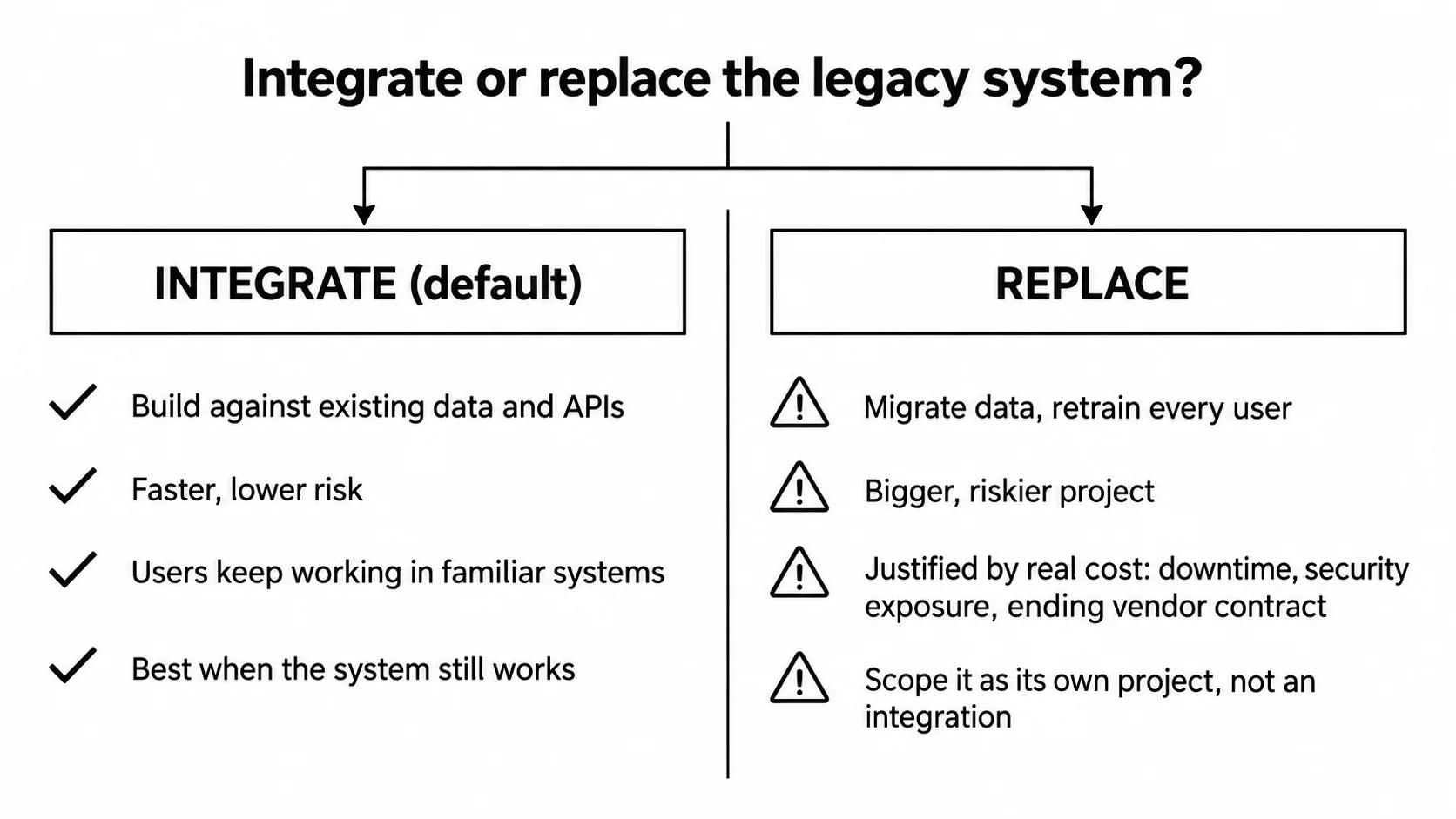
Integration is almost always the faster, lower-risk path, and it's the one we recommend by default. It means building against the legacy system's existing data and APIs (or building an API layer over a system that doesn't have one, which is its own real project) rather than migrating years of data and retraining every user on a new system of record at once. The tradeoff is that integration work is often the least glamorous part of the build and the part most likely to be underscoped in an initial estimate, because nobody fully knows what the legacy system actually does until someone starts building against it.
Full replacement makes sense when the legacy system is actively costing the business money through downtime, security exposure, or a vendor relationship that's ending. It's a materially bigger, riskier project, and it should be treated as one from the start, not scoped as if it were an integration project that happens to also migrate data.
We cover the general version of this scoping discipline, the two stages where most software projects go wrong regardless of company size, in our custom software development process guide. The legacy integration question above is the enterprise-specific version of that same underlying failure mode: unclear scope at the boundary between old and new.
The second structural difference is governance. A startup team can often make a build-or-don't-build call in one meeting. An enterprise project usually needs sign-off from IT security, the business unit that owns the workflow being changed, procurement if a new vendor is involved, and sometimes compliance or legal if the software touches regulated data. Each of those groups can stop the project, and each one evaluates it against a different concern.
The mistake we see most often isn't skipping this process, most enterprise teams know it exists, it's sequencing it wrong. Bringing security review in at the end, after the architecture is locked, means any finding forces a rework instead of a design adjustment. The same is true of compliance: a data-handling requirement discovered after the schema is built costs far more to fix than one discovered during requirements.
The fix is boring and unglamorous: map every stakeholder with real veto power before requirements are finalized, and get their specific concerns, not just their attendance, into that requirements phase. This is slower upfront and dramatically faster overall, because it prevents the single most expensive failure mode in enterprise projects: a technically complete build that stalls for months waiting on an approval that should have been sought three months earlier.
If the enterprise project involves an outside development partner rather than an internal team, the vendor relationship itself becomes part of the process, not a separate procurement step that happens before the "real" work starts. We hold a firm view here: if an agency won't give you the repo, walk away. Code ownership isn't a feature you negotiate for, it's the baseline deal, and an enterprise team locked into a vendor's proprietary codebase has effectively outsourced a piece of its own infrastructure indefinitely.
The same applies to support and continuity commitments. We structure every engagement with 30 days of post-launch support and full code ownership handed over at delivery, specifically because an enterprise buyer needs to know the software is theirs to maintain, extend, or hand to a different team later, not permanently dependent on the original vendor. For teams evaluating an outside partner for an enterprise mobile build specifically, we cover the vetting questions in more depth in our enterprise mobile app development company guide; most of the same questions apply to any enterprise engagement, mobile or not.
None of the above is about the code taking longer to write. A well-scoped enterprise feature often takes about as long to build as the equivalent startup feature. The difference is entirely in the integration and governance decisions above: the legacy system audit, the stakeholder sign-off sequencing, the security and compliance review cycles. Teams that budget only for development time and treat these as afterthought line items are the ones whose enterprise projects run months over an estimate that was, on the coding alone, accurate.
Structurally, two things: integrating with or replacing existing legacy systems, and coordinating approval across multiple stakeholders with real veto power (security, the business unit, procurement, sometimes compliance). The actual engineering practices, testing, architecture, deployment, are largely the same as any serious software project.
Integration is the faster, lower-risk default in most cases, building against the existing system's data and APIs rather than migrating everything at once. Full replacement is justified when the legacy system is actively costing the business money through downtime, security risk, or an ending vendor contract, and should be scoped as its own bigger project from the start.
Usually not because the code takes longer to write. It's because integration scope with legacy systems gets underestimated, and stakeholder approval (security, compliance, the business unit) gets sequenced too late, forcing rework instead of design adjustments.
Whether you get full code ownership and the repo at delivery, what post-launch support is included, and how they've handled legacy system integration on past projects specifically, not just greenfield builds. A vendor unwilling to hand over the repo is a vendor who has made you dependent on them indefinitely.
During requirements, before architecture is locked. A finding discovered after the schema and integration points are designed costs far more to fix than the same finding surfaced during scoping.
Written by the Codestreaks team; drafting is AI-assisted with human editing over patterns from our own engagements involving legacy system integration and multi-stakeholder sign-off, not a generic framework. The integrate-vs-replace diagram above is an original chart built for this post, not a stock graphic.
If you're scoping an enterprise build and want a second opinion on integration approach or stakeholder sequencing before committing to an architecture, we do web development engagements with full code ownership and 30 days of post-launch support included, and take on two new engagements a quarter. Start a project or book a free 30-minute scoping call, we respond within two business days.


