

White label AI voice agents let agencies sell a phone-answering product without building the stack. Here's what you're actually reselling, and where it breaks.


A white label AI voice agent is a phone-answering product built by one company and resold under another company's brand, usually a marketing or web agency that wants a recurring-revenue line without hiring engineers who understand telephony, speech models, and prompt orchestration. The pitch is simple: a client asks their agency for "an AI that answers the phone," the agency doesn't build one, they license one and put their logo on the dashboard.
That pitch works. What agencies underestimate is what they're actually agreeing to support once a client's real customers start calling it.
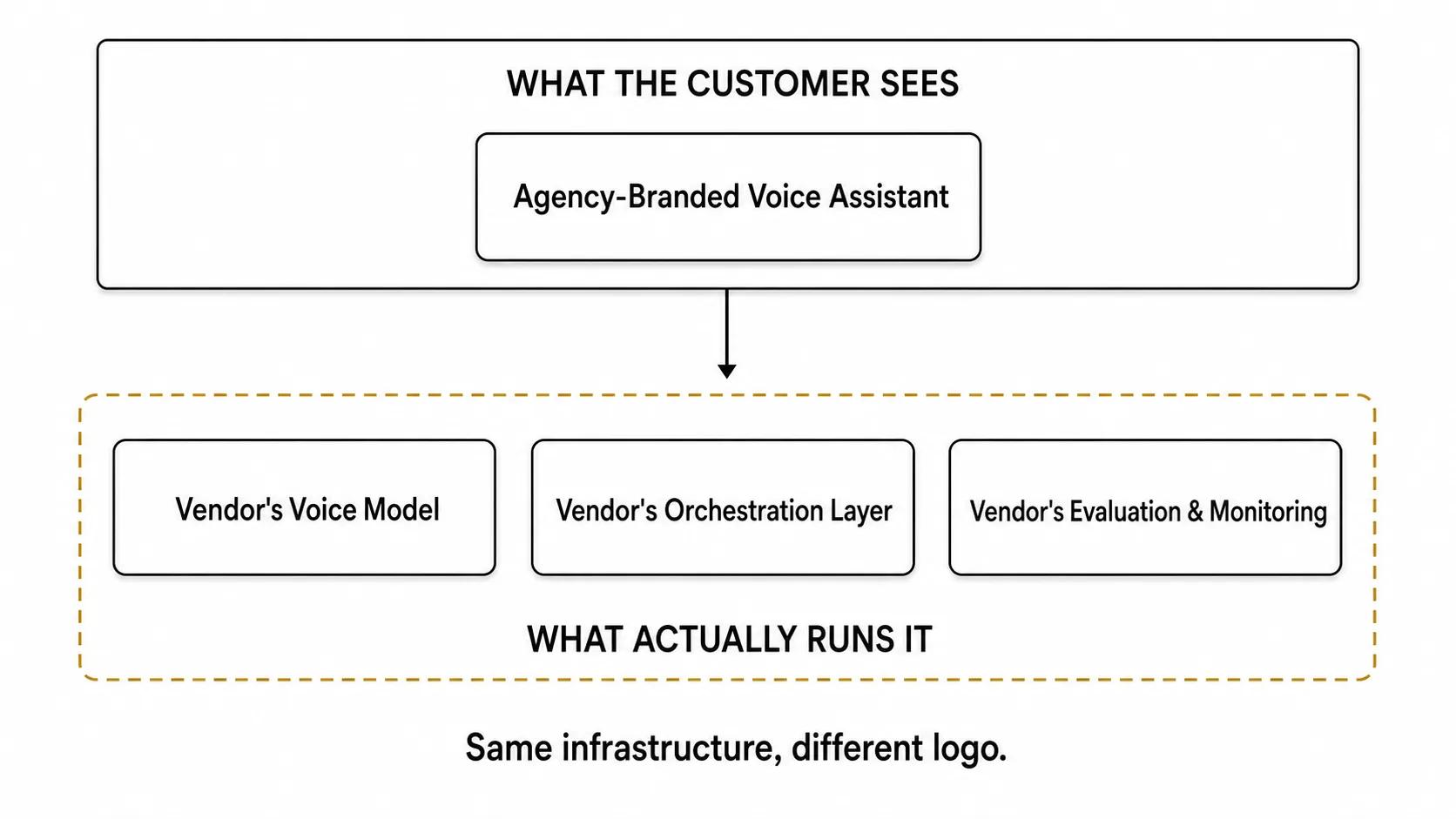
A voice agent looks like a single thing in the demo: someone calls a number, a natural-sounding voice answers, the call resolves. Underneath, it's three separate systems stitched together, and white labeling only rebrands the top layer.
The telephony and speech layer. This is the part that answers the call, converts speech to text, and converts the response back to speech (how that speech pipeline sets call latency). It's usually the most commoditized piece, licensed from a handful of providers, and the part agencies assume is "the product." It isn't. It's the plumbing.
The orchestration and prompting layer. This decides what the agent actually says and does: which intents it recognizes, when it transfers to a human, what it's allowed to promise a caller. This is where most of the real engineering lives, and it's the layer a white label vendor controls entirely. If your agreement doesn't let you edit prompts per client, you're reselling one script with different logos on it.
The evaluation and monitoring layer. This is the part almost no white label agreement mentions, and it's the part that determines whether the agent gets better or silently gets worse over time. Without it, you find out the agent has been misrouting calls the same way a client finds out: because someone finally complained.
Agencies price these the way they price any subscription reseller deal: a markup on a per-minute or per-seat licensing fee. That's fine as a floor, but it's not where the money is.
We build the underlying agent infrastructure for clients rather than reselling someone else's, and the pattern holds across every engagement: production agent inference typically runs $50 to $2,000 a month depending on call volume and model choice, and good engineering work, caching repeat intents, routing simple calls to a cheaper model, tightening the prompt so it doesn't re-reason from scratch on every turn, cuts that cost 3 to 10x. That gap is the actual margin in this business. A reseller who can't touch the orchestration layer can't capture it. They're stuck marking up someone else's infrastructure bill.
The agencies doing well with white label voice agents treat the vendor relationship as a starting stack, not a finished product, and negotiate access to the prompt and routing layer specifically so they can do that tuning per client. The ones doing badly resell a black box and compete on price alone, which is a race to a margin that keeps shrinking as the underlying model APIs get cheaper.
This is the opinion that gets us pushback, and it's the one that matters most for a reseller specifically. A voice agent that isn't being scored against real call transcripts, on a schedule, by someone checking for wrong answers and dropped intents, is not a working product. It's a demo that hasn't failed on camera yet.
We've seen this exact silent-failure pattern play out in a different automation context we track closely: in one internal audit of our own browser-automation tooling, roughly one in three actions reported success back to the system while nothing had actually happened downstream. The action looked complete from the outside. It wasn't. Voice agents fail the same way. A call "resolves" (the caller hangs up, no error is logged, the dashboard shows a completed interaction) while the agent booked the wrong slot, quoted the wrong price, or promised a callback that never triggers. Nothing in the interface tells you that happened. Only a transcript review does.
If your white label agreement doesn't include, or doesn't let you add, a way to sample and review real call transcripts against expected outcomes, you're reselling exactly this risk to your clients without knowing it.
The recurring pattern we see across client engagements, voice or otherwise: a team arrives with a demo that impressed everyone in a meeting and fell apart on real data. Voice agents are especially prone to this because the demo call is always a clean, cooperative caller reading from a happy path. Real callers interrupt, mumble, call from a loud kitchen, or ask something the intent map never anticipated. The gap between "worked in the demo" and "works for the five thousandth real caller" is where the actual engineering is, and it's the gap a pure reseller has the least ability to close.
Before signing a white label agreement, get real answers to these, not marketing answers:
If a vendor can't answer the transcript-access question specifically, that's the one to walk away from. It's the same reasoning behind our own stance on code ownership: if an agency won't hand you the repo, walk away, because ownership isn't a feature, it's the deal. The voice-agent version of that is transcript and prompt access. Without it, you don't own the product you're reselling. You're renting a script with your logo on it.
We cover a closely related buying decision, choosing between a traditional IVR system and an AI phone agent in the first place, in our IVR vs AI phone agents comparison. And if the white label motion itself is new territory for your agency, our piece on scaling web development work without hiring covers the same reseller economics from the web-dev side, most of it transfers directly.
It can be, but only past the point where you're negotiating on markup alone. The margin is in tuning the orchestration layer per client (caching, routing, prompt tightening), not in the base licensing fee. A pure resale-with-no-access deal has thin, shrinking margins as underlying model costs drop industry-wide.
An IVR routes callers through a fixed menu tree using button presses or simple keyword matching. A voice agent understands open-ended speech and can handle a wider range of requests without a rigid menu, at the cost of needing real evaluation and monitoring to catch misunderstandings an IVR's fixed tree never has to worry about. We break down the tradeoff in detail in our IVR vs AI phone agents guide.
Sample real call transcripts against expected outcomes on a regular schedule, not just after a complaint. A call can show as "completed" in a dashboard while the agent gave a wrong answer. Aggregate success metrics won't catch that. Transcript review will.
Yes, and for agencies planning to make this a real product line rather than an add-on, owning the orchestration and evaluation layer from the start avoids the margin ceiling a pure resale model runs into. It costs more upfront and is worth it past a certain client volume.
Who owns the call transcripts and recordings if you switch vendors, and can you export them. If the answer is vague, assume you can't, and price that lock-in into your decision.
Written by Arsalan Amin; drafting is AI-assisted with human editing over our own project data and cost figures from production agent engagements, not industry averages. The one-in-three browser-automation failure rate cited above comes from an internal audit of our own tooling, not a third-party study.
White label voice agents are a real product decision, not a checkbox. If you're evaluating whether to resell one or build your own, we do AI agent development including the orchestration and evaluation layer specifically, and we take on two new engagements a quarter. Start a project or book a free 30-minute scoping call, we respond within two business days.
A serial maker of SaaS products and AI agents, I’ve built and launched 10+ tools, grown products to thousands of users, and taken multiple ventures. I share the process what works, what breaks, and how builders can ship faster and smarter. Previously a data scientist at a Big Four consulting firm.


