

Retail vision projects stall on cameras, networks and destination systems, not on the model. Here is what the integration actually involves, and what it costs.

A retail chain we talked to last quarter had already picked a vision vendor, already run a two-store proof of concept, and already had a number they liked. What they did not have was an answer to a much duller question: which system receives the alert at 2pm on a Tuesday, and what does the person on the receiving end do with it. That question is the project. Retail AI vision systems integration is where these deployments succeed or quietly stall, and the model is almost never the reason either happens.
We build computer vision systems for a living, over 30 production projects delivered since 2024, and the shape of a retail vision engagement is consistent. Roughly a fifth of the work is the model. The rest is cameras, networks, and the four or five business systems that have to act on what the camera saw.
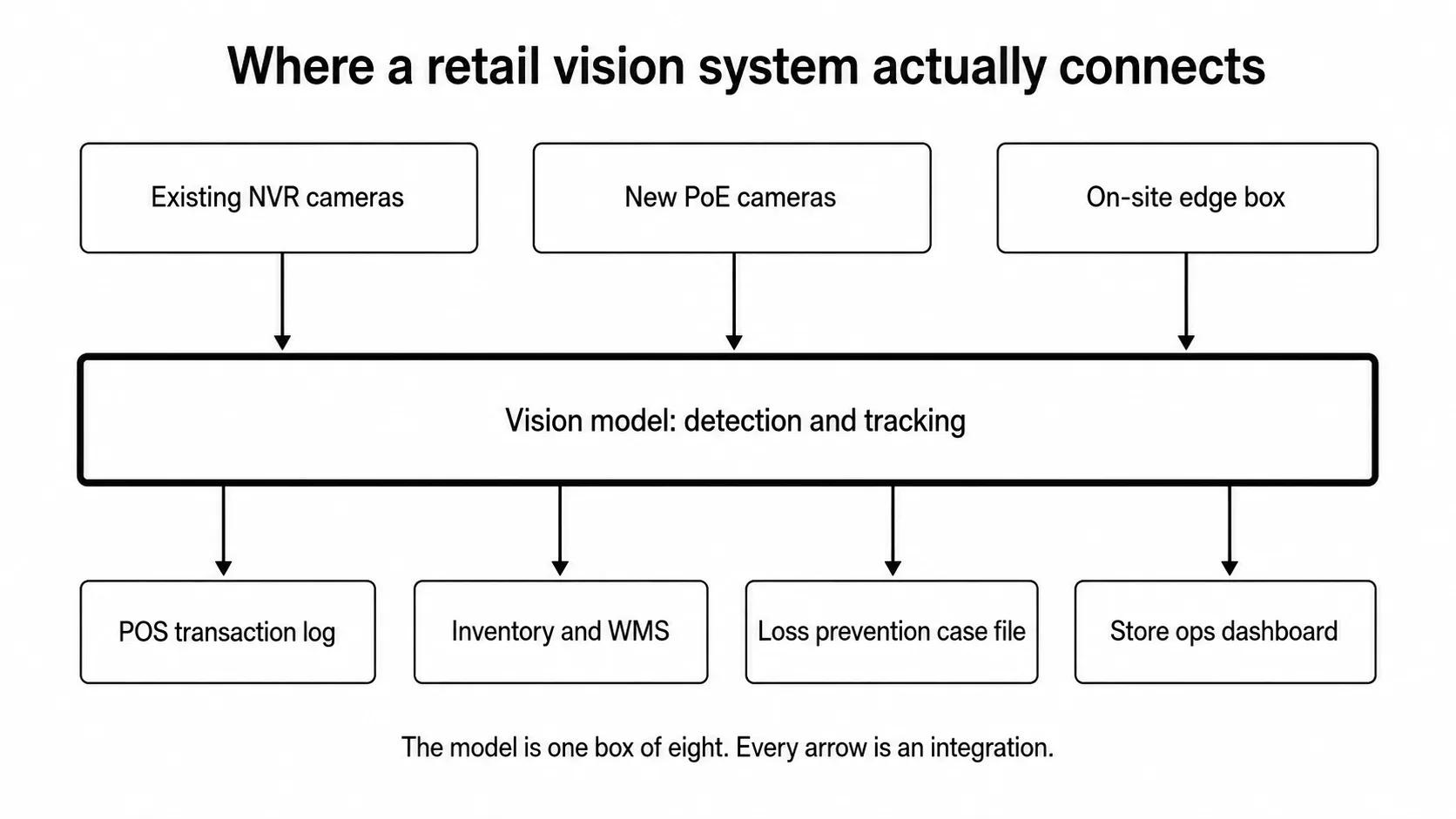
Every retail integration conversation starts the same way. You have cameras. You have had them for years. Surely the vision system can just use those.
Sometimes. The honest test has three parts. Can you get the stream off the recorder in a format something else can read, usually RTSP rather than a proprietary client. Is the camera pointed at the thing you want measured, which for most legacy security installs it is not, because those cameras were aimed at doors and registers for evidence, not at shelves for counting. And is the resolution and frame rate enough at the distance involved.
Most sites end up mixed. Some existing feeds get reused for coarse work like queue length or zone occupancy. The specific measurement you actually care about, shelf gaps or self-checkout mis-scans, usually needs a camera placed for that job. Budget for a partial re-camera rather than being surprised by one in week three.
This is the one architectural choice that changes the cost line, and it has a boring deciding factor: how much video you would be shipping and what your stores' uplinks actually are.
Continuous 1080p streaming from a handful of cameras per store, across a few hundred stores, is a real network bill and a real dependency on connectivity that retail sites do not reliably have. Running inference on a small box in the stockroom and sending only events, a JSON payload saying what happened and when, collapses that to almost nothing. The tradeoff is hardware you now own and have to update in every store.
Cloud makes sense when you have few sites, good connectivity, or a model you expect to retrain often. Edge makes sense at fleet scale and when the site has to keep working with the WAN down. We have built both. The mistake is picking one because it sounds modern and discovering the constraint afterwards.
Here is the part that gets skipped in vendor decks. A detection is not an outcome. Something has to receive it.
Shrink detection has to land in whatever your loss prevention team already works out of, as a case with the clip attached, not as an email. Out-of-stock detection has to reach the inventory system or a task on the store associate's handheld, or nobody restocks the shelf. Self-checkout interventions have to reach the attendant's screen within seconds, which is a latency requirement that changes your architecture, not a nice-to-have.
Write those destinations down before you scope. Each one is an integration with its own auth, its own rate limits, and its own owner who has to agree to it. That list, more than the model, is what sets the timeline.
The industry 4.0 framing that shows up around retail vision is not marketing. It is the observation that the pattern is identical to what manufacturing already did. Sensors produce events, events land in a system of record, humans act on exceptions rather than on raw data.
Retail's version is just newer and has worse network conditions. If you have looked at factory-floor vision, the visual inspection walkthrough we published applies almost line for line, including the finding that gets underrated most: lighting changes accuracy more than model choice does. In a store that means the aisle under the skylight behaves differently at 9am and 4pm, and a model validated at one of those times will look broken at the other.
Our fixed-price bands are public, and vision projects sit across them the same way agent projects do. A single-purpose deployment, one detection job, one destination system, runs $4,000 to $10,000 over three to four weeks. A multi-step workflow, several detections feeding several systems with review steps in between, runs $10,000 to $22,000 over five to seven weeks. A fleet platform with per-store edge boxes and an ops console runs $22,000 to $30,000 and up, delivered in phases over eight to twelve weeks.
Inference cost surprises people in the opposite direction. Running production models typically costs us $50 to $2,000 a month, and careful engineering, batching frames, dropping redundant ones, routing only ambiguous frames to a bigger model, cuts that three to ten times. The recurring bill is rarely what makes or breaks a retail vision case. The integration labor and the camera hardware are.
If you want the return side of that arithmetic rather than the cost side, we wrote the retail vision ROI worksheet as a companion to this.
The recurring pattern in our client conversations, and the reason we are blunt about this, is a demo that impressed a room and then fell apart on real data. Vision is the worst offender because video demos are so persuasive.
A pilot that runs for two weeks in one store, in one season, on one planogram, has told you very little. Shelves get reset. Seasonal displays block camera angles. Staff move a fixture. The holiday crowd changes what the tracking sees. Moving a vision system from 90% to 99% reliability is where the actual engineering lives, and that work only starts once the system has seen a store change under it.
Run the pilot long enough to catch one reset, and instrument it so you can tell a model failure from a camera someone bumped. We cover the accuracy question in more depth in our custom computer vision guide.
Some retail vision cases should not be built. If the measurement you want does not connect to a decision anybody would change, you are buying a dashboard. If the site has no reliable network and no room for an edge box, you are buying an outage. If the store's process depends on an associate acting within a minute and there is no associate on the floor at that hour, the detection is theater.
We take on two engagements per quarter, which forces us to say this out loud rather than take the work. It is a better conversation to have in scoping than in month three.
Partly, usually. Reuse works for coarse measurements like occupancy and queue length if you can pull an RTSP stream and the angle happens to suit. Shelf-level and checkout-level measurement almost always needs cameras placed for that specific job, because security cameras were aimed for evidence, not for counting.
Three to four weeks for a single detection feeding one system. Five to seven weeks for a multi-step workflow. Eight to twelve weeks, phased, for a multi-store platform with edge hardware. The variable that moves the timeline most is how many destination systems have to be integrated, not how hard the detection is.
Decide it on bandwidth and site reliability. At fleet scale, or anywhere the store must keep working with the WAN down, run inference on site and ship events. With a handful of sites, good connectivity, or frequent retraining, cloud is simpler and cheaper to operate.
Treat them as a different project that happens to share cameras. Loss prevention has its own case management workflow, its own evidence retention rules, and its own review process. Bolting shrink detection onto a shelf-availability project usually means neither one gets the workflow it needs.
Often better. Warehouse lighting is consistent, layouts change less, and the measurements, count accuracy and receiving discrepancies, tie directly to a number finance already tracks. Several retailers we have scoped had a stronger warehouse case than store case and had not looked at it.
Written by the Codestreaks team, edited by Arsalan Amin. The cost bands, timelines, inference figures and project count are our own current numbers, not industry estimates. The lighting and pilot-reliability observations come from our own computer vision deployments, including the inspection work published on 2026-08-28. Drafting is AI-assisted and every draft gets a human editing pass against measured data before it ships. The diagram is original, drawn for this post.
If you are weighing a retail vision deployment, the useful next step is a free 30-minute scoping call where we map your destination systems and your camera reality before anyone quotes a model. We reply within two business days. See what we build on the computer vision development page, or send us the outline at start a project.
A serial maker of SaaS products and AI agents, I’ve built and launched 10+ tools, grown products to thousands of users, and taken multiple ventures. I share the process what works, what breaks, and how builders can ship faster and smarter. Previously a data scientist at a Big Four consulting firm.


