

Retail computer vision ROI reduces to three recoveries you already track: shrink, redeployed labor, and out-of-stock sales. The worksheet turns them into a payback date.


Somewhere on your desk is a vendor deck promising that computer vision will cut shrink by 30%, and somewhere above you is a person who will ask one question about it: what do we get back, and when. That question has a real answer. It is just not in the deck, because the honest ROI calculation for computer vision in retail depends on three numbers only you have, and most retailers walk into pilots without writing any of them down first.
We build computer vision systems for a living, over 30 production projects delivered since 2024, and the pattern we see in retail conversations is consistent. The technology question (can a camera detect this) is usually settled in the first call. The ROI question is where projects live or die, and it deserves the same rigor you would apply to any other capital decision.
Every credible return case we have scoped in retail reduces to some mix of three recoveries:
Shrink recovered. The National Retail Federation's most recent security survey put average shrink at 1.6% of sales. If a store does $10M a year, that is $160,000 walking out annually. A vision system watching self-checkout mis-scans or receiving discrepancies does not recover all of it. A defensible pilot assumption is a slice of one named shrink category, at one named location, measured against last year's count.
Labor hours redeployed. Shelf-scanning, count verification, and receiving checks are hours someone is paid for today. If an associate spends 90 minutes a day walking planograms and a camera does the same sweep continuously, that is roughly 550 hours a year per store you can point somewhere better. You know your loaded hourly cost. Multiply.
Availability sales recovered. Out-of-stocks are the quiet one. IHL Group has estimated out-of-stocks cost retailers over $1 trillion globally, but the global number is useless for your calculation. The usable version: your own on-shelf availability percentage, times the sales value of the gap, times the fraction a faster restock alert can realistically close. If you do not currently measure on-shelf availability, that is the first finding of the ROI exercise, before any camera is installed.
Add the three recoveries, subtract build and running cost, and you have a payback period you can defend in a budget meeting. Notice that every input is a number your existing systems either already track or should.
The most common failure we see in retail AI vision pilots is not technical. It is that nobody wrote down the baseline. A pilot that starts without last quarter's shrink number for that store, or last month's measured on-shelf availability, ends in an argument about whether it worked.
This is an opinion we hold across every project type, not just retail: a system without an evaluation baseline is a liability with a dashboard. Pick the one metric the deployment is supposed to move, record twelve weeks of it before go-live, and agree in writing on what number at week twelve after go-live counts as success. Computer vision retail metrics worth anchoring to, in rough order of how cleanly they attribute:
Industry 4.0 language shows up in a lot of retail vision proposals. Strip it out. A camera that tells a person to restock aisle seven is not a fourth industrial revolution. It is a measurable workflow change, which is better, because measurable things get renewed budgets.
Here is the cost side with real figures, because ROI math with a fuzzy denominator is theater. These are our current fixed-price bands, published, not estimated:
A single-purpose deployment, one camera zone, one detection task (say, flagging empty shelf facings in one aisle set, or counting pallets at one receiving door) runs $4,000 to $10,000 and takes three to four weeks. A multi-step system, several zones, alert routing into your existing tools, a review dashboard, runs $10,000 to $22,000 across five to seven weeks. A multi-site rollout with central reporting sits at $22,000 to $30,000 and up, phased over eight to twelve weeks, and it should be phased, because the second store always teaches you something the first one hid.
Running cost is the number vendor decks skip: typically $50 to $2,000 a month in inference and infrastructure depending on camera count and how much runs on edge hardware versus cloud. Good engineering (frame sampling, edge filtering, only escalating uncertain frames) sits you at the low end. We covered the same cost anatomy for factory settings in our visual inspection guide, and the economics transfer almost line for line to a stockroom.
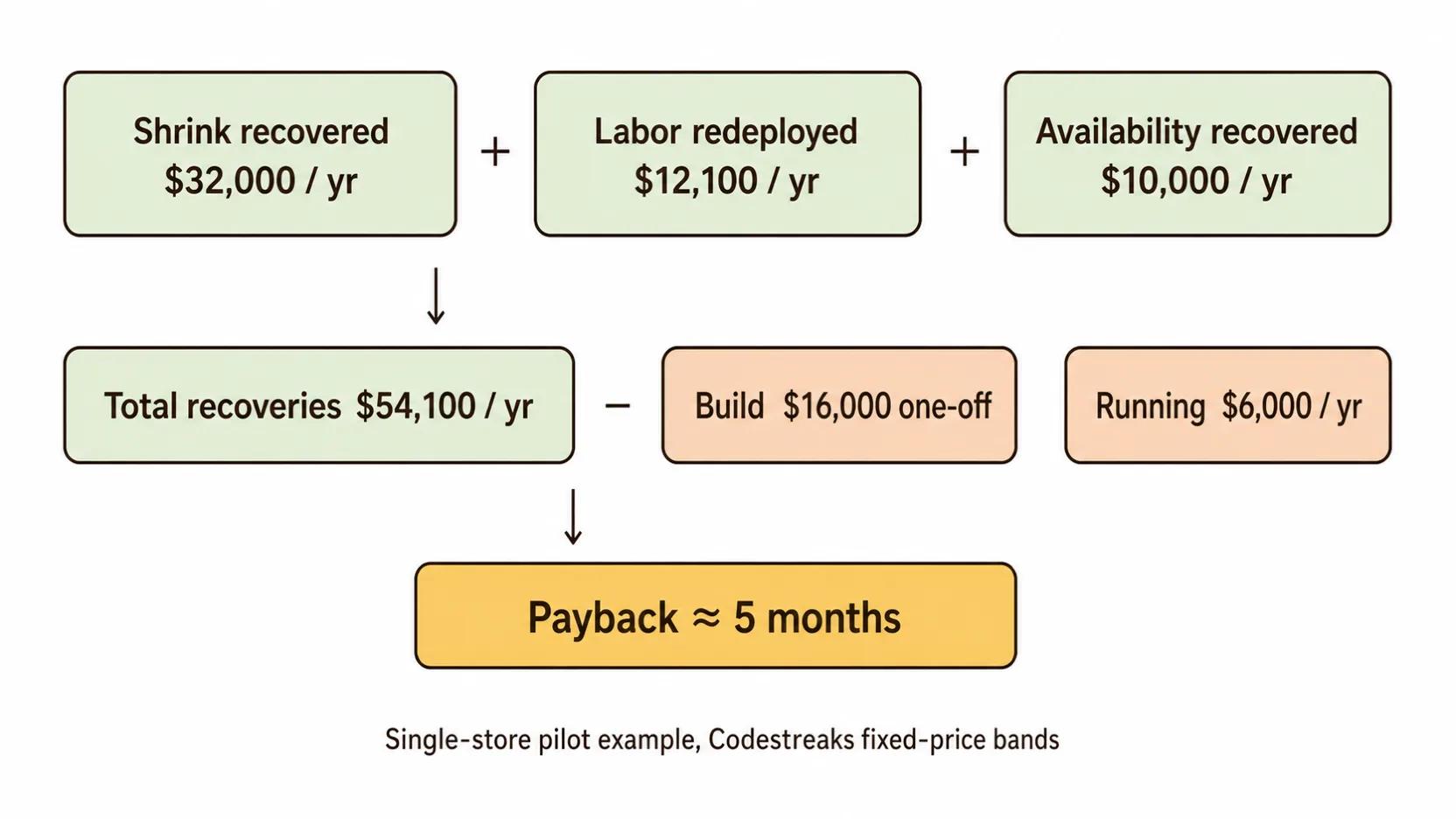
Worked example, one mid-size store: recover a fifth of a $160,000 shrink line ($32,000), redeploy 550 shelf-walking hours at a $22 loaded rate ($12,100), close a quarter of a $40,000 availability gap ($10,000). That is $54,100 a year against, say, a $16,000 build and $6,000 a year running. First-year return just under 2.5x, payback around five months. Your numbers will differ. The point is the shape: every line came from somewhere auditable.
"Retail vision" gets sold as one thing, but computer vision retail security systems and safety monitoring have different math and different failure costs. Loss prevention tolerates false positives poorly in one specific way: wrongly flagging a customer is a brand incident, not a statistics problem. So real deployments flag transactions and zones for human review rather than accusing anyone, and the ROI counts recovered inventory, never confrontations.
Safety monitoring (spill detection, blocked fire exits, ladder use in stockrooms) has the opposite profile. False positives cost an employee a wasted walk. False negatives cost an injury claim. The system can and should be tuned aggressively sensitive, and its return shows up in insurance and incident-rate lines that accumulate slowly. If a proposal blends security, safety, and operations into one ROI figure, ask for them separated. They will not move on the same timeline.
If you are choosing where to start, look behind the store. Computer vision in the warehouse and receiving dock tends to beat the sales floor on ROI for an unglamorous reason: the environment cooperates. Fixed lighting, repeatable camera angles, barcoded objects, no customers in frame, no privacy review. Receiving verification (does what came off the truck match the advance ship notice) is a bounded problem with a directly measurable discrepancy rate.
The same logic applies to ecommerce operations: pick-verification cameras at pack stations catch wrong-item ships before the label prints, and every catch is a returned-order cost you can price exactly. We wrote about why demo accuracy collapses in uncontrolled environments in our computer vision development guide, and the sales floor is precisely the uncontrolled environment that article warns about. Earn the sales-floor deployment with a warehouse win first.
Retail AI vision systems integration is where scoped ROI goes to die quietly. A detection with nobody to act on it recovers nothing. The alert has to land where work already happens: the task queue in your workforce app, the exception log in your POS back office, the receiving screen your dock team already stares at. Every recovery line in the worksheet above assumes a human closes the loop, so the integration is not an add-on to the vision system. It is the half of the system that produces the return.
This is also the honest argument against buying a sealed platform when your stack is even slightly unusual. We took the same position for retail software generally in our custom retail software piece: the platform is fine until the integration you need is the one it does not have. Ask any vision vendor two questions: which of my existing systems does the alert land in, and who at my company can modify that when the workflow changes. If the answer to the second is "nobody, you file a ticket", price that into the running cost.
Run the worksheet and sometimes the answer is genuinely no, and it is worth saying what that looks like. Single site doing under $2M a year, shrink already below 1%, no measured availability gap: the recoveries land under $15,000 a year, and even a lean build takes two-plus years to pay back while the workflow-change cost stays constant. In that case, do not buy computer vision. Fix the two boring process gaps the exercise exposed, and revisit when the store count grows. We turn down work on this basis and it is the cheapest advice in this article.
For a scoped single-store pilot against a measured baseline, the cases we consider fundable pay back inside 6 to 18 months. Shorter claims usually mean the baseline was soft. If the worksheet says three-plus years, the site or the use case is wrong, not the technology.
Sometimes, and it is the right first question because it can remove most of the hardware line. The honest constraints: mounting height and angle chosen for wide coverage often will not resolve shelf-level or item-level detail, and older DVR systems may not expose usable streams. A one-day feasibility check against recorded footage from your actual cameras settles it before any money moves.
No, and loss prevention is often not even the strongest case. Availability monitoring, receiving verification, and pack-station checks frequently produce cleaner returns because they measure processes instead of policing people, which also makes them easier to deploy without privacy review friction.
One primary metric with a twelve-week pre-launch baseline: shrink rate for a category, on-shelf availability for monitored aisles, or receiving discrepancy rate. Plus two health metrics on the system itself: false positive rate per week and median time from alert to human action. If alerts are ignored, the ROI is zero regardless of model accuracy.
Ours typically run $50 to $2,000 a month depending on camera count and edge versus cloud split. Frame sampling and edge filtering keep most single-store deployments near the low end. Get the running cost in writing as a range tied to camera count, because it scales with the rollout while the build cost does not.
Written by the Codestreaks team, AI-assisted drafting with human editing. The cost and timeline figures are our current published fixed-price bands, the worked example uses those real bands against NRF and IHL industry baselines (labeled as such), and the deployment observations come from our own computer vision project work since 2024. We publish real capacity (two engagements a quarter) and real prices, and this article says no where the math says no.
If you have a shrink number, an availability gap, or a receiving discrepancy rate you suspect a camera could move, book a free 30-minute scoping call. We will run the worksheet above against your actual figures and tell you plainly if the math does not clear, we respond within two business days, and every engagement ships with 100% code ownership. Start at our computer vision development service page or start a project.
A serial maker of SaaS products and AI agents, I’ve built and launched 10+ tools, grown products to thousands of users, and taken multiple ventures. I share the process what works, what breaks, and how builders can ship faster and smarter. Previously a data scientist at a Big Four consulting firm.


