

Custom retail software development takes 4 to 8 weeks and $4,000 to $30,000. Which parts of a retail stack to build, and which to leave on Shopify or BigCommerce.
Codestreaks Team
Custom retail software development means building the parts of a retail operation a platform cannot handle: inventory synced across stores and channels, a POS that updates the website in real time, checkout logic for non-standard pricing, and loyalty built on real purchase data. With us, a build takes 4 to 8 weeks and $4,000 to $30,000, and most retailers should extend Shopify or BigCommerce rather than replace it.
Most retailers start on Shopify or BigCommerce because it is the right call. You get a checkout, a theme, a payment processor, and an inventory panel in an afternoon, and none of that is worth building from scratch while you're proving a business model. The question isn't whether the platform was right at launch. It's whether it's still right once you have a real catalog, a real store network, and customers who expect the site to behave the way your business actually runs.
That second question is where most retailers get stuck, because it doesn't announce itself as a crisis. It shows up as workarounds: a spreadsheet reconciling inventory across three physical locations because the platform's sync can't handle split stock. A manual export-import routine every morning because the loyalty program lives in a separate tool that doesn't talk to checkout. A developer on retainer just to keep apps from conflicting with each other. None of that looks urgent. It looks like Tuesday. And it's exactly the kind of thing that should trigger a real look at custom retail software development, not another app-store patch.
Treating platform-vs-custom as a single binary choice is where the confusion starts. A retailer doesn't need to rebuild everything to get value from custom development, and an agency pitching a full rip-and-replace when three specific workflows are broken is optimizing for its own invoice, not your business.
The useful question is narrower: which parts of your operation are genuinely differentiated, and which are commodity? Payment processing and standard checkout flows are commodity. Shopify and BigCommerce have spent a decade hardening those, and there's no version of you building it better in-house. But the moment your business does something the platform's designers never anticipated, custom checkout logic, inventory that has to sync across warehouses and POS terminals in near real time, a loyalty program tied to purchase history in ways built-in apps can't express, you're paying a recurring tax to keep forcing a generic tool into a specific shape. That tax doesn't show up on an invoice. It shows up in every hour someone spends reconciling numbers that shouldn't need reconciling.
We cover this same decision from the pure ecommerce build angle in our custom ecommerce development guide, which goes deeper on catalog and marketplace complexity. This piece is about the broader retail operation, physical and digital together, where the platform question extends past the storefront into POS, inventory, and loyalty.
Four things come up in nearly every custom retail engagement we've scoped, and they're rarely a surprise to the retailer asking. They already know these are the pain points; what they don't know is how to describe the fix.
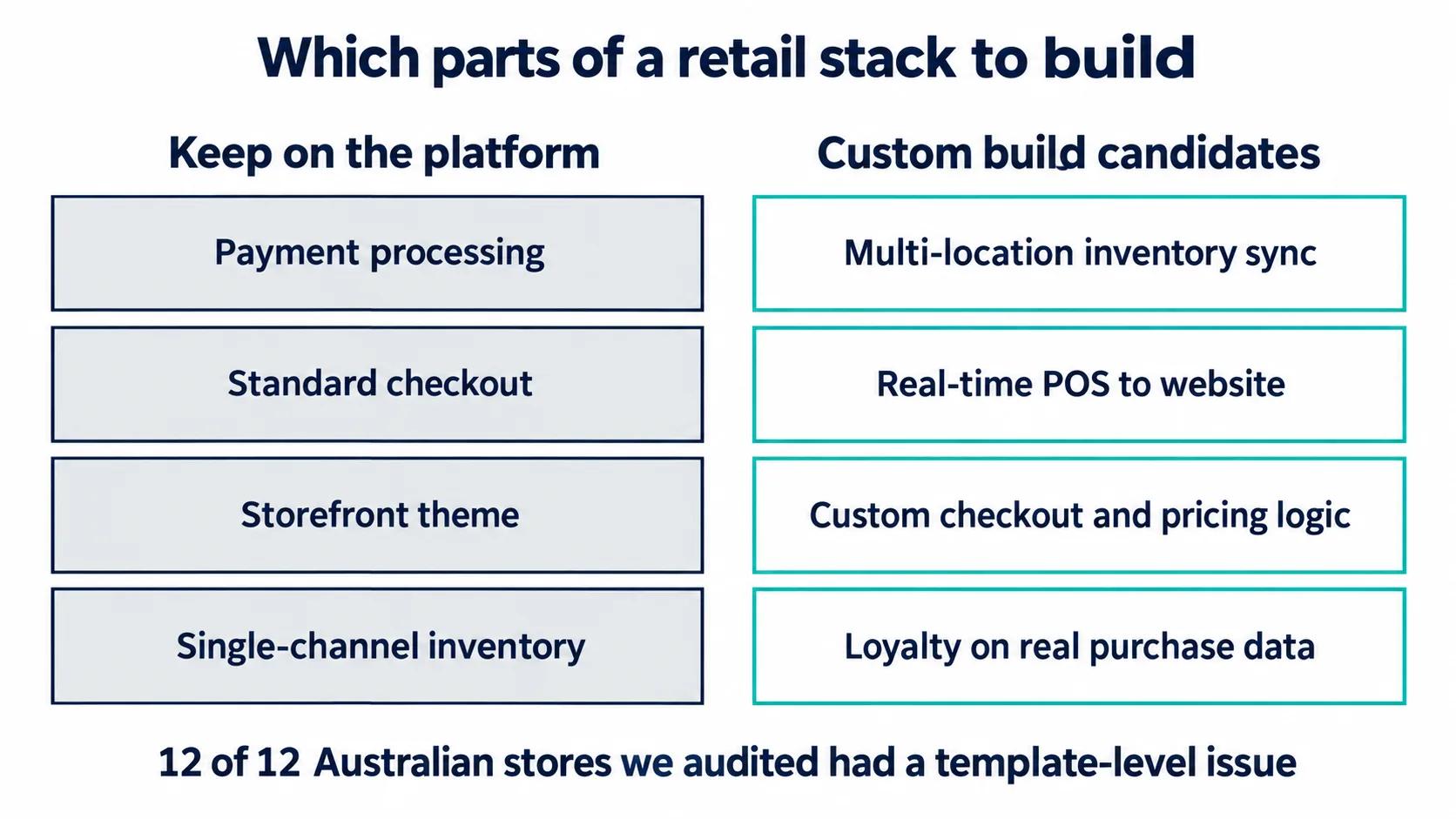
Inventory sync across channels. A retailer selling in a physical store, on a website, and maybe through a marketplace needs one source of truth for stock levels, not three that drift apart and get manually reconciled. Off-the-shelf platforms handle single-channel inventory well. Multi-location, multi-channel sync with real-time updates is where their native tooling runs out, and third-party apps that promise to fill the gap usually add another point of failure instead of removing one.
POS integration that actually shares data with the website. Plenty of retailers run a point-of-sale system in-store and an ecommerce platform online, connected by a nightly batch job or nothing at all. That's fine until a customer buys the last unit in-store at 2pm and the website still shows it in stock at 6pm. Custom integration means the systems talk continuously, not on a schedule.
Custom checkout logic. Bundled pricing, tiered wholesale discounts, subscription-plus-one-time-purchase combinations, region-specific tax and shipping rules that don't map onto a plugin's configuration options. Off-the-shelf checkout is built for the median store. If your pricing model isn't the median, you'll spend more time fighting the plugin's assumptions than you would have spent building the logic once, correctly.
Loyalty and retention systems that use real purchase data. Most platform loyalty apps are point-and-badge systems bolted onto checkout. A loyalty program that actually changes behavior needs access to real purchase history, segment logic, and often a direct tie into email or SMS retention flows, exactly what a generic app marketplace wasn't built to offer.
This is the kind of work our team scopes as part of our retail and ecommerce web development. Worth saying plainly: retail software development services that only touch the storefront theme aren't solving the problem above. The theme was never the bottleneck.
Here's the proof, not a reasoned guess. We ran ecommerce audits on 12 Australian retailers in a single month, mostly Shopify with a couple of Magento stores, and every single one had a template-level issue. Not a one-off bug a support ticket would fix, but a problem baked into the store's underlying template or platform choice itself, touching every product or category page the same way because the constraint was structural, not incidental.
That's the pattern worth paying attention to. A one-off bug costs an hour to fix. A template-level constraint costs that same hour, multiplied by every SKU, every category, every region variant in your catalog, until someone rebuilds the piece that's actually broken. The specific failure mode varied store to store: discount logic that broke on an edge case nobody had tested, inventory sync that drifted from the storefront by hours instead of updating on change, checkout flows that assumed a cart shape the platform never actually guaranteed. What was consistent across all 12 was where the failure lived: baked into the template or platform choice, not a line of code anyone could patch in an afternoon. Twelve for twelve isn't a coincidence. It's what happens when a store's core logic is built entirely on top of someone else's assumptions about how retail works.
This is the concrete evidence for the platform-vs-custom argument: these weren't isolated incidents you could patch and move past. They were compounding, catalog-wide constraints that only a structural fix, custom development on the specific broken piece, could resolve. If you're auditing your own store, look for exactly this pattern. A bug that appears once is a bug. A bug that appears on every product page is your platform telling you something about itself.
Prototypes lie. A demo checkout that works cleanly on ten hand-picked products tells you nothing about whether it holds up across five thousand real SKUs with edge cases: bundles, backorders, regional tax rules, split shipments. We've watched this pattern play out with clients across categories, not just retail: a team arrives with something that impressed everyone in a demo meeting and falls apart the first week it touches real production data. Most of the actual engineering work on any build is reliability engineering: making the thing that worked on ten examples also work on the ten thousandth. It's rarely the flashy part, and it's almost always the part that determines whether launch goes well.
The underestimation usually happens at scoping, before a line of code gets written. A retailer finds an app that claims to solve their loyalty problem, installs it, and learns three months later it can't segment customers the way their retention strategy needs. Or they hire a developer to "just add" custom checkout logic without checking whether that checkout is even extensible in the way the request assumes. Shopify's checkout, for instance, is famously locked down outside of Shopify Plus, and even there the flexibility has real limits. Finding that out after signing a contract is an expensive way to learn it.
Typical custom retail engagements run four to eight weeks from kickoff to live deployment, landing between $4,000 and $30,000: a single integration at the lower end, a multi-system rebuild touching POS, inventory, and loyalty at the higher end. Neither number is a universal quote. It's meant to set expectations before a plugin fight that was never going to resolve itself.
If you're evaluating a platform migration alongside the custom question, our BigCommerce web development guide covers a closely related version: what a platform genuinely handles out of the box versus what still needs a custom layer on top, even after you've picked the right platform.
Ask three questions before committing either direction. First: is the workflow something every retailer in your category needs, or is it specific to how your business operates? Generic workflows belong on the platform. Specific ones are custom candidates. Second: is the current workaround a one-time cost or a recurring one? A reconciliation you do once during a busy season is annoying but survivable. One you do daily is a standing tax on your team's time, and it compounds the way the template-level issues in our audit did. Third: does fixing this on the platform mean stacking another third-party app on the ones you already have, and how many points of failure does that add? Every app is a dependency you don't control, on a roadmap you don't influence.
If the honest answers land on "specific to us," "recurring," and "another app to stack," that's a real signal to scope a custom build for that piece, not the whole storefront.
Written by the Codestreaks team, drafted with AI assistance and edited by a human for accuracy and voice. The audit finding, 12 Australian ecommerce stores checked in one month with all 12 carrying a template-level issue, came from client audit work we ran ourselves, not from an industry report. The price range and timeline are our published engagement terms. The diagram is ours.
Look for recurring workarounds, not one-time annoyances. If your team repeats the same manual reconciliation or double-entry task every week because two systems don't talk to each other, that's a signal the platform's default behavior doesn't match how your business runs. A one-off bug is a bug. A workaround you repeat weekly is a structural gap worth scoping for custom development.
Yes, and for most retailers that's the right first move rather than a full replatform. Custom checkout logic, inventory sync, and loyalty integrations can often be built as extensions that sit alongside your existing platform instead of replacing it. Full replatforming only makes sense when the platform's core architecture, not just a missing feature, is the actual constraint.
Engagements we scope generally run $4,000 to $30,000 depending on complexity. A single checkout or inventory-sync fix sits at the lower end. A multi-system build connecting POS, inventory, and loyalty across several channels sits at the higher end, with timelines of four to eight weeks from kickoff to live deployment.
For a well-scoped single integration, four to six weeks is typical, from technical discovery through testing on real inventory data to live deployment. Multi-location sync projects with more edge cases (backorders, split shipments, regional stock rules) tend to run closer to seven or eight weeks.
Assuming an app marketplace can fully solve a problem that's actually structural. Retailers install an app, discover months later it can't do what they needed (usually segmentation, real-time sync, or checkout logic), and end up paying for both the failed subscription and the custom fix they needed from the start. Scoping the real requirement before shopping for a plugin saves that wasted cycle.
If you're weighing a custom build against another round of platform patches, we offer a free 30-minute scoping call and respond within two business days. Start a project directly, or check our web development services page for the kind of work we typically take on.


