

Ecommerce support agents fail on split shipments, returns judgment and peak-season rate limits. What to test before you buy, and when a custom build wins.


If you are searching for the best AI agents for ecommerce support, you will find a dozen comparison pages ranking the same five vendors. We keep one of those ourselves. What none of them tell you is the thing that actually decides whether the agent works in your store: an ecommerce support agent is only as good as the systems it can reach, and most of them break on the same five questions.
We build support agents for a living, over 30 production projects delivered since 2024, and the pattern in ecommerce is specific enough to be worth writing down. The vendor choice matters less than people expect. The integration surface matters far more.
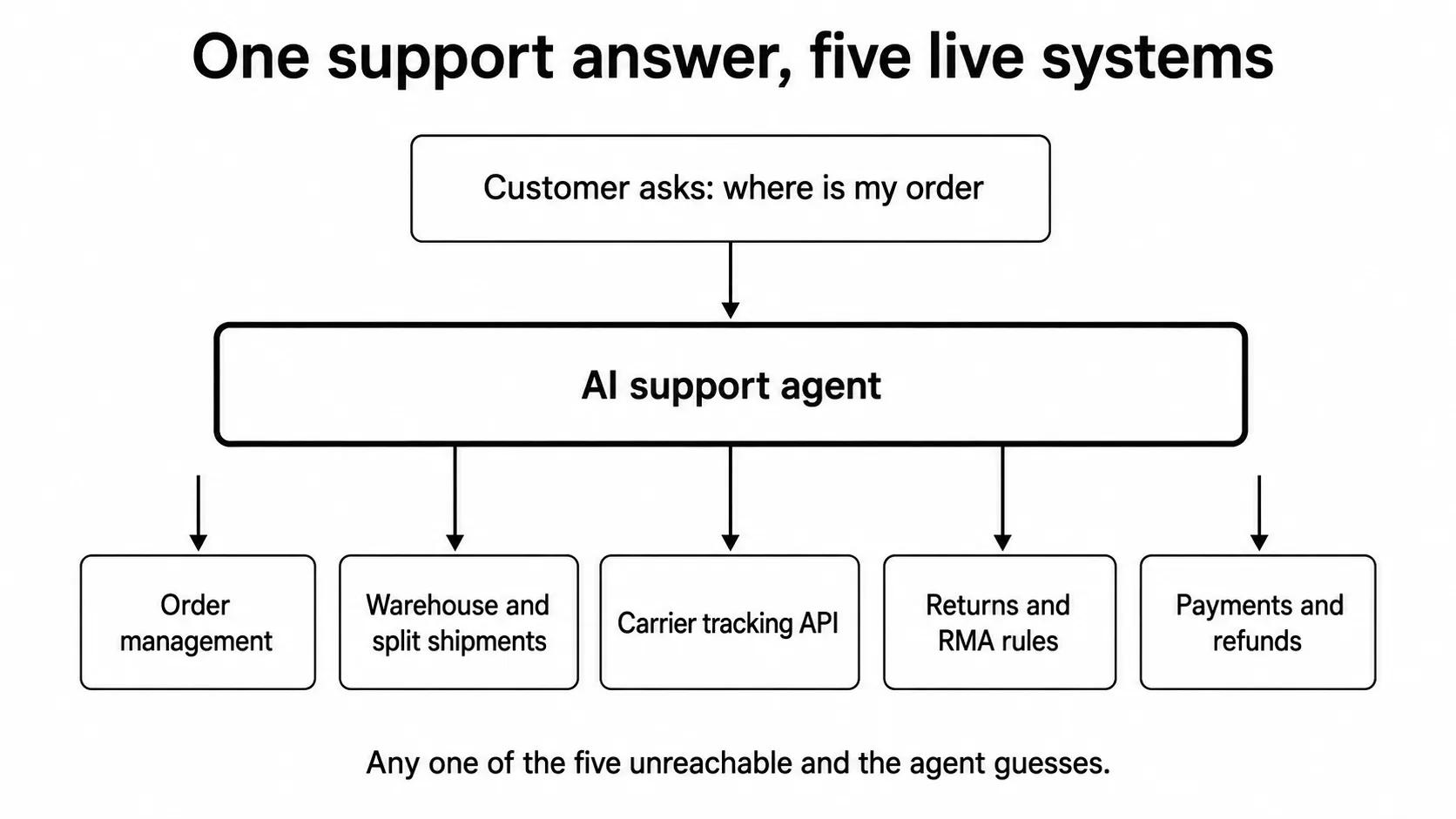
The single highest-volume ticket in ecommerce looks trivial and is not. Answering it properly means the agent knows the order exists, knows whether it shipped, knows whether it shipped in one box or three from two warehouses, knows what the carrier's last scan says, and knows your policy on what to tell someone when the carrier scan is four days stale.
Miss any of those and you get an agent that confidently says "your order is on its way" to a customer whose second parcel was never picked. That is worse than no agent, because the customer now has a written answer to argue with.
Split shipments are the specific trap. Plenty of agents are wired to order management and stop there, and order management often reports a single status for what is physically several packages. If you sell anything that ships from more than one location, test that case before you sign anything.
The second-biggest ticket category is returns, and it is where the build-versus-buy question gets decided.
Order status is a lookup. Returns are a judgment: is this within the window, is this category returnable, was it on final sale, who pays the shipping, does this customer's return rate trip your abuse threshold. Those rules live in your head, in a Notion page, and in three exceptions your senior support person applies from memory.
An off-the-shelf agent will happily be given a policy document and will answer from it. It will also answer from it in the cases you did not think about, and it has no idea which of its answers are the expensive ones. This is where we tell clients to draw the automation line: let the agent resolve the clean cases and hand off the judgment cases with the context already gathered. We wrote about where that line sits generally in our guide to what to automate first in customer service.
Every ecommerce support agent looks fine in March. The interesting question is what it does when November volume arrives with the carrier delays that come with it.
Three things go wrong at once. Ticket volume multiplies. The proportion of hard tickets rises, because delayed shipments generate the tickets an agent handles worst. And your order management API, which was comfortable at normal load, starts rate limiting you exactly when you are querying it most.
Design for that before you need it. Cache what is cacheable, degrade to a truthful "I cannot reach the carrier right now, here is what I do know" rather than to a guess, and make sure the handoff queue can absorb a spike. An agent that fails loudly and hands off is a working system. An agent that fails quietly and invents a delivery date is a liability with a chat interface.
Two different numbers, and people conflate them.
Running inference on a production support agent typically costs us $50 to $2,000 a month depending on volume and how much context each answer needs. Engineering moves that a lot. Caching common lookups, routing simple intents to a small model and only escalating ambiguous ones, and trimming the prompt down to what the answer actually requires will usually cut the bill three to ten times. Teams that never do this pay for their laziness monthly, forever.
Building it is a fixed price with us. A single-purpose agent, order status and tracking against one system, is $4,000 to $10,000 over three to four weeks. A multi-step workflow agent handling status, returns initiation and refund eligibility across several systems is $10,000 to $22,000 over five to seven weeks. A platform build with multi-brand routing, an agent console and full analytics runs $22,000 and up, phased over eight to twelve weeks. Every client gets 30 days of post-launch support and 100% code ownership, which for a support agent matters more than usual, because the policy rules inside it are your business logic.
Our ecommerce chatbot guide covers the pre-purchase side of this, which is a genuinely different build with different failure modes.
Ask a different one: what does the agent need to reach, and does the platform you are considering already reach it.
If your stack is Shopify plus a mainstream helpdesk plus a common 3PL, the packaged vendors are genuinely good and you should buy one. Gorgias, Intercom Fin, Zendesk and the newer resolution-focused platforms have that integration work done. Buying beats building whenever the integrations you need are already in the box.
Custom wins in narrower cases: a homegrown or heavily customised order system, returns rules with real complexity, a multi-brand or multi-region setup where one policy does not apply, or a requirement that the agent write into an internal tool nobody has built a connector for. That is most of what comes to us, and it is why we say so plainly rather than pretending every case needs a build. Our comparison of the main ecommerce support platforms exists for the other case.
The number every vendor quotes is deflection rate, and it is easy to inflate. A ticket the agent answered and the customer then re-opened is not deflected. A ticket the customer abandoned in frustration is not deflected either, it is churn with better reporting.
Measure three things instead: resolution without human touch, re-contact rate within 72 hours on those same conversations, and CSAT on agent-only threads compared with human-only threads. If the second number climbs while the first looks great, the agent is producing answers, not resolutions. That distinction is the whole game, and it is the reason we insist on an evaluation suite before launch rather than after. We go deeper on the human-in-the-loop side in our agent assist walkthrough.
If your stack is mainstream, Shopify or similar with a common helpdesk and 3PL, the packaged platforms are the right answer and the integrations are already built. Custom is worth it when the order system is homegrown, the returns policy has real judgment in it, or the agent needs to write into an internal tool no vendor connects to.
Issue refunds outside policy, make delivery promises the carrier data does not support, and handle anything touching a chargeback or a damaged-goods claim. Those need a human, and the agent's job is to arrive at that human with the context already collected.
Three to four weeks for order status and tracking against one system. Five to seven weeks once returns and refund eligibility are included. Longer builds are usually integration schedules, not model work.
In our experience it changes what the team does more than how many people are on it. The routine lookups go away and what remains is the harder half, which needs your more experienced people, not fewer of them. Teams that plan for a reallocation get a better result than teams that plan for a cut.
Replay real historical tickets against it, including the ugly ones you resolved by exception, and score the answers against what your team actually did. An agent with no evaluation suite is guesswork with a chat interface, and replaying your own ticket history is the cheapest suite you will ever build.
Written by the Codestreaks team, edited by Arsalan Amin. The price bands, timelines, project count and monthly inference figures are our own current numbers rather than industry estimates. The failure modes described here, split shipments, peak-season rate limiting and re-contact rate masking deflection, come from support agents we have built and operated. Drafting is AI-assisted and every draft gets a human editing pass against measured data before it ships. The diagram is original, drawn for this post.
If you are deciding between buying a platform and building one, a free 30-minute scoping call is the fastest way to find out which you need. We will map your integration surface and tell you honestly if an off-the-shelf agent covers it. We reply within two business days. See the AI customer support agent page, or outline your stack at start a project.
A serial maker of SaaS products and AI agents, I’ve built and launched 10+ tools, grown products to thousands of users, and taken multiple ventures. I share the process what works, what breaks, and how builders can ship faster and smarter. Previously a data scientist at a Big Four consulting firm.


