

A banking chatbot and a conversational AI assistant aren't the same build. Here's what actually changes when a bank moves from scripted flows to a real conversational layer.


Every bank we've scoped a conversational project for starts the call the same way: "we already have a chatbot, we want conversational AI." Those two things get used interchangeably in vendor decks and they are not the same build. A banking chatbot answers a fixed list of intents (balance, last transaction, branch hours) and fails politely outside that list. A conversational AI layer holds context across turns, pulls from account state, and hands off cleanly when it hits a wall. The gap between the two is most of the engineering.
Most "AI-powered" banking chat widgets you've used are intent classifiers wired to a decision tree. A customer types a question, the system matches it to one of 40-80 predefined intents, and returns a canned response or a deep link into the app. This works fine for the top of the funnel: checking a balance, finding a branch, resetting a password. It breaks the moment a customer asks something that mixes two intents ("why did my transfer to my savings account fail and can I redo it now") because the tree has no branch for that combination.
We've built both kinds. The scripted version ships in 3-4 weeks and covers 60-70% of real support volume immediately, cheaply. It's the right first build for a bank that has never had any self-service layer at all. We cover the general version of that same fast-first-build pattern in our AI customer service automation guide, which applies outside banking too.
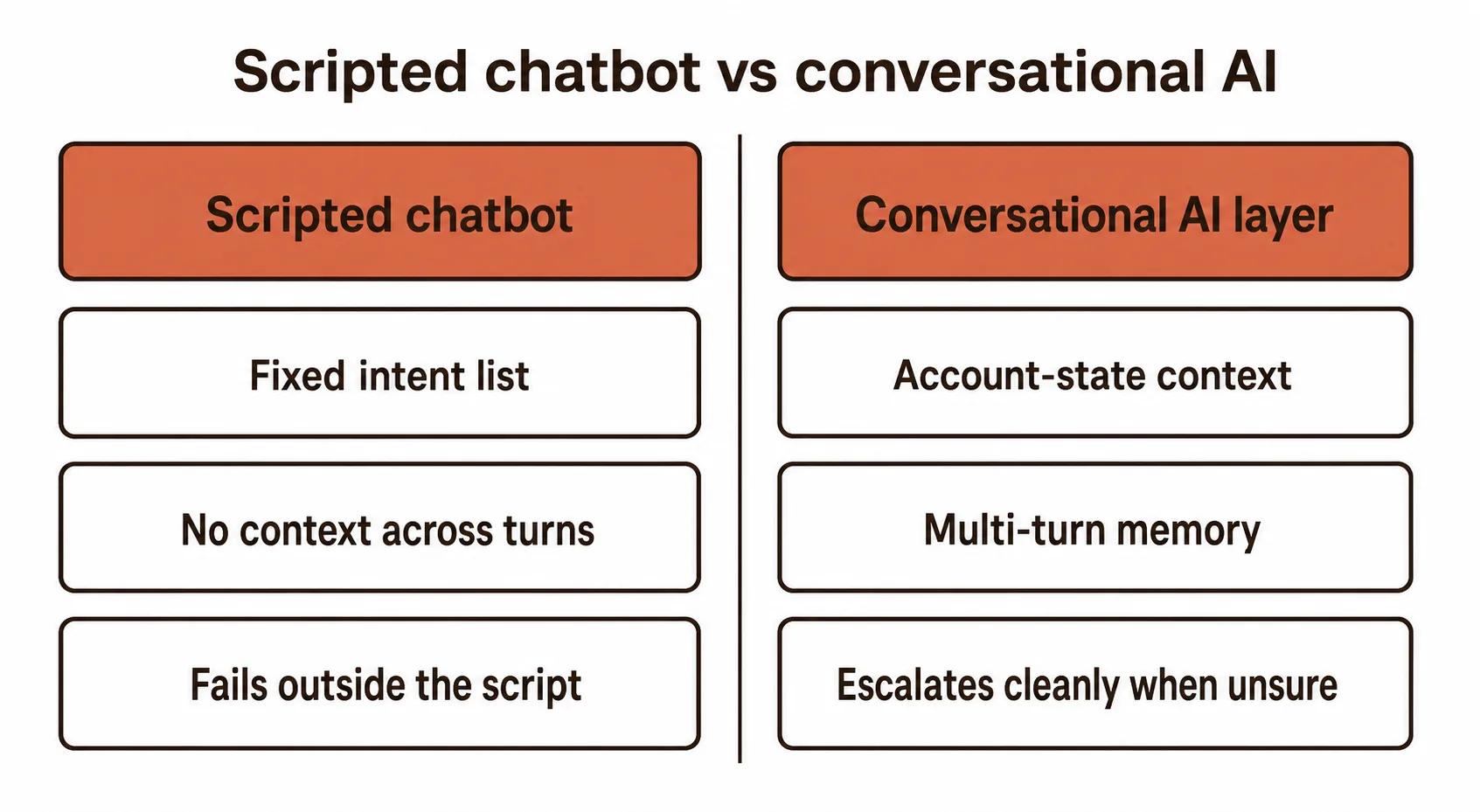
A conversational AI assistant keeps state across the conversation and can reason about account-specific context (recent transactions, current product holdings, KYC status) rather than matching keywords. Practically, that means:
That last point is where most banking conversational AI projects actually fail in production, not in the demo. A demo that handles five clean questions perfectly tells you nothing about the five thousand messy real ones a live account holder will send. Getting from a working demo to something a compliance team will sign off on is where the real engineering time goes: retrieval grounded in actual account data, guardrails on what the model is allowed to state as fact versus what it must confirm through a system call, and an escalation path that loses zero context when a human picks up.
Banking is one of the few verticals where "the model said something wrong" has real regulatory consequence, not just a bad review. Every conversational banking build we've scoped needs, at minimum: an audit log of every response tied to the account and timestamp, a hard block on the model stating balances or transaction details it hasn't verified through a live system call (never letting it "recall" a number from earlier in the conversation without re-checking), and a documented escalation trigger list reviewed by compliance before launch, not after. None of that shows up in a vendor's feature list. All of it shows up in the actual project timeline.
If you already have a working intent-based chatbot handling routine questions, you don't need to rip it out. The pattern we usually build is a router in front: simple, high-confidence intents stay on the fast scripted path, and anything ambiguous or multi-step gets handed to the conversational layer with full context carried over. That keeps your fast, cheap, reliable path for the 60-70% of volume that's genuinely simple, and reserves the more expensive conversational reasoning for the traffic that actually needs it. We cover the broader automation-versus-conversation tradeoff in our banking automation guide, and the mechanics of a bot handling structured back-office work rather than live conversation in our banking bot guide.
The number a vendor will show you in a demo is accuracy on a test set of clean questions. The number that predicts whether the project was worth doing is contained resolution: the share of conversations that end without the customer needing a second contact (a follow-up chat, a call, a branch visit) within 48 hours. A conversational assistant that answers 95% of questions technically correctly but still leaves 30% of customers needing a human afterward, because the answer wasn't actually complete or actionable, isn't doing its job. We instrument every conversational build we ship against this number from week one, not after launch, because it's the only measurement that catches the gap between "the model responded" and "the customer's problem was actually solved."
The second number worth tracking, especially in a regulated environment, is escalation accuracy: of the conversations the system chose to hand off to a human, how many actually needed a human, versus how many it could have safely answered itself. Too many false escalations and the tool isn't saving anyone time. Too few, and it's the failure mode compliance actually worries about, the system answering something it shouldn't have. Getting that balance right takes real usage data, not a pre-launch test set, which is why we build in a monitored ramp period before a conversational assistant handles unsupervised traffic at full volume.
No. A chatbot in most banking apps today is an intent classifier matched to a fixed decision tree; it handles a known list of questions well and fails outside it. Conversational AI holds context across turns and can reason about account-specific state, at meaningfully higher build and maintenance cost.
Only if it's architected to verify every number through a live system call rather than stating anything from memory or inference. That constraint has to be built in from day one, not patched on after a demo.
A scripted chatbot covering common intents typically ships in 3-4 weeks. A full conversational layer with compliance-reviewed escalation and audit logging runs closer to 6-10 weeks, depending on how many systems it needs to call into.
It absorbs routine volume so human staff spend their time on cases that need judgment, not repetitive lookups. Every build we've shipped keeps a clean, fast human handoff for anything the system isn't confident about.
The model stating something as fact that it hasn't verified. Every guardrail in the system exists to prevent that one failure mode, because in banking it's the one that turns into a real complaint or a regulatory finding.
Written by the Codestreaks team, drafted with AI assistance and edited by a human against our own build history: the intent-classifier-versus-conversational-layer distinction, the 60-70% routine-volume figure, and the compliance guardrail list all come from banking and fintech conversational projects we've scoped and shipped, not industry benchmarks. No client names are used in this post because the engagements involved are under NDA.
Ready to see where a conversational layer fits your existing support stack? Book a free 30-minute scoping call or read more about our AI agent development work. Two business day response, no obligation.
A serial maker of SaaS products and AI agents, I’ve built and launched 10+ tools, grown products to thousands of users, and taken multiple ventures. I share the process what works, what breaks, and how builders can ship faster and smarter. Previously a data scientist at a Big Four consulting firm.


