

CRM and CEM aren't competing categories, they answer different questions. Here's what each actually tracks, and where an AI layer belongs in each.


We get asked to "add CEM to the CRM" more often than the two terms actually get used correctly. A CRM (customer relationship management) system tracks a record: who the customer is, what they bought, what was said in the last support ticket, what's owed. A CEM (customer experience management) system tracks a pattern: how the customer feels across every interaction, whether friction is trending up or down, and where in the journey people quietly give up. One is a database of facts. The other is a measurement system for something that doesn't have a single source of truth. Confusing the two is how a company ends up with a CRM full of clean data and zero idea why churn is rising.
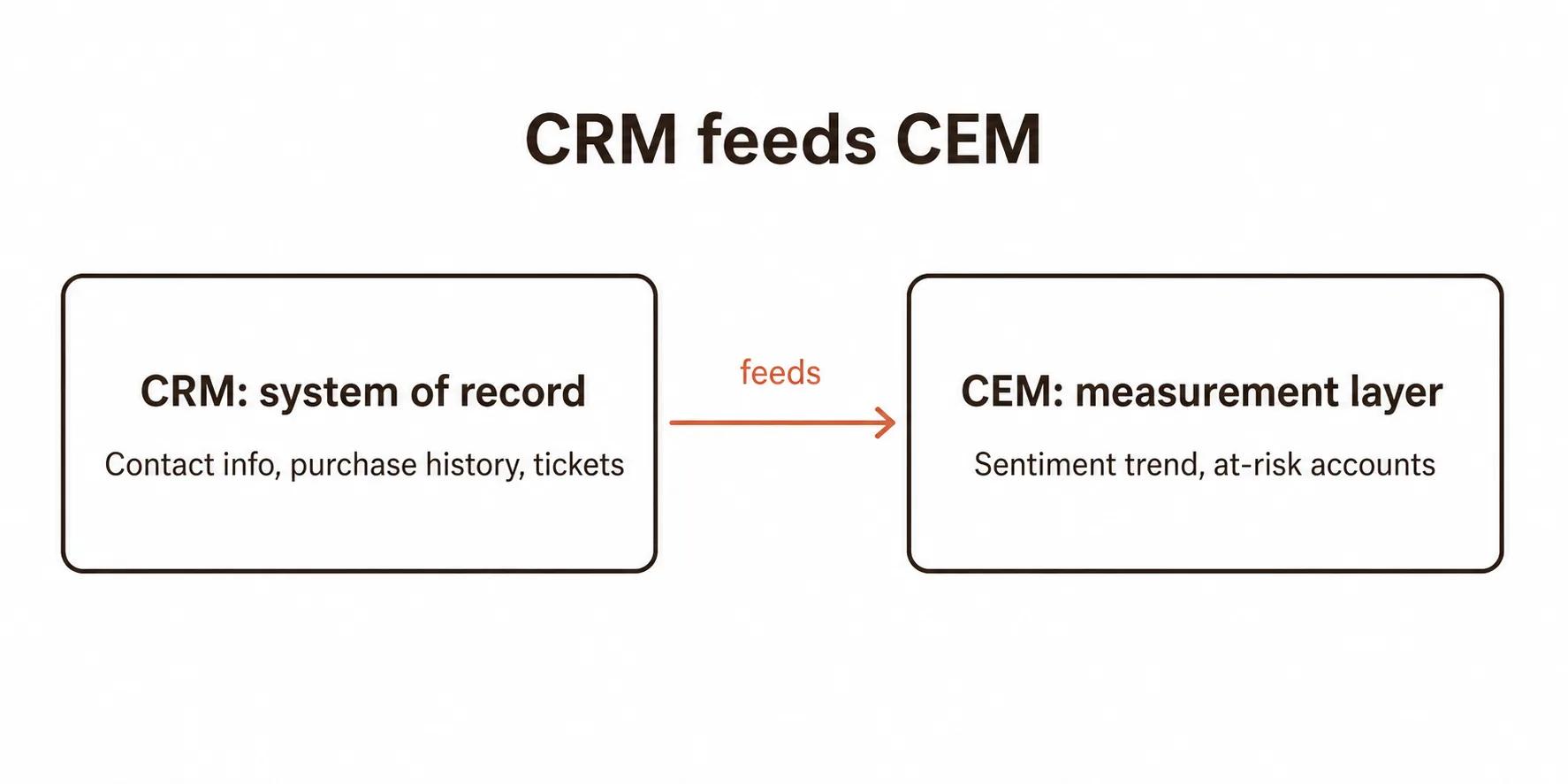
A CRM answers "what happened with this specific account." It's transactional and record-based: contact info, purchase history, open tickets, notes from the last call. Salesforce, HubSpot, and most industry CRMs are built around this. It's the system of record, and every downstream system, including a good CEM layer, should be pulling from it rather than duplicating it.
What a CRM does not answer well: whether the customer is actually satisfied, whether this is their third frustrating support interaction this month, or whether the experience quality is trending toward a cancellation before the cancellation request comes in. That's a different measurement problem, and bolting a satisfaction score field onto a CRM record doesn't solve it. It just gives you one number with no context for why it moved.
CEM answers "how does this feel, across every touchpoint, and is it getting better or worse." It pulls signal from support transcripts, NPS and CSAT surveys, session replay, response time trends, and (increasingly) sentiment extracted from conversational interactions, then rolls it up into something a product or support team can act on before a customer churns, not after.
The useful CEM builds we've done aren't dashboards. A dashboard tells someone a number went down. What actually changes an outcome is a system that flags the specific accounts trending toward a bad experience while there's still time to intervene, with the underlying reason attached (three slow response times in a row, a repeated unresolved issue, a sentiment shift in the last two support tickets), not just a red indicator with no context.
Why the trend line matters more than the snapshot: Forrester's 2026 US CX Index (published August 2026) recorded the first year-over-year rise in experience quality since 2021, after four straight years of decline, and the emotion dimension moved most, up 1.4 points. A CRM field holding last quarter's CSAT would not show that turn. A CEM pipeline that tracks sentiment per account would, and emotion is exactly the signal a CRM record has no column for.
In a CRM, AI mostly helps with data quality and retrieval: summarizing a long ticket history into three sentences before a rep picks up the call, or surfacing the one prior interaction that's actually relevant instead of making a rep scroll a full history. That's a real time saver and a modest build.
In CEM, AI does something structurally different: it turns unstructured signal (call transcripts, free-text survey responses, chat logs) into a measurable trend, which is otherwise nearly impossible to do at scale by hand. Extracting sentiment and specific friction causes from thousands of support transcripts a month is not a job a human team can do consistently. That's the actual case for building or buying a CEM layer rather than just adding more fields to the CRM.
The most common mistake is treating CEM as a reporting layer on top of the CRM rather than its own measurement system with its own data pipeline. A CSAT score sitting as a field on a CRM contact record tells you the last score. It doesn't tell you the trend, the cause, or which accounts need attention this week. If experience quality actually matters to the business (churn-sensitive, high-ACV, or support-heavy products), it earns a dedicated pipeline, not a bolt-on field. We cover a closely related build, extracting structured signal from raw call data, in our AI conversation intelligence guide, and the upstream signal that often feeds a CEM at-risk flag, whether a customer is showing intent to churn or expand, in our buying signals guide.
The builds that hold up in production have a consistent shape: raw signal comes in from every touchpoint (support tickets, call transcripts, survey responses, in some cases product usage events), gets classified into a small, consistent set of categories a human reviewer actually agrees with, and rolls up per account into a trend line, not a single snapshot score. The classification step is where most CEM projects either work or quietly produce garbage. If the categories are too broad ("positive," "negative," "neutral"), the trend is too coarse to act on. If they're too granular without validation against real human judgment, the model drifts into inconsistent labeling that looks precise and isn't.
We validate every classification layer against a sample a human has independently scored before it goes into production, and we re-check that agreement rate periodically, not just at launch. A CEM system that was accurate at launch and silently drifted six months later is worse than no system at all, because the team keeps trusting a number that's no longer measuring what they think it's measuring.
No. CEM should read from the CRM as its system of record for account and interaction data, then add its own measurement layer on top. They're complementary, not competing systems.
In most vendor usage they're the same thing, customer experience management, with CXM as the newer marketing term. Some vendors use CXM to mean the broader program (strategy, org structure, tooling) and CEM for the measurement system specifically, but the distinction isn't consistent across the industry.
If experience quality directly affects revenue (high churn cost, support-heavy product, high customer lifetime value), it's worth a dedicated pipeline. If support volume is low and the CRM already captures enough signal, extending it with a few well-chosen fields is often enough.
Yes, and this is one of the more reliable AI use cases in the category, because it's summarization and classification against real text, not open-ended generation. The engineering work is mostly in getting consistent categories and validating them against a sample a human has reviewed.
A focused build (transcript sentiment extraction plus an at-risk account flag) usually runs 4-6 weeks. A full program with dashboards, alerting, and integration across every touchpoint runs longer and is closer to a phased engagement.
Written by the Codestreaks team, drafted with AI assistance and edited by a human against our own project history in customer-experience and conversation-intelligence builds. The distinction between CRM as system-of-record and CEM as measurement layer, and the specific failure mode of bolting a CSAT field onto a CRM record, both come from scoping calls where that exact mistake was already in production before we were brought in.
Want help figuring out whether your team needs a CRM extension or a real CEM pipeline? Book a free 30-minute scoping call or see our AI agent development work. Two business day response.
A serial maker of SaaS products and AI agents, I’ve built and launched 10+ tools, grown products to thousands of users, and taken multiple ventures. I share the process what works, what breaks, and how builders can ship faster and smarter. Previously a data scientist at a Big Four consulting firm.


