

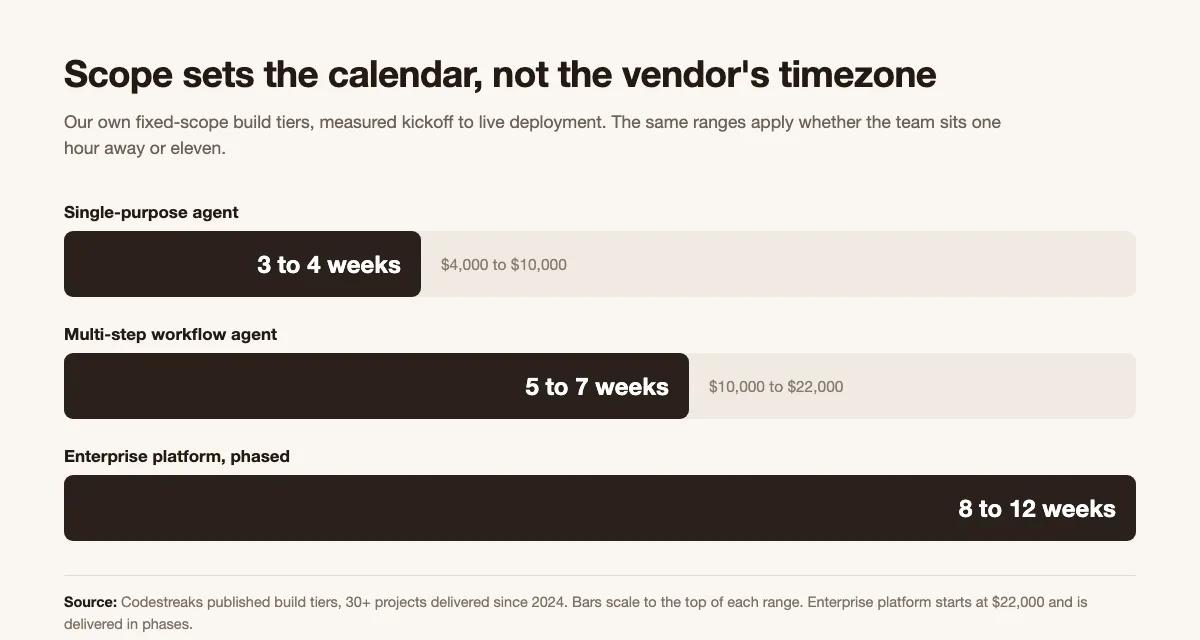
Our builds run 4 to 8 weeks kickoff to live. The nearshore label moves with the buyer, not the vendor, and for well-specified work offshore is the better call.
Codestreaks Team

Nearshore SaaS development means outsourcing to a team in a similar timezone, one to four hours off instead of eight to twelve. It costs somewhat more per hour than offshore outsourcing in a distant timezone, and it buys back something offshore can't: overlapping working hours where a Slack message gets a same-day answer instead of a next-morning one. For most SaaS teams iterating weekly, that overlap is worth more than the hourly rate difference.
We've built SaaS products for teams who'd previously tried both models. The pattern that comes up most often: offshore outsourcing looked cheaper on the initial quote, and then the actual cost showed up as slower iteration. A design question asked at 4pm got answered at 9am the next day. A bug found in QA sat for a full day before anyone on the other side could triage it. Multiply that by a few dozen exchanges over a project and the "savings" evaporate into a longer timeline.
Outsourcing SaaS development, nearshore or offshore, genuinely saves money in a few specific situations, and it's worth being honest about which ones apply to you:
Well-specified, self-contained work. A defined API integration, a reporting module with a clear spec, a migration script. Work that doesn't need much back-and-forth benefits less from timezone overlap, so offshore rates make more sense here.
Work that runs in parallel with your core team. If you have in-house engineers building the core product and want a second workstream (say, an admin dashboard or a reporting layer) running alongside without pulling focus, an outsourced team, nearshore or offshore, can genuinely run in parallel.
Where it doesn't save money: early-stage product development where requirements are still being discovered. This is exactly the situation where daily collaboration matters most, and it's exactly the situation where offshore timezone gaps hurt the most. We've seen founders outsource an MVP offshore to save money, then spend three extra months in back-and-forth because every clarifying question cost a day.
When founders search for how to outsource SaaS development, they usually mean one of two different things, and the distinction matters: staff augmentation (embedding one or two contractors into your existing process and tools) versus a fixed-scope build (handing an entire feature or product to an outside team with a defined deliverable). Staff augmentation needs heavier timezone overlap to work well, because the contractor is participating in your daily standups and code reviews. A fixed-scope build can tolerate more timezone gap because the collaboration happens at defined checkpoints, not continuously.
From the field: one SaaS client had tried an offshore team for their MVP build before coming to us. Their retro on that engagement: not the code quality, which was fine, but that every design decision took two days minimum to resolve because of the 11-hour gap. We work from the US, closer to their hours, and the same category of decision now closes same-day. The code isn't better. The velocity is.
Two different things get searched with almost the same words. One is a role: you want a nearshore SaaS developer added to a team you already run. The other is an engagement: you want a nearshore team to own a deliverable. The rate card looks similar. What you get is not.
Hiring the role means you keep the architecture, the backlog and the review burden. The developer needs your context, your conventions and someone on your side with time to unblock them. Overlap matters more here than anywhere else, because the work is continuous rather than checkpointed. If nobody in-house has hours to spend answering questions, a nearshore hire will underperform an offshore one at twice the price, because you are paying for availability you are not using.
Buying the engagement means the ownership moves. Architecture decisions, review and sequencing sit with the vendor, and you review outcomes rather than commits. That is a different skill purchase, and it is the one most SaaS founders actually want when they start searching for developers.
The question that separates a real answer from a sales answer is how thinly the people are spread. We take on two engagements per quarter, which is the reason the same people stay on a build from kickoff to deployment rather than rotating off when something louder arrives. Ask any vendor for that number directly. Ask how many active clients each engineer is split across, who reviews their code, and what happens to your branch when a bigger account has an incident. Every client we take gets 100% code ownership and 30 days of post-launch support, so the handover is a date on the calendar rather than a negotiation.
Any of this is checkable before you sign. None of it is visible on a rate card, which is why the rate card is the wrong document to choose from. We wrote more about that decision in our guide on when outsourcing software development is actually the right call.
Nearshore rates typically land somewhere between US in-house rates and offshore rates, not because the work is different but because the market prices in convenience and overlap. If your project has a lot of ambiguity left to resolve, that premium buys back weeks of calendar time, which is usually worth more than the rate difference. If your project is genuinely well-specified with minimal back-and-forth needed, offshore can be the better economic call. The mistake is picking the model based on rate card alone without asking how much of the work still needs daily judgment calls.
Onshore means the team is in your own country. Nearshore means a neighbouring timezone, one to four hours off. Offshore means the eight to twelve hour gap. Most comparisons skip the middle one, which is a problem, because for a US buyer the real choice is often onshore against offshore, with nearshore sitting between them on both price and overlap.
Here is our own position stated plainly, since it decides how to read everything above. Abdullah, our senior mobile app developer, works from Austin, Texas. For a US client we are onshore, and the overlap argument in this post is one we benefit from rather than one we are selling around. For a European client the same engagement is nearshore or offshore depending on where you sit. The label moves with the buyer, not with the vendor, and any vendor whose "nearshore" claim does not change depending on who is asking is describing marketing rather than geography.
The number that usually gets left out of the comparison is ramp-up. Our builds run four to eight weeks from kickoff to live deployment. A two week ramp-up on a four week build is half the project spent getting started, which is why ramp-up matters far more on short engagements than on long ones and why it is worth asking about before the rate. On a twelve week phased platform the same two weeks is noise. The shorter your build, the more the onshore premium buys back, and the less the offshore saving survives contact with the calendar.
Contracts are the other half of the onshore question and the half that surprises people. Crossing a border changes where your data sits and who is allowed to touch it. If you are a UK or EU buyer, the things worth confirming in writing are which country the data is stored and processed in, whether a data processing agreement is in place, and which subprocessors the vendor uses. Those are questions for your counsel rather than answers a vendor blog should give you, but they belong on the shortlist call, not in the final contract review, because the answer can disqualify a vendor after you have already spent three weeks on them. The same border logic shows up in mobile work too, which we covered in our breakdown of offshore, nearshore and in-house app outsourcing.
The theory of overlapping hours only pays off if the process is actually built around it. That means daily or near-daily standups happening in real time, not async status updates that could have been written from any timezone. It means code review turnaround measured in hours, not the next business day. It means a design or product question raised mid-morning gets a same-day answer instead of sitting in a queue overnight.
When we run nearshore-style engagements, the biggest difference clients notice isn't the code, it's how fast ambiguity gets resolved. A vague requirement that would take three days to clarify over an 11-hour offshore gap gets clarified in one working session. Over a multi-month build, that compounds into weeks of calendar time saved, not because anyone worked faster, but because nobody was waiting.
The risk on the vendor side is treating "nearshore" as a marketing label rather than an operating model. A team technically based in a nearby country but working hours that don't actually overlap with yours gets you the higher rate without the collaboration benefit. Confirm actual working hours, not just geography, before assuming the timezone advantage is real, and ask for a reference client who can speak specifically to collaboration speed, not just final code quality.
Usually, per hour, yes, but total project cost depends on velocity, not just rate. A slower offshore engagement with more clarification cycles can cost more in calendar time and opportunity cost than a faster nearshore one.
Four to six overlapping working hours is generally enough for daily standups, same-day code review, and real-time debugging sessions. Below two hours of overlap, most teams end up working asynchronously by default, which changes how you have to manage the engagement.
Yes, and it's common: nearshore or in-house for the parts needing daily collaboration (core product, active feature work), offshore for well-specified self-contained modules once the spec is locked.
Ask for their actual working hours relative to yours, not just the country they're based in (some "nearshore" teams still work hours that barely overlap). Ask how they handle code review turnaround and how many active clients each engineer is split across.
No, quality is a function of the team and process, not geography. What geography changes is collaboration speed, not skill.
Written by the Codestreaks team and edited by Arsalan Amin. The delivery ranges, tier pricing and engagement load in this post come from our own published build tiers and the 30-plus projects we have delivered since 2024, not from industry survey data. The chart above is built from those same tiers.
This post was expanded in September 2026 after we pulled Search Console data for it and found it drew roughly 570 impressions and zero clicks across three months, ranking for queries about nearshore developers, onshore comparisons and ramp-up that the page never actually answered. The two sections above were written to answer them. Drafting is AI-assisted and every draft gets a human editing pass against real numbers we can back. Where we did not have a measured figure, such as average timezone overlap hours across engagements, we left the claim out rather than estimating one.
If you're weighing nearshore against offshore for a SaaS build, the real question isn't the rate card, it's how much of your remaining work still needs daily judgment calls. We can give you a straight answer on a free 30-minute call, and respond within two business days either way. See how we approach SaaS development or start a project.


