

The test is whether you can draw a box around the work. Three failure modes, what it really costs against hiring, and the four things to fix before sending a brief.

Outsourcing software development is the right call when the work has a clear edge around it and the wrong call when it does not. That is the whole test, and most of the advice on this question never gets to it.
We are an agency, so treat what follows accordingly. We also turn work down, we take on two engagements a quarter, and across 30+ projects delivered to production since 2024 the pattern of which ones went well is consistent enough to write down.
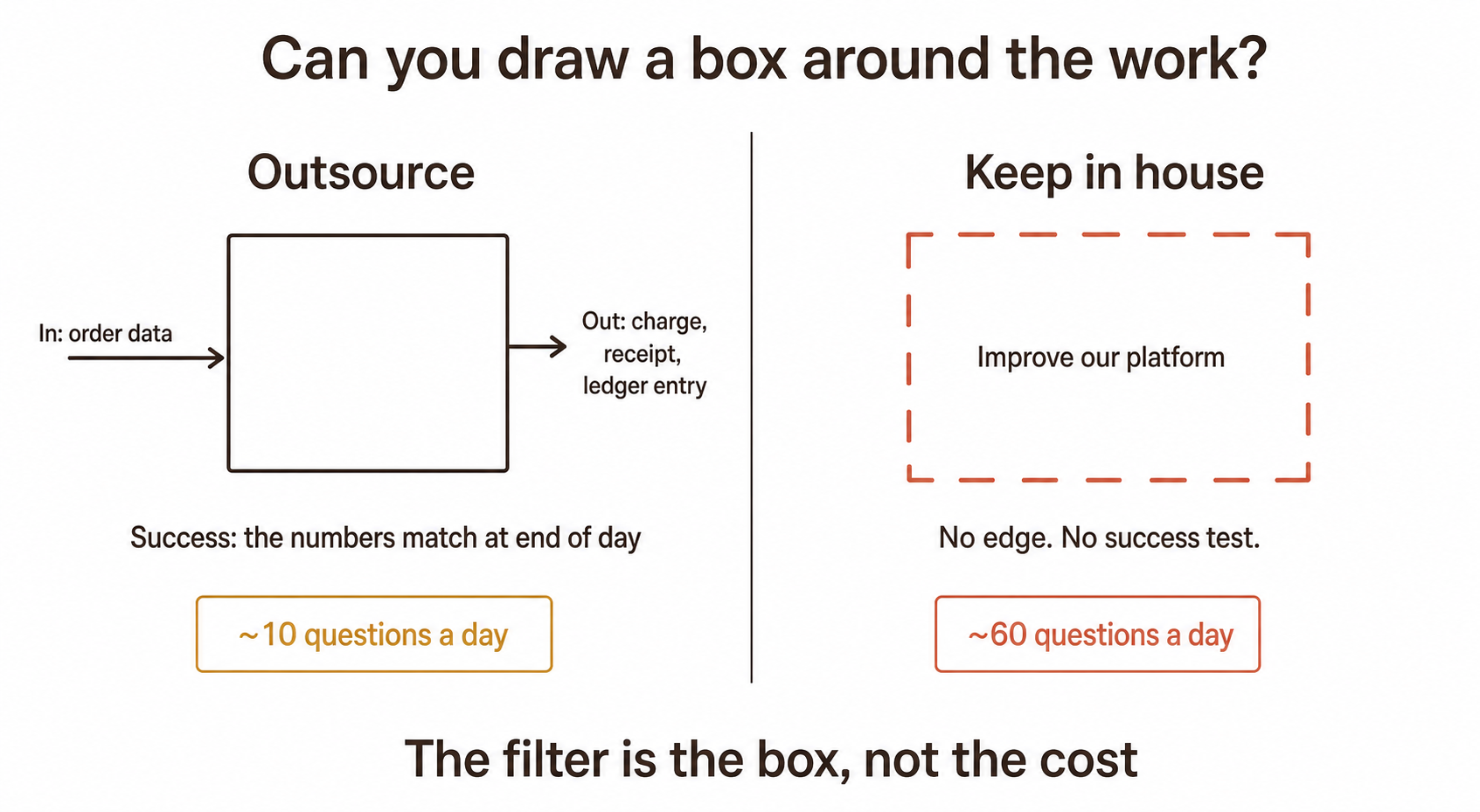
Before you compare vendors, try to describe the work as a box with three things written on the outside. What goes in. What comes out. How you will know it worked.
A payments integration passes. In: order data. Out: a charge, a receipt, a reconciled ledger entry. Success: the numbers match at end of day.
"Improve our platform" fails. There is no edge. Every decision inside that box needs context that lives in your team's heads, and every one of those decisions becomes a question someone external has to ask. Ten questions a day is a functioning engagement. Sixty is you doing your job and someone else's.
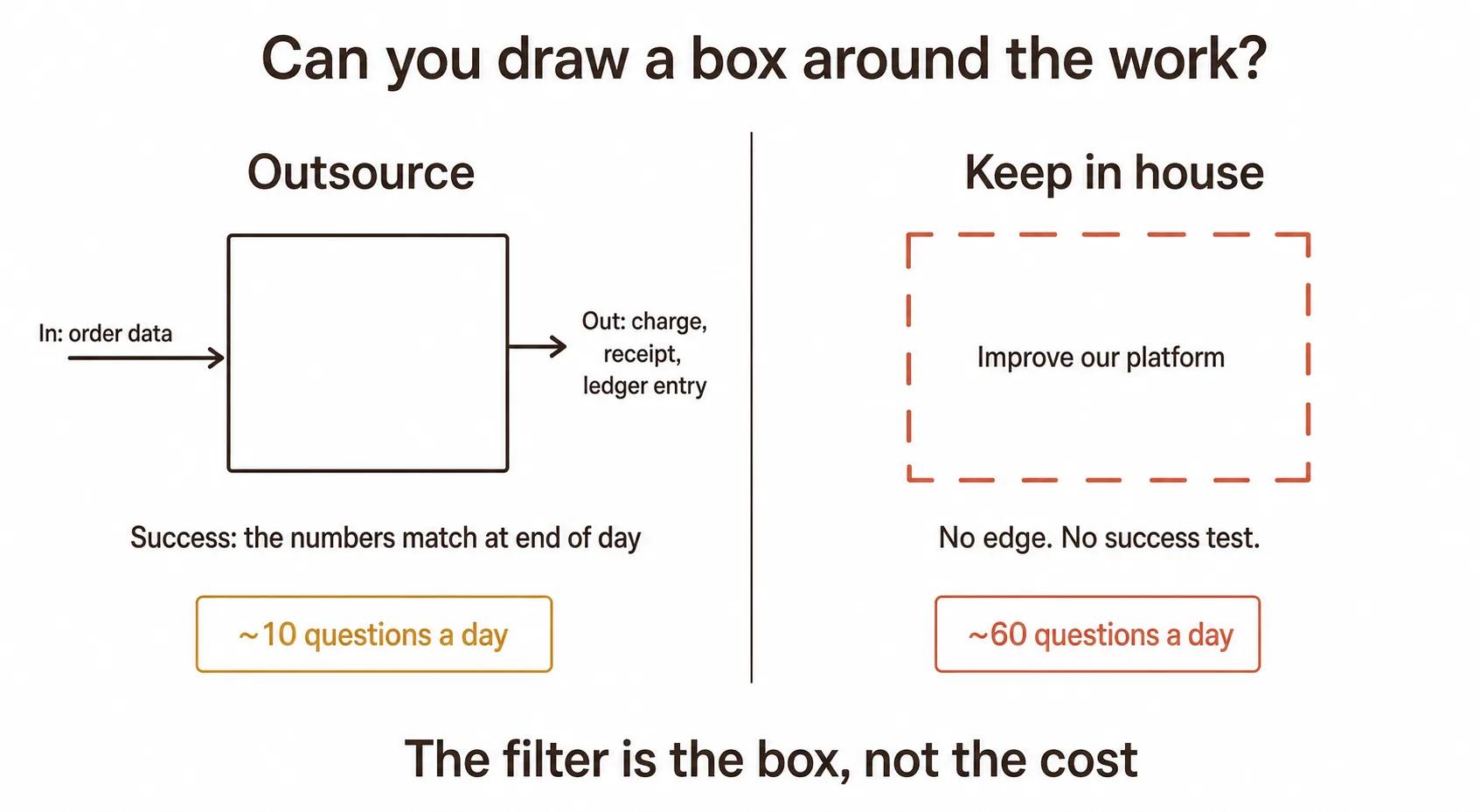
That is the real filter. Not cost, not timezone, not whether the work is "core". Plenty of core work outsources fine when the box is clean, and plenty of peripheral work is a disaster because nobody can say what done looks like.
The pitch is usually that outsourcing is cheaper. Sometimes it is. That is not why it works when it works.
Our fixed-price band is $4,000 to $30,000. A single-purpose build runs $4,000 to $10,000 over three to four weeks. A workflow app with real integrations runs $10,000 to $22,000 over five to seven weeks. A platform runs $22,000 to $30,000 and up, phased over eight to twelve weeks.
Compare that against the loaded cost of hiring, which is not a salary. It is recruiting time, three to six months to first useful output, and the risk that the person leaves in year two with the only working knowledge of the system. For a defined piece of work, an agency is cheaper because it is bounded, not because the hourly rate is lower.
Where it stops being cheaper: anything continuous. If you need someone in the standup every day for two years, hire. We say that to prospects and occasionally lose the work, which is fine. An agency engagement that turns into a permanent staffing arrangement is worse value than a hire and everybody knows it by month eight.
The stated reason is cost. The real reasons, in the order we see them:
Capacity, not capability. The team knows exactly how to build it and has no room. This is the healthiest reason and the highest success rate.
A skill they do not want permanently. A one-off mobile app when the team is all backend. Hiring a mobile engineer for one app and then having nothing for them to do is worse for everyone, including the engineer.
Speed to a decision. They need to know whether the idea works before committing headcount. This is a good reason if you actually treat the output as a decision input, and a bad reason if the prototype quietly becomes production. Which it does, more often than anyone plans for. We covered why prototypes mislead in our MVP scoping guide.
Nobody left who understands the system. The person who wrote it left. This is the hardest kind of engagement and the one where we ask the most questions before quoting.
Watching this go wrong repeatedly, it is nearly always one of three things, and none of them is the vendor's technical skill.
No single decision-maker. Three stakeholders who can each change priorities and none of whom can overrule the others. No process survives this. We ask who the decision-maker is before kickoff and have declined work where the answer was a committee.
The spec was the sales pitch. The brief describes what the software should feel like, not what it must do. Ambiguity gets resolved by whoever is closest to the keyboard, and it is not resolved the way you assumed.
No handover plan. The build ships, the agency leaves, and nobody internal can change a line of it. This is the one that turns a good project into a bad two years.
Four things, and they cost you a week:
If you cannot produce that in a week, the work is not ready to outsource. That is a finding about your requirements, not about vendors.
A client came to us after an offshore engagement had gone badly enough that they were ready to write off outsourcing entirely. The code was not the problem. It was fine.
The problem was that they had sent a fourteen-page brief describing screens, and the vendor had built exactly those screens. What the brief never said was that the data feeding those screens arrived twice a day as a CSV with inconsistent column ordering, because everyone internally had known that for years and nobody thought to write it down. The software worked perfectly on clean data and fell over every single morning.
That is not an offshore problem. We would have built the same thing from the same brief. Our integration question exists because of engagements exactly like that one, and it is the first thing we ask now, before anything about screens.
Rope Access Logbook went the other way. The founder could describe the box in one sentence: replace a paper logbook that technicians fill in at height, with no signal, that an auditor has to accept. Clear inputs, clear output, unambiguous success test. It shipped in eight weeks. Chad Dubuisson put it this way afterwards: "Codestreaks took our rough idea and turned it into a real product in just 8 weeks. The way they built it saved us months of headaches down the road."
Same agency, same process. The difference was entirely in how well the box was drawn before anyone wrote code.
You own the repository. Not a copy at the end, access throughout.
If a vendor will not give you the code, you did not buy software, you rented it, and the renewal terms are whatever they decide later. We give every client 100% code ownership and 30 days of post-launch support, and we think anything else is a bad deal at any price. If you are comparing proposals and one of them is quiet on this, that is your answer.
For the adjacent question of what happens to the CMS and content side after handover, we wrote that up separately in our CMS handoff guide.
When you can define the work as a box with clear inputs, outputs, and a success test, and when the need is bounded rather than continuous. Capacity gaps and one-off specialist skills are the strongest cases. Ongoing daily work that needs deep product context is usually a hire.
The stated reason is cost, but in practice it is capacity (the team knows how, and has no room), a skill they do not want permanently, speed to a decision before committing headcount, or the loss of whoever understood the existing system. Cost savings are real for bounded work and mostly illusory for continuous work.
For a defined project, usually yes, because it is bounded and there is no recruiting time, ramp-up, or retention risk. For continuous work it is not. A rough test: if you would still need this person in eighteen months, hire.
Name one decision-maker, list every external system the software touches and what happens when each fails, write down what is out of scope, and agree what handover means before signing. Most failed engagements failed on one of those four, not on code quality.
Anything you cannot describe without your own team in the room. If resolving day-to-day ambiguity requires context that only exists internally, an external team will resolve it differently from how you would, and you will not find out for weeks.
Written by the Codestreaks team in Austin, TX. The price bands and timelines here are our own published fixed-price tiers, drawn from 30+ projects delivered to production since 2024. The CSV brief story and the eight-week Rope Access Logbook timeline are from real engagements, the first retold without naming the client. We are an agency writing about outsourcing, which is a conflict worth stating plainly, so the cases where we say hire instead are the ones to weigh most. Drafting is AI-assisted with a human editing pass against our own project record.
If you have a piece of work and are genuinely unsure whether it should be outsourced, that is a good 30-minute conversation, and we will say so if the answer is hire. Free call, reply within two business days.
More on how we scope on our SaaS development service page, or start a project.
A serial maker of SaaS products and AI agents, I’ve built and launched 10+ tools, grown products to thousands of users, and taken multiple ventures. I share the process what works, what breaks, and how builders can ship faster and smarter. Previously a data scientist at a Big Four consulting firm.