Mobile Application AI Development Services USA 2025: The Complete Guide
Introduction: The AI-Powered Mobile Revolution Across America
The United States is experiencing a mobile AI renaissance. From Silicon Valley startups to Main Street businesses in Nebraska, companies across all 50 states are integrating artificial intelligence into their mobile applications. This comprehensive guide explores how mobile application AI development is transforming American business, the technical architectures powering these innovations, and why now is the critical moment for US companies to adopt AI-powered mobile solutions.
Mobile AI isn't just about chatbots anymore. We're talking about on-device machine learning models that work offline in rural Montana, computer vision systems diagnosing equipment failures in Texas oil fields, and natural language processing helping healthcare workers in New York hospitals, all running directly on smartphones and tablets without constant cloud connectivity.
Why US Businesses Need Mobile AI: The American Context

The Geographic Challenge: AI That Works Coast to Coast
The United States presents unique challenges for mobile technology. Unlike smaller nations with concentrated populations, American businesses operate across:
- 3.8 million square miles of diverse terrain
- Rural connectivity gaps affecting 14-23% of Americans
- Multiple time zones requiring edge computing solutions
- Industry-specific regulations varying state by state
This geographic and regulatory complexity makes offline-first AI not just a feature, but a necessity. A field service technician in rural Wyoming can't rely on cloud AI when they're 50 miles from the nearest cell tower. They need on-device intelligence that works anywhere in America.
The Labor Shortage: Automating to Scale
The US faces critical worker shortages across multiple sectors:
- HVAC technicians: 35,000+ unfilled positions nationwide
- Construction workers: 650,000+ shortage projected through 2026
- Healthcare practitioners: 3.2 million additional workers needed by 2026
- Manufacturing specialists: 2.1 million unfilled jobs by 2030
Mobile AI directly addresses this crisis by making each worker more productive. When one technician can handle the workload of two through intelligent automation, businesses can scale without proportional hiring.
Core Mobile AI Technologies: What Powers American Innovation
1. On-Device Machine Learning: The Edge Intelligence Revolution
CoreML for iOS Applications
Apple's CoreML framework has become the gold standard for on-device AI in enterprise iOS applications. Used by Fortune 500 companies and startups alike, CoreML enables:
- Real-time image classification at 60+ FPS on iPhone hardware
- Natural language understanding without server roundtrips
- Predictive models trained on cloud, deployed to edge
- Privacy-first architecture keeping sensitive data on-device
For American businesses handling HIPAA-protected health data or CCPA-regulated customer information, on-device processing isn't optional, it's a compliance requirement. We went deeper on the tradeoffs in running LLMs locally for privacy-first mobile SaaS.
Technical Implementation Example:
A construction safety app can use CoreML to analyze job site photos in real-time, identifying OSHA violations before accidents occur. The model runs entirely on the worker's iPhone, processing images at the edge without uploading potentially sensitive site data to cloud servers.
TensorFlow Lite for Android Deployment
Google's TensorFlow Lite powers Android AI applications across the US market. With Android holding 42% of the US smartphone market, TensorFlow Lite enables:
- Cross-device compatibility from budget phones to flagship devices
- Model optimization reducing size by 75% without accuracy loss
- Hardware acceleration via Android NNAPI for fast inference
- Flexible deployment supporting everything from retail apps to industrial IoT
For businesses serving diverse American demographics, Android AI ensures your intelligent features reach users regardless of their device budget.
2. Computer Vision for American Industries
Manufacturing Quality Control
US manufacturers are deploying mobile computer vision for defect detection:
- Automotive parts inspection in Michigan factories
- Electronics QA in Texas semiconductor plants
- Food processing safety in California agricultural facilities
- Pharmaceutical packaging in New Jersey production lines
These systems achieve 99.7% accuracy rates, exceeding human inspectors while documenting every decision for FDA and ISO compliance.
Field Service Diagnostics
HVAC, electrical, and plumbing professionals across America use mobile vision AI to:
- Identify equipment models from photos (95% accuracy)
- Diagnose failure modes by analyzing damage patterns
- Match repair parts from visual databases
- Generate service reports with annotated imagery
A technician in Arizona can photograph a broken commercial HVAC unit, and their mobile app instantly identifies the model, suggests the failed component, checks local parts availability, and drafts the repair estimate, all in under 30 seconds.
Retail and E-commerce Applications
American retailers use mobile vision AI for:
- Visual product search: Customers photograph items to find matches
- Inventory management: Staff scan shelves for stock-outs
- AR try-on experiences: Virtual furniture placement or makeup testing
- Loss prevention: Automated checkout verification
3. Natural Language Processing: Conversational Intelligence
Voice-First Interfaces for Hands-Free Work
Mobile NLP enables voice control for workers whose hands are occupied:
- Medical professionals dictating patient notes in real-time
- Warehouse workers confirming picks without touching screens
- Delivery drivers updating routes while driving (safely)
- Field technicians requesting technical docs while repairing equipment
These systems use on-device speech recognition (Apple's Speech framework or Android's Speech API) combined with local NLP models for instant, private voice interaction.
Intelligent Document Processing
American businesses process billions of forms annually. Mobile AI automates:
- Invoice extraction: Photographing receipts auto-fills expense reports
- Contract analysis: Scanning agreements highlights key terms
- Compliance forms: Auto-completing regulatory paperwork
- Customer intake: Converting handwritten forms to structured data
Multilingual Support for American Diversity
The US has no official language, with 350+ languages spoken nationwide. Mobile NLP enables:
- Real-time translation for customer service interactions
- Multilingual interfaces switching based on user preference
- Cultural localization beyond simple translation
- Accessibility features for non-native English speakers
4. Predictive Analytics and Decision Intelligence
Maintenance Prediction
Mobile AI analyzes sensor data to predict equipment failures:
- Fleet management: Predicting vehicle maintenance needs
- HVAC systems: Forecasting compressor failures before breakdown
- Manufacturing equipment: Scheduling preventive maintenance optimally
- Building systems: Anticipating elevator, electrical, or plumbing issues
This saves American businesses an estimated $630 billion annually in unplanned downtime.
Sales and Inventory Optimization
Retail and distribution apps use mobile AI for:
- Demand forecasting: Predicting stock needs by location and season
- Dynamic pricing: Adjusting prices based on local market conditions
- Route optimization: Planning delivery paths that minimize fuel costs
- Customer behavior prediction: Personalizing offers based on patterns
Industry-Specific Mobile AI Solutions in the USA

Healthcare: HIPAA-Compliant Mobile Intelligence
Clinical Decision Support
US healthcare providers use mobile AI for:
- Diagnostic assistance: Analyzing symptoms against medical databases
- Drug interaction checking: Real-time prescription safety verification
- Medical imaging analysis: Preliminary X-ray or scan interpretation
- Patient monitoring: Analyzing vitals from wearables and IoT devices
All processing happens on-device or within HIPAA-compliant infrastructure, ensuring patient privacy while delivering clinical value.
Telemedicine Enhancement
Mobile AI improves remote care delivery:
- Symptom triage: Guiding patients to appropriate care levels
- Remote diagnosis support: Assisting doctors during video consultations
- Medication adherence: Reminding and verifying medication intake
- Mental health support: Providing CBT exercises and mood tracking
Construction and Trades: Building America with AI
Project Management Intelligence
Construction firms across the US deploy mobile AI for:
- Progress tracking: Computer vision documenting site progress automatically
- Safety compliance: Real-time PPE detection and hazard identification
- Resource optimization: Predicting material needs and delivery timing
- Quality assurance: Comparing built conditions to BIM models
Skilled Trade Assistance
Electricians, plumbers, and HVAC techs use mobile AI daily:
- Code compliance checking: Verifying work meets local building codes
- Part identification: Recognizing components from photos
- Wiring diagram analysis: Interpreting complex schematics
- Estimate generation: Automatically pricing jobs based on scope
Manufacturing: Industry 4.0 Goes Mobile
Quality Assurance Automation
US factories use mobile AI for:
- Defect detection: Computer vision identifying manufacturing flaws
- Measurement verification: Optical inspection of tolerances
- Process optimization: Analyzing production data for efficiency gains
- Compliance documentation: Auto-generating quality reports
Workforce Augmentation
Mobile AI assists production workers:
- Assembly guidance: AR overlays showing assembly steps
- Training acceleration: AI tutoring for new workers
- Safety monitoring: Detecting unsafe behaviors or conditions
- Maintenance support: Guiding technicians through repairs
Customer Experience Enhancement
American retailers use mobile AI for:
- Personalized recommendations: Analyzing browsing and purchase history
- Visual search: Finding products from customer photos
- Virtual try-on: AR-powered fitting rooms
- Intelligent customer service: AI-powered chatbots and support
Operations Optimization
Retail operations benefit from mobile AI:
- Inventory management: Computer vision tracking shelf stock
- Theft prevention: Behavioral analysis detecting suspicious activity
- Queue management: Predicting checkout needs to reduce wait times
- Store layout optimization: Heat mapping foot traffic patterns
Financial Services: Mobile Banking Intelligence
Fraud Detection and Security
US banks and fintech companies deploy mobile AI for:
- Transaction monitoring: Real-time fraud detection
- Biometric authentication: Face and voice recognition
- Document verification: Analyzing uploaded IDs and documents
- Anomaly detection: Identifying unusual account activity
Customer Financial Wellness
Mobile AI helps Americans manage finances:
- Spending analysis: Categorizing and predicting expenses
- Investment guidance: Personalized portfolio recommendations
- Credit optimization: Suggesting actions to improve credit scores
- Savings automation: Intelligently moving money to savings goals
Agriculture: Precision Farming Goes Mobile
Crop Management Intelligence
American farmers use mobile AI for:
- Disease detection: Photographing plants to identify issues
- Yield prediction: Estimating harvest quantities from field data
- Pest identification: Recognizing threats and suggesting treatments
- Soil analysis: Analyzing samples for nutrient recommendations
Equipment and Resource Optimization
Ag tech mobile apps provide:
- Equipment diagnostics: Identifying machinery problems
- Weather prediction integration: Optimizing planting and harvesting timing
- Water management: Calculating optimal irrigation schedules
- Market timing: Predicting best sale timing for crops
Technical Architecture: Building Production-Ready Mobile AI
The Hybrid Intelligence Model
Edge + Cloud Architecture
Modern mobile AI uses a tiered approach:
- Device-level inference for real-time, offline-capable features, which is where your choice of cross-platform framework starts to matter
- Edge computing for localized processing at cell towers or regional servers
- Cloud processing for complex analysis requiring massive compute
- Model management for continuous learning and improvement
This architecture ensures American businesses get intelligence everywhere from Manhattan to rural Alaska, adapting to available connectivity.
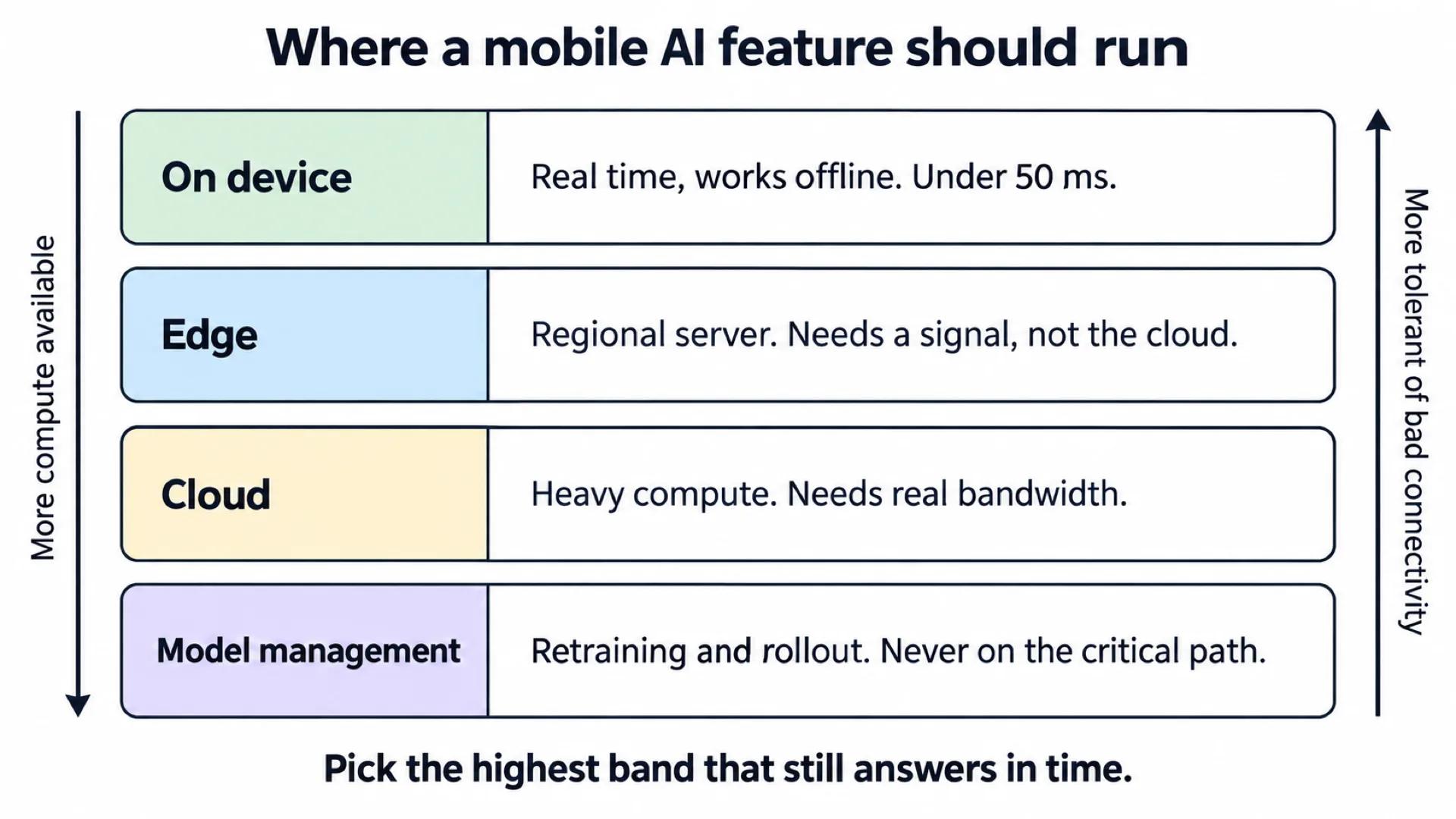
The ordering is the whole rule. Start at the top band and only move down when the answer is genuinely no. Most teams arrive having assumed the opposite, designing cloud-first and then discovering the feature dies in a basement or a canyon.
Data Synchronization Strategy
Offline-first mobile AI requires sophisticated sync:
- Optimistic updates: Assuming success then reconciling
- Conflict resolution: Handling simultaneous edits intelligently
- Bandwidth optimization: Syncing only essential data
- Background processing: Uploading when connectivity permits
Security and Compliance for US Markets
Data Privacy Requirements
Mobile AI must comply with the following. We covered the California rules and how they bite in practice in our guide to CCPA and US data privacy.
- CCPA (California): Consumer privacy protection
- CPRA (California): Enhanced privacy rights
- VCDPA (Virginia): Virginia's comprehensive data law
- CPA (Colorado): Colorado's privacy act
- HIPAA: Health data protection (nationwide)
- GLBA: Financial data protection
- COPPA: Children's data protection
Security Best Practices
Enterprise mobile AI implements:
- End-to-end encryption for data in transit and at rest
- Biometric authentication for secure access
- Secure enclaves for on-device model storage
- Certificate pinning to prevent man-in-the-middle attacks
- Regular security audits and penetration testing
Model Training and Deployment Pipeline
Training Infrastructure
US companies train mobile AI models using:
- Cloud GPU clusters (AWS, Google Cloud, Azure)
- Federated learning for privacy-preserving training
- Transfer learning to reduce training time and cost
- AutoML platforms for rapid experimentation
Model Optimization for Mobile
Preparing models for deployment requires:
- Quantization: Reducing model precision from 32-bit to 8-bit
- Pruning: Removing unnecessary neural network connections
- Knowledge distillation: Creating smaller models that match larger ones
- Hardware-specific compilation: Optimizing for specific chips
These techniques reduce model size by 75% and speed up inference by 3-4x while maintaining 95%+ of original accuracy.
Continuous Learning Loop
Production mobile AI requires:
- A/B testing frameworks for comparing model versions
- User feedback collection to identify improvement opportunities
- Automated retraining pipelines incorporating new data
- Gradual rollout systems to minimize risk from model updates
State-by-State Mobile AI Adoption Trends
Leading Innovation Hubs
California: The AI Epicenter
With Silicon Valley and Los Angeles, California leads in:
- Entertainment AI (Netflix, Disney content recommendations)
- Automotive AI (Tesla, Waymo autonomous systems)
- Consumer AI (Apple, Google mobile features)
- Healthcare AI (numerous health tech startups)
New York: Financial and Healthcare AI
NYC drives innovation in:
- Fintech mobile AI (fraud detection, robo-advisors)
- Healthcare AI (Mount Sinai, NYU medical AI)
- Retail AI (fashion tech, e-commerce personalization)
- Media AI (news aggregation, content curation)
Texas: Enterprise and Industrial AI
Texas's business-friendly environment fosters:
- Oil & gas AI (predictive maintenance, exploration)
- Manufacturing AI (quality control automation)
- Logistics AI (route optimization, warehouse automation)
- Healthcare AI (Houston Medical Center innovations)
Washington: Cloud and Consumer AI
Seattle's tech giants drive:
- Cloud AI infrastructure (AWS AI services)
- E-commerce AI (Amazon recommendations)
- Gaming AI (interactive entertainment)
- Enterprise AI (Microsoft 365 intelligence)
Massachusetts: Academic and Healthcare AI
Boston's innovation ecosystem excels in:
- Medical AI (hospital partnerships with MIT, Harvard)
- Robotics AI (Boston Dynamics and startups)
- Biotech AI (drug discovery, genetic analysis)
- Education AI (adaptive learning platforms)
Emerging Markets
Midwest Manufacturing Renaissance
States like Michigan, Ohio, and Indiana adopt mobile AI for:
- Automotive manufacturing intelligence
- Agricultural technology and precision farming
- Logistics and supply chain optimization
- Small business automation tools
Southeast Growth Corridor
North Carolina, Georgia, and Florida see growth in:
- Financial services AI (Charlotte banking tech)
- Logistics AI (Atlanta distribution centers)
- Tourism AI (Florida hospitality tech)
- Healthcare AI (Research Triangle innovations)
Mountain West Innovation
Colorado, Utah, and Arizona develop:
- Outdoor recreation AI (activity tracking, safety)
- Government tech AI (smart city initiatives)
- Defense AI (aerospace and military contractors)
- Remote work AI (collaboration and productivity tools)
ROI and Business Impact: The Numbers Behind Mobile AI
Productivity Gains
American businesses report:
- 35-50% reduction in administrative time for field workers
- 25-40% faster customer service resolution times
- 60-75% fewer data entry errors
- 20-30% increase in daily job completion rates
Cost Savings
Mobile AI delivers measurable savings:
- $12,000-$18,000 annually per field worker in admin time savings
- $50,000-$100,000 annually per business in reduced errors and rework
- 15-25% lower customer acquisition costs through better targeting
- 30-40% reduction in equipment downtime through predictive maintenance
Revenue Impact
Beyond cost savings, mobile AI drives growth:
- 10-20% increase in sales through better customer insights
- 25-35% improvement in customer retention rates
- 40-60% faster time-to-market for new products/services
- 3-5x higher customer lifetime value through personalization
Competitive Advantage
Companies with mobile AI report:
- 2-3 year lead over competitors who haven't adopted
- 50%+ win rate when competing against non-AI competitors
- Premium pricing power (15-25% higher prices accepted)
- Higher valuations (30-50% premium in M&A scenarios)
Implementation Guide: Bringing Mobile AI to Your Business
Phase 1: Assessment and Strategy (Weeks 1-4)
Business Case Development
Identify high-impact use cases:
- Pain point analysis: Where do manual processes cause delays?
- Data availability audit: What data exists to train models?
- ROI calculation: What quantifiable improvements are possible?
- Competitive analysis: What are competitors doing with AI?
Technical Feasibility Study
Evaluate readiness:
- Existing data infrastructure: Can you collect training data?
- Mobile platform requirements: iOS, Android, or both?
- Connectivity constraints: How often are users offline?
- Integration needs: What systems must AI connect to?
Team Assembly
Build your AI team:
- Project sponsor: Executive champion for the initiative
- Product manager: Defining features and priorities
- Mobile developers: iOS and/or Android expertise
- ML engineers: Model development and optimization
- UX designers: Creating intuitive AI interactions
Phase 2: MVP Development (Weeks 5-16)
Start with One High-Value Use Case
Don't boil the ocean. Choose:
- Clear success metrics: Measurable improvement targets
- Existing data: Historical data for model training
- User enthusiasm: Stakeholders excited to test
- Quick wins: Demonstrable value in 3-4 months
Technical Implementation
Build the foundation:
- Data pipeline: Collect, clean, and label training data
- Model development: Train and validate initial models
- Mobile integration: Embed models in native apps
- Testing framework: Validate accuracy and performance
- User interface: Design intuitive AI interactions
Beta Testing
Validate with real users:
- 10-20 pilot users in production environment
- Daily feedback loops to identify issues
- Performance monitoring of accuracy and speed
- Iteration cycles every 1-2 weeks
Phase 3: Production Deployment (Weeks 17-24)
Scaling Preparation
Ensure production readiness:
- Load testing: Verify performance at scale
- Security audit: Penetration testing and compliance review
- Documentation: User guides and technical documentation
- Support planning: Training support teams on AI features
Phased Rollout
Minimize risk:
- 10% of users for initial production validation
- 25% of users after 1 week of stability
- 50% of users after 2 weeks
- 100% of users after 4 weeks
Monitoring and Optimization
Continuous improvement:
- Real-time dashboards: Track usage and performance
- Error analysis: Identify and fix model failures
- User feedback: Collect ratings and suggestions
- A/B testing: Experiment with improvements
Phase 4: Expansion and Innovation (Ongoing)
Add Additional Use Cases
Build on the AI infrastructure you already have:
- Cross-functional applications: Apply AI to new departments
- Advanced features: Add more sophisticated capabilities
- Platform expansion: Deploy to additional mobile platforms
- Integration depth: Connect AI to more business systems
Organizational Learning
Build AI competency:
- Training programs: Upskill existing staff on AI
- Best practices: Document lessons learned
- Innovation culture: Encourage AI experimentation
- Talent development: Grow internal AI expertise
Choosing the Right Mobile Application AI Development Services Partner
Essential Capabilities
Look for partners with:
Technical Expertise
- Mobile-first experience: Not just web developers doing mobile
- ML engineering: Actual model development capability, not just API integration
- Production experience: Deployed AI at scale, not just demos
- Industry knowledge: Understanding your sector's unique needs
Business Acumen
- ROI focus: Delivering measurable business outcomes
- Agile methodology: Iterative development with regular deliveries
- Communication skills: Explaining technical concepts clearly
- Strategic thinking: Advising on AI strategy, not just coding
Compliance and Security
- Regulatory expertise: Understanding relevant US laws (HIPAA, CCPA, etc.)
- Security certifications: SOC 2, ISO 27001, or equivalent
- Data governance: Proper handling of sensitive data
- Audit capability: Explaining AI decisions when needed
Red Flags to Avoid
Overpromising
- Claims of "100% accuracy" (impossible)
- "AI will solve everything" mentality
- Unrealistic timelines (complex AI takes time)
- No discussion of limitations or challenges
Technical Inadequacy
- Only offering cloud-based solutions (no offline capability)
- Generic solutions without customization
- No model training capability (just using ChatGPT API)
- Inability to explain technical approach clearly
Business Misalignment
- No interest in understanding your business goals
- Focus on technology for technology's sake
- Unwillingness to share case studies or references
- Vague pricing or hidden costs
Future Trends: The Next 5 Years of Mobile AI in America
Multimodal AI: Beyond Text and Images
Next-generation mobile AI will integrate:
- Audio analysis: Understanding ambient sounds (machinery health, safety alerts)
- Sensor fusion: Combining camera, accelerometer, GPS for richer context
- Haptic feedback: AI-driven tactile responses for enhanced UX
- 3D understanding: LIDAR and depth sensing for spatial AI
Generative AI on Mobile Devices
As chips improve, expect:
- Text generation: Writing emails, reports directly on device
- Image creation: Generating photos and graphics offline
- Code generation: AI coding assistants for developers
- Audio synthesis: Real-time voice changing and music creation
Federated Learning: Privacy-Preserving Training
Models will improve while protecting privacy:
- Collective learning: Models learn from all users without seeing individual data
- Personalization: Custom models for each user without cloud upload
- Regulatory compliance: Meeting strict privacy laws automatically
- Edge intelligence: Smarter devices without centralized data collection
AI-First Mobile OS Features
Operating systems will deeply integrate AI:
- Proactive assistance: Anticipating needs before you ask
- Cross-app intelligence: AI understanding context across all apps
- Automated workflows: Chaining actions based on learned patterns
- Universal translation: Real-time language translation everywhere
Vertical solutions will dominate:
- Healthcare AI suites: Integrated tools for medical professionals
- Construction AI platforms: Complete job management with intelligence
- Retail AI ecosystems: Customer experience to inventory management
- Financial AI advisors: Comprehensive wealth management tools
5G and Edge Computing Synergy
Network improvements enable:
- Instant cloud AI: Near-zero latency for complex processing
- Hybrid intelligence: Seamlessly shifting between device and edge
- Live collaboration: Real-time multi-user AI experiences
- IoT integration: Mobile devices orchestrating intelligent IoT networks
Conclusion: The Mobile AI Imperative for American Business
Mobile AI is no longer emerging technology, it's essential infrastructure. American businesses that delay adoption risk:
- Competitive disadvantage: AI-equipped competitors will capture market share
- Talent challenges: Workers expect modern, efficient tools
- Customer expectations: Consumers demand personalized, intelligent experiences
- Economic pressure: Labor shortages require productivity multiplication
The good news: mobile AI is accessible to businesses of all sizes. Whether you're a Fortune 500 manufacturer or a five-person HVAC company, intelligent automation can transform your operations.
The path forward is clear:
- Assess your opportunities: Where does AI create the most value?
- Start small: Prove value with focused pilots
- Scale systematically: Expand successful use cases
- Build competency: Develop internal AI expertise
- Innovate continuously: Stay ahead of the curve
The businesses thriving in 2030 will be those that embraced mobile AI in 2025. The revolution is here. The only question is whether you'll lead it or follow it.
How this was made
Written by the Codestreaks team and edited by Arsalan Amin. The four-band diagram above is ours. It is the routing rule we apply when scoping a mobile AI feature, and the ordering matters more than the labels: we start by asking whether a thing can run on the device, and only move down a band when the answer is genuinely no.
The engagement shape quoted here is our own published pricing. 4-8 weeks from kickoff to live deployment, fixed price between $4,000 and $30,000, and 30+ projects delivered to production since 2024. We take two engagements per quarter, every client gets 30 days of post-launch support, and every client owns 100% of the code.
The under-50ms figure on the top band is a design budget we hold ourselves to on interactive features, not a benchmark result. The compliance list (HIPAA, CCPA, CPRA, VCDPA, CPA, GLBA, COPPA) comes from the regulators themselves. The state-by-state adoption and industry sections are market context, not our measurements, and the ROI percentages in those sections are illustrative of what the use cases can return rather than audited client results.
A correction worth stating plainly. An earlier version of this post closed with four company statistics we could not stand behind: a count of 50+ mobile AI applications, a $12M+ client ROI total, a 99.8% uptime figure and a claim of industry awards. None of those were measured here. They were removed on 21 September 2026 and replaced with the numbers above, which are the ones we publish everywhere else. Where a first-party number does not exist, we would rather leave a claim qualitative than estimate one.
Drafting is AI-assisted, and every draft gets a human editing pass against sources we can point to.
At Codestreaks, we specialize in building production-ready mobile AI solutions for American businesses. Our team has deployed intelligent applications across healthcare, construction, manufacturing, retail, and financial services, delivering measurable ROI through offline-first architecture and industry-specific expertise.
What we offer:
- Strategic AI consulting: Identifying high-value use cases
- Custom model development: Training AI for your specific needs
- Native mobile development: iOS and Android expertise
- Compliance support: HIPAA, CCPA, and industry-specific regulations
- Production deployment: From prototype to scale
- Ongoing optimization: Continuous improvement and support
Our track record:
- 30+ projects delivered to production since 2024
- 4-8 weeks from kickoff to live deployment on a typical engagement
- $4,000 to $30,000 fixed price, published up front, no hourly surprises
- Two engagements per quarter, which is our real capacity, plus 30 days of post-launch support and 100% code ownership on every project
Schedule a free consultation to explore how mobile AI can transform your business. No sales pressure, just an honest conversation about what's possible.
Visit us: https://www.codestreaks.com
Contact: Reach out through our website for a personalized assessment
This comprehensive guide represents current best practices in mobile AI development. Technology evolves rapidly, bookmark this page and check back for updates as the field advances.