

Most small businesses asking about custom software should not buy it. The hours test that decides, the three cases worth building, and what it costs at this scale.

Most small businesses that ask us about custom software should not buy custom software. We say that on the first call fairly often, and it is the most useful thing we can offer, because the honest answer usually saves them $10,000 or more.
Here is the line we use to decide, drawn from 30+ production projects since 2024 and a fair number of scoping calls that ended in a recommendation to buy something off the shelf instead.
Off-the-shelf software is cheap because thousands of businesses share the development cost. You give up fit. For most processes, that trade is correct and obvious.
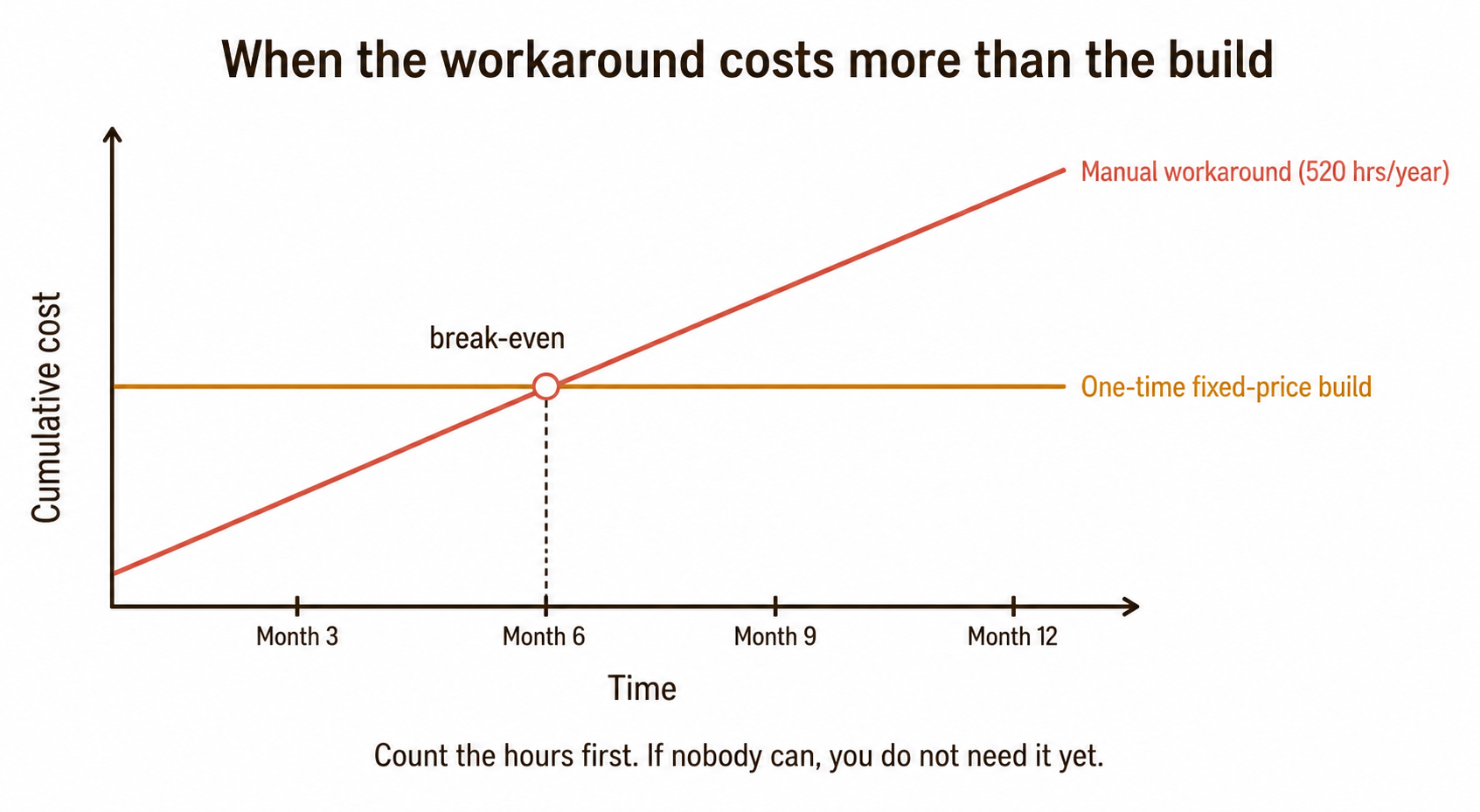
It stops being correct at the point where the workaround costs more than the software would.
That sounds circular until you actually count it. A workaround is a person's time, every week, forever. Two staff spending five hours a week each re-keying data between two systems is 520 hours a year. At any realistic loaded rate that is well past the cost of building the thing that removes it, and it recurs annually while the build does not.
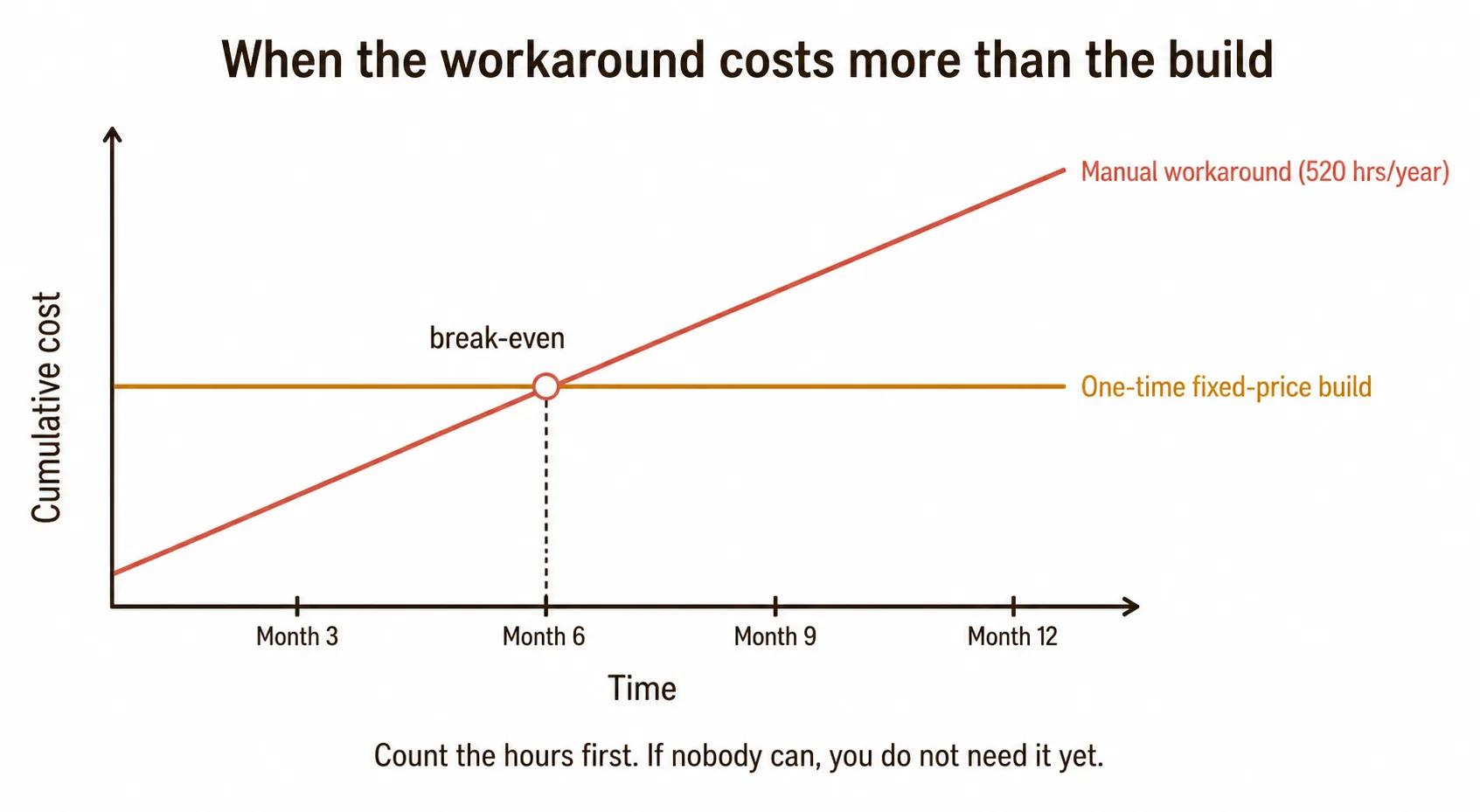
So the question is not "do we need custom software". It is "what are we currently paying, in hours per week, to work around not having it". If nobody can answer that in numbers, the answer is you do not need it yet.
The integration nobody sells. You use two tools that do not talk to each other and never will, because no vendor has a commercial reason to connect them. This is the most common good case, and usually the cheapest to solve. It sits at the bottom of our range: $4,000 to $10,000 for a single-purpose build over three to four weeks.
The process that is actually your business. If how you quote, schedule, or dispatch is the thing that makes you better than competitors, generic software will flatten it to the industry average. That is a real cost that never appears on an invoice.
Compliance nobody has productised. Your industry has a record-keeping requirement, the off-the-shelf tools cover 80% of it, and the missing 20% is what an auditor asks about. Rope Access Logbook was exactly this: a paper logbook that industrial technicians fill in at height, no signal, and it carries legal weight. It shipped in eight weeks.
"The tool is annoying." Annoying is not expensive. Count the hours before you act on irritation.
You want a cheaper version of an existing product. Building your own CRM to avoid a per-seat fee almost never pays. You are not just buying features, you are buying every future update and security patch, forever, and you become responsible for all of it.
The process changes every few months. Custom software encodes a process. If yours is genuinely still moving, encode it too early and you have bought a constraint.
Nobody internally will own it. Software needs someone to answer questions about it. Not a developer, an owner. Without one, it drifts into disuse in about a year and you have bought an expensive lesson.
Our published fixed-price band is $4,000 to $30,000. For a small business, the useful part of that range is the bottom.
$4,000 to $10,000, three to four weeks: one workflow, one integration, one user type. This covers the overwhelming majority of genuinely worthwhile small-business builds. The integration that nobody sells lives here.
$10,000 to $22,000, five to seven weeks: multiple integrations, more than one user role, real reporting.
Above that you are into platform territory, which is usually the wrong shape for a business under a certain size. Not always, but the burden of proof is higher.
The estimate is driven by how many external systems the software touches, not by how many screens it has. A three-screen app that reconciles inventory across two systems that disagree is more work than a fourteen-screen app that talks to nothing. We go into that in more detail in our cost breakdown by app type.
Whatever you are imagining, the first version should do one workflow, for one type of user, properly.
The instinct is to specify everything now because it feels more efficient to build it all at once. It is not. It is the reliable way to spend the whole budget before anything is in anyone's hands. Every project we have seen go badly at this scale went badly this way, and the second version is always different from what was specified up front, because using the first one changes what you know.
Cut integrations, not quality. One system, done properly, that you can extend. Cutting testing to hit a number costs more inside a year.
A client with a small field service business asked for a quote to replace their scheduling tool. They had a list of complaints about it and a rough spec for a replacement.
We asked the hours question. It turned out nobody was losing meaningful time to the scheduler at all. What they were losing time to was one specific thing: after each job, someone manually copied job details into their accounting software. About six hours a week, one person, every week.
That was not a scheduling tool replacement. It was one integration. We built it at the bottom of our range and they kept the scheduler they had been complaining about, because once the copying stopped, it was fine.
That is the pattern more often than not. The frustration attaches to the thing you look at most, and the cost sits somewhere quieter. Asking where the hours actually go, rather than what feels worst, is most of the work in scoping a small-business build.
We would rather do the $6,000 version of that project than sell the $25,000 one that also replaces a tool nobody needed replaced. Fake urgency and inflated scope work exactly once, and we publish real capacity, two engagements a quarter, and real prices, for the same reason.
Three things, and they take an afternoon:
If those three are hard to produce, that is a finding about readiness, not about vendors. For the vendor-selection side of it, our outsourcing decision guide covers what to check before signing anything.
Some of these tools work better as desktop software than as web apps; our custom desktop application development guide covers the three cases where that holds.
For a real small-business build, $4,000 to $10,000 over three to four weeks covers one workflow with one integration, which is the shape of most worthwhile projects at this scale. $10,000 to $22,000 covers multiple integrations and user roles. Our full fixed-price band runs to $30,000, but small businesses rarely need the top of it.
Only when the workaround is measurably expensive. Count the hours currently spent working around the gap. If two people lose five hours a week each, that is 520 hours a year and the build pays for itself quickly. If nobody can put a number on it, it is not worth it yet.
Usually not. You are not only replacing features, you are taking on every future update, security patch, and bug fix permanently. Per-seat frustration is rarely a good enough reason on its own. The integration nobody sells is a much better one.
One workflow, one user type, one integration, built properly. Specifying everything up front is the most reliable way to spend the budget before anything reaches a user, and the second version is always different once people have actually used the first.
Building a replacement for the tool that annoys people most, rather than the task that consumes the most hours. They are frequently not the same thing, and only one of them is worth money.
Written by the Codestreaks team in Austin, TX. The price bands are our own published fixed-price tiers across 30+ projects delivered to production since 2024, and the two-engagements-a-quarter capacity figure is real and published. The field service scheduling story and the six-hours-a-week finding are from a real scoping call, retold without naming the client, and that engagement ended smaller than the client expected to spend. The eight-week Rope Access Logbook timeline is from that project. Drafting is AI-assisted with a human editing pass against our own project record.
If you can tell us where the hours go, we can usually tell you within a call whether this is worth building, including when the answer is no. Free 30 minutes, reply within two business days.
More on how we work on our web development service page, or start a project.
A serial maker of SaaS products and AI agents, I’ve built and launched 10+ tools, grown products to thousands of users, and taken multiple ventures. I share the process what works, what breaks, and how builders can ship faster and smarter. Previously a data scientist at a Big Four consulting firm.