

Ecommerce, social, and education apps priced from our own fixed-price book of 30+ builds, and the one question that predicts the number better than screen count.

Most people asking what a mobile app costs have already been quoted three wildly different numbers. One agency said $15,000. Another said $120,000. A freelancer said six weeks and $9,000. Nobody explained why.
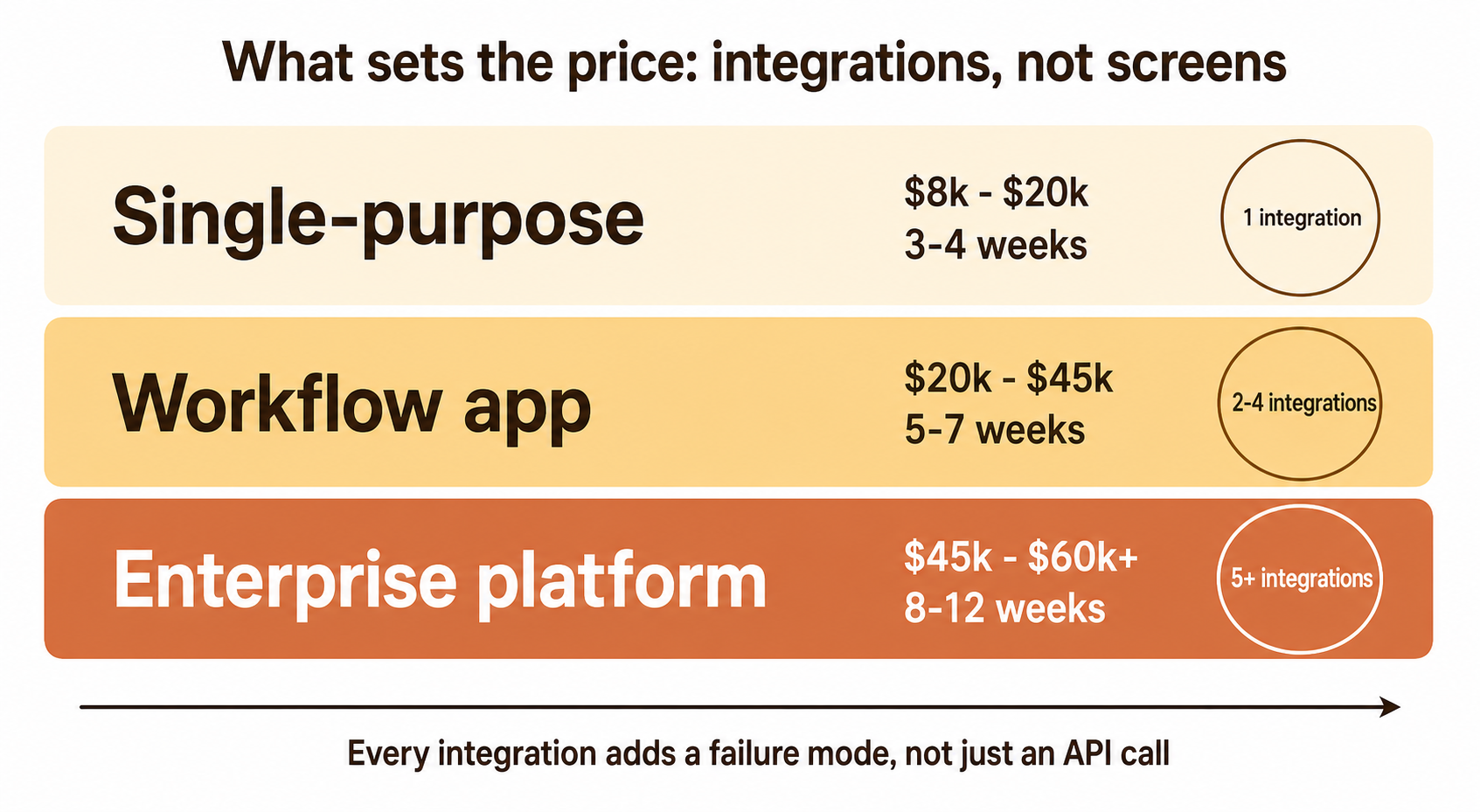
Here is the short answer, from our own book of work. At Codestreaks we price fixed, and across 30+ projects delivered to production since 2024 the band is $4,000 to $30,000. A single-purpose app runs $4,000 to $10,000 and ships in three to four weeks. A multi-step workflow app with real integrations runs $10,000 to $22,000 over five to seven weeks. An enterprise platform starts around $22,000 and runs to $30,000 and beyond, phased across eight to twelve weeks. Those are our real numbers, published, not a range designed to start a negotiation.
The spread between those tiers is not about screen count. It is about how many systems your app has to be honest with.
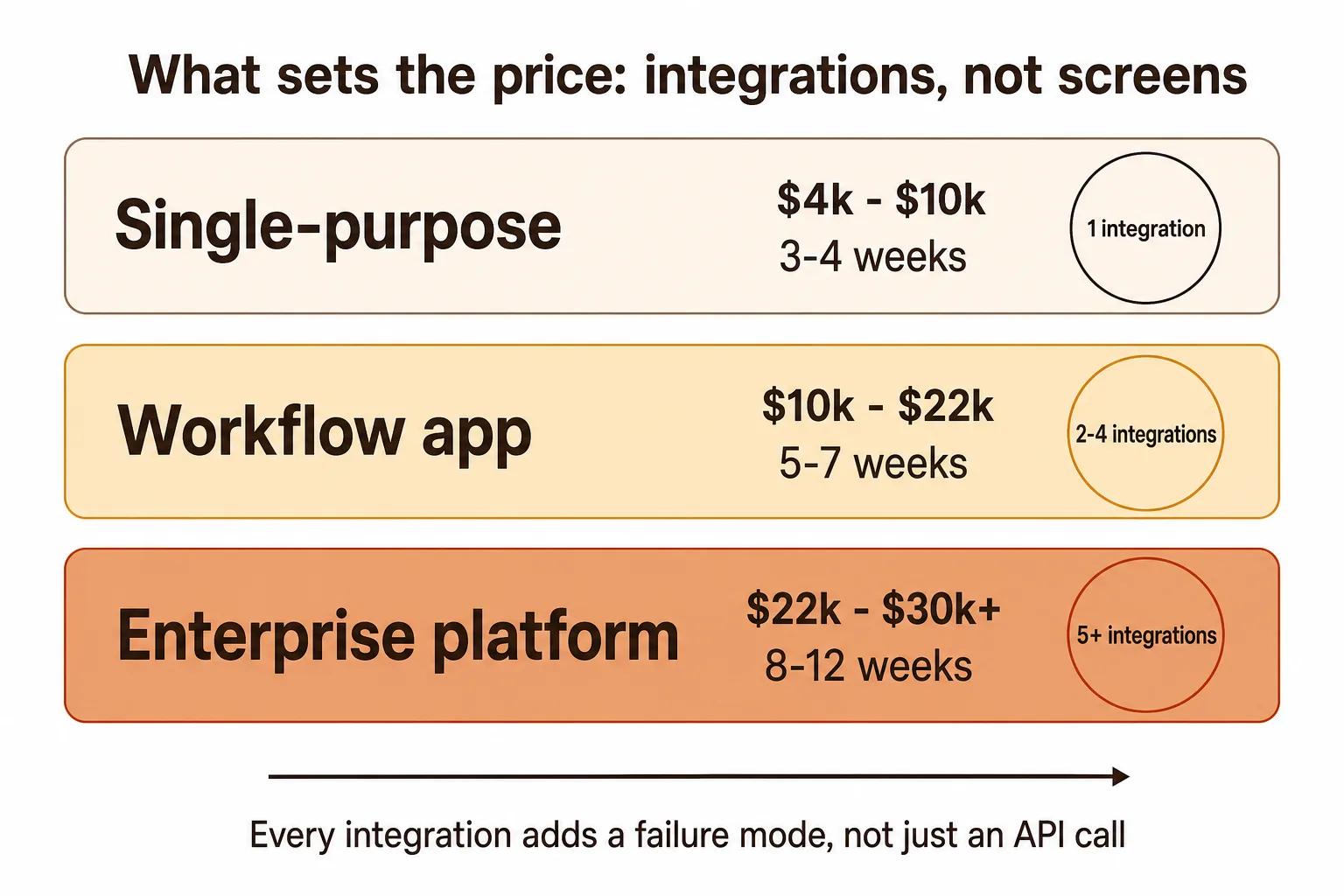
Ask an agency how many screens your app has and you learn nothing. Ask how many external systems it has to read from and write to, and you can price it in an afternoon.
A fitness tracker with 14 screens that talks to nothing but its own database is cheap. A three-screen ecommerce app that has to reconcile inventory with an ERP, take payment through a gateway with a settlement window, honour a loyalty balance that lives in a fourth system, and stay correct when two of those four are down, is not cheap. It has three screens.
Every integration adds a failure mode you have to design for, not just an API call you have to write. That is the part junior quotes miss. Writing the call takes an afternoon. Deciding what your app does when the inventory service returns stale data during a flash sale takes a design conversation and a week of defensive engineering.
When we scope, we count integrations first and screens last. It predicts the number better than anything else we have tried.
Ecommerce is the app type where clients are most often surprised, and it is almost always payments and inventory.
A catalogue and a cart are commodity work. We have built them enough times that the estimate barely moves. What moves the estimate is everything downstream of the buy button. Payment gateway integration with proper idempotency so a double-tap does not double-charge. Refund and partial-refund flows, which most briefs forget entirely until week six. Tax and shipping calculation that matches whatever the web store already does, because a customer who sees a different total in the app than on the site will not buy from either again. Inventory that does not oversell.
Budget $12,000 to $27,000 for a real one. The bottom of that range assumes you have a clean commerce backend already (Shopify, BigCommerce, a well-built custom API) and the app is a client on top of it. The top assumes we are reconciling two systems that disagree.
If you already have a web store and are deciding whether the app is worth it at all, we worked through that decision separately in our ecommerce mobile app guide.
Social apps look cheap in a wireframe. Post, scroll, like, follow. Four verbs.
The cost is in the feed and in moderation. A feed that reads well at 200 users is a database query. A feed that reads well at 200,000 users is a ranking system with a cache strategy, and it is a different piece of software. Building the first and hoping it becomes the second is the single most common way a social app burns its budget twice.
Moderation is the other one nobody prices. The moment users can post, you need reporting, blocking, a review queue, and someone to staff it. Skip it and your app gets pulled from the store, which is a cost with a zero in front of it that nobody put in the estimate.
Real range: $15,000 to $30,000, and be honest with yourself about scale before you pick a number inside it. We went deeper on the architecture side in our social media app build guide.
Education apps have a quiet second product inside them. The learner app is what you demo. The thing that decides whether it survives is the tool your team uses to get content in.
We have watched more than one education build spend its whole budget on a beautiful student experience, ship, and then discover the only way to add a lesson is a developer running a script. The client has a content team of six people who now cannot do their jobs.
Price the admin side from day one. It is usually 30 to 40 percent of the total. That puts a realistic education app at $9,000 to $20,000, and the low end only applies if you genuinely can live with a spreadsheet import for the first year.
Five things, in rough order of how often they blow an estimate:
Offline behaviour. "It should work on the subway" is a different app. Conflict resolution when two devices edited the same record offline is real engineering, not a checkbox.
Compliance. HIPAA, PCI, GDPR, SOC 2. Each one adds audit trails, encryption requirements, and documentation that has to exist before you can sell. Add 20 to 30 percent, and do not discover this in month three.
Real-time. Live chat, live location, live collaboration. Sockets are easy. Sockets that reconnect cleanly on a flaky cellular handoff are not.
Design from scratch versus a system. A defined design system saves weeks. Bespoke screens for everything costs them.
Legacy systems. If your app has to talk to something written in 2009 that nobody currently employed understands, that is the project. The app is a side effect.
Some things get quoted as expensive that genuinely are not, and you should push back.
Cross-platform versus native is mostly a false premium in 2026. Most business apps have no meaningful reason to be two codebases. We covered where that actually breaks down in our cross-platform guide.
Push notifications, analytics, crash reporting, authentication, and app store submission are all solved. If any of those appear as a big line item, ask why.
A client came to us with a $140,000 quote from another shop for what they described as a marketplace app. We asked our integration question. The answer was two systems: Stripe and their own Postgres database. Everything else in the brief was screens.
We scoped it at $19,000 over six weeks. It shipped. The difference was not that we are cheap. The difference is that the other quote priced 40 screens and we priced two integrations and a defensible data model.
The reverse happens too, and we say so. A client wanted a "simple" logbook app for industrial rope access technicians. Simple, except it replaced a paper record that carries legal weight, needed to work with no signal at height, and had to satisfy an auditor. That one was not a $6,000 app. Rope Access Logbook shipped in eight weeks, and its founder Chad Dubuisson put it this way: "Codestreaks took our rough idea and turned it into a real product in just 8 weeks. The way they built it saved us months of headaches down the road."
Eight weeks was the honest number. Quoting three would have been a lie with an invoice attached.
Four questions that separate a real estimate from a guess:
That last one is not a cost question, but it decides what your money bought. If an agency will not hand you the code, you rented an app. We give every client 100% code ownership and 30 days of post-launch support, and we think anything else is a bad deal regardless of price.
For a production app from a real team, $4,000 to $30,000 covers most of the market. Single-purpose apps sit at $4,000 to $10,000, workflow apps with integrations at $10,000 to $22,000, and enterprise platforms at $22,000 and up. Anything materially under $4,000 is usually a template, an offshore body shop, or a quote that will change.
Because most briefs are ambiguous about integrations, offline behaviour, and admin tooling, and each agency resolves that ambiguity differently. One prices the happy path, another prices the failure modes. Give three agencies the same explicit integration list and the spread narrows dramatically.
Yes, meaningfully. A clean commerce backend turns the app into a client rather than a reconciliation project. That is usually the difference between the $12,000 end of the range and the $27,000 end.
For most business apps, yes, and by more than people expect, because the saving compounds across every future change rather than showing up once at build time. It stops being the right call when you need deep platform-specific hardware access or the app is a performance-critical game.
Cut integrations, not quality. One system, one user type, one workflow done properly. That is a real $4,000 to $10,000 app that you can extend. Cutting testing or admin tooling to hit a number costs more within a year.
Written by the Codestreaks team in Austin, TX. The cost bands here are our own published fixed-price tiers, drawn from 30+ projects delivered to production since 2024, not survey data or industry averages. The eight-week Rope Access Logbook timeline and Chad Dubuisson's quote are from that engagement. Drafting is AI-assisted and every post is edited by a human against our real project data before it ships. Where we did not have our own measurement, we left the claim out rather than borrowing someone else's number.
If you have a brief and want a straight number against it, we do free 30-minute scoping calls and reply within two business days. Bring your integration list, not your screen count.
See what a build actually involves on our mobile app development service page, or start a project when you are ready.
A serial maker of SaaS products and AI agents, I’ve built and launched 10+ tools, grown products to thousands of users, and taken multiple ventures. I share the process what works, what breaks, and how builders can ship faster and smarter. Previously a data scientist at a Big Four consulting firm.


