

Custom travel software development takes 4 to 8 weeks for a single-supplier booking tool. Supplier integrations, not screens, set the cost and the timeline.
Codestreaks Team

Custom software development for travel means building booking, itinerary, and operations tools around suppliers you do not control. That last part is the whole job. Your feature list is not what decides the timeline. The number of external systems you have to talk to, and how badly each one behaves, is what decides it.
We have delivered 30+ projects to production since 2024, and travel work has a shape you can spot early. The interface is straightforward. The data underneath arrives late, arrives incomplete, and occasionally contradicts itself between two calls thirty seconds apart. Teams that budget for the interface and not the plumbing are the ones who end up six weeks over.
Here is what actually matters when you scope a travel build.
A travel platform is mostly a translation layer. Flights come from a GDS or an aggregator. Hotels come from a bed bank, sometimes several. Cars, transfers, activities, insurance, and payments each arrive from somewhere else, in a different shape, with different rules about what a date means.
The practical consequence: you cannot design the data model from your own product spec. You design it from the intersection of what your suppliers actually return. Every field you promise a user has to survive that intersection. If one supplier gives you a room description as structured amenities and another gives you a paragraph of marketing text, your comparison screen has a problem no amount of frontend work will fix.
We scope travel projects by listing the integrations first, before any screens. That ordering is the same one we use in our general custom software development process, where scoping is one of the two stages projects actually fail at. For each one, three questions. Is it REST or something older. Does it have a sandbox that behaves like production. What is the rate limit. The answers move estimates by weeks, not days.
Live availability calls are slow. A search across several suppliers can take multiple seconds, which is unusable on a results page. So everyone caches. The question nobody asks early enough is what happens when the cache is wrong.
A cached price that is stale by an hour will show a customer a fare they cannot book. They reach checkout, the live call comes back different, and now you are choosing between eating the difference, showing an error, or silently rebooking at a higher price. Each of those is a policy decision with revenue attached, and it belongs to the business, not to whoever writes the caching layer at 11pm.
Decide it up front and write it down. How long is a price valid. Who absorbs a small difference. At what threshold does the customer get told. Then the engineering is simple. Skip that conversation and you get an inbox full of complaints that read like bugs but are actually unmade decisions.
A package booking touches several suppliers that have no knowledge of each other. The flight confirms. The hotel fails. Now you are holding a confirmed flight for a trip that does not exist, and the hotel supplier has no rollback.
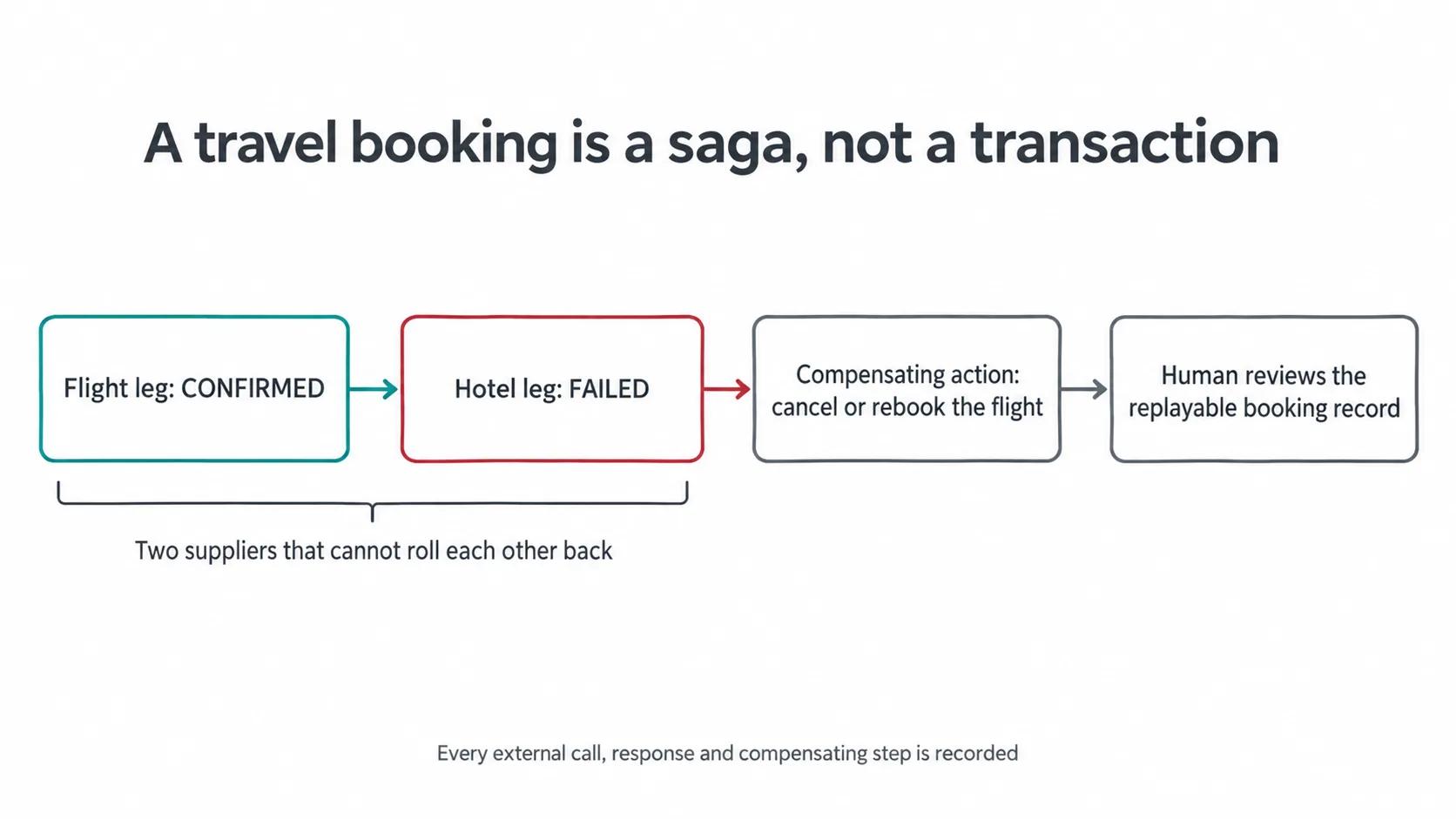
This is the part of travel software that separates a working system from a demo. You need a booking state machine that records every external call, every response, and every compensating action, and that can be replayed by a human at 2am when a customer is on the phone. Not a log file. A queryable record of what your system asked, what came back, and what it did next.
Most of our work across projects is reliability engineering rather than the first demo, and travel is the clearest example of why. Prototypes lie. The same pattern shows up in why web application timelines slip. A booking flow that works on five hand-picked test itineraries tells you nothing about the five thousand real ones, where a supplier times out mid-confirmation and a customer has already been charged.
One pattern we see constantly across industries: ops teams doing triage by hand at night because the tool does not talk to the other tool. Travel operators live in that pattern. Someone is reconciling a supplier confirmation email against a booking record by eye, at an hour when nobody should be awake, because the two systems were never connected.
That gap is usually one integration and one agent away from gone, which is the shape of most AI customer service automation that actually earns its keep. Not a platform rebuild. A specific job that reads confirmations, matches them to bookings, and escalates only the ones that genuinely disagree. It is unglamorous work and it is the highest-return thing in most travel operations, because it removes a nightly human step that scales linearly with bookings.
Most teams do not need a transformation program. They need three boring workflows automated properly.
Our typical engagement runs 4 to 8 weeks from kickoff to live deployment, at $4,000 to $30,000 fixed price depending on scope. For travel specifically, the range widens on integration count more than on screen count.
A single-supplier booking tool with one payment provider sits at the low end and ships in the usual window. A multi-supplier aggregator with cached inventory, a booking saga, and reconciliation is a phased build in the $22,000 and up range, because you are effectively writing one small integration project per supplier and then a coordination layer over the top.
The estimate that should worry you is the one that quotes a travel platform without asking which suppliers you use. That quote is priced on screens. The screens are not the work.
Useful right now: normalizing messy supplier content into consistent structured data, matching duplicate hotel records across bed banks, drafting itinerary summaries, and triaging support queues so a human sees the exceptions rather than everything.
Not useful right now: anything where a wrong answer books something. Pricing, availability, and payment must stay deterministic. An agent that decides a fare is probably still valid is not a feature, it is a liability with a chat interface.
If you do add an agent to a travel operation, it needs an evaluation suite before it touches a customer path. Inference cost is usually not the constraint. Production agents typically run $50 to $2,000 per month, and good engineering around caching, model routing, and prompt design cuts that by 3 to 10 times. The constraint is what happens on the wrong answer.
Ask for the integration list and the sandbox status of each one. Ask what happens when a supplier returns a price different from the cached one, and listen for whether the answer is a policy or a shrug. Ask to see a booking record from a previous project, redacted, so you can tell whether the system can explain what it did.
And ask who owns the repository. Every client of ours gets 100% code ownership and 30 days post-launch support, because owned software compounds and rented software does not. If an agency will not hand over the repo, that answers a different and more important question.
Written by the Codestreaks team, drafted with AI assistance and edited by a human against our own delivery history. We have shipped 30+ projects to production since 2024, take on two engagements per quarter, and our builds run 4 to 8 weeks from kickoff to live, so the scoping order here (integrations before screens) is how we actually scope, not a template. The booking saga in the diagram is ours. No client names appear in this post, and the supplier behaviours described are general patterns rather than any one engagement.
A single-supplier booking tool typically ships in our normal 4 to 8 week window. Multi-supplier platforms with cached inventory and a booking saga run longer and are best phased, because each supplier integration behaves like its own small project.
Off-the-shelf wins when your suppliers and your process match what the product assumes. Custom wins when your margin comes from something the standard flow cannot express, such as unusual packaging rules, negotiated rates, or an operations workflow that is genuinely yours.
Coordinating a booking across suppliers that cannot roll each other back, and deciding what the system does when one leg confirms and another fails. That single problem drives more of the architecture than any customer-facing feature.
Only if you are selling flights that require it. Many operators do fine on aggregator APIs with lower integration overhead. Decide it on your inventory, not on what sounds complete.
Rate limits and per-call pricing should be modeled during scoping, not discovered in month two. Caching strategy, search fan-out, and how often you refresh availability all change the monthly bill materially.
If you are weighing a travel build, the fastest way to a real number is a scoping conversation about your suppliers rather than your screens. We offer a free 30-minute scoping call, and we reply within two business days. We take on two engagements per quarter and we say no when scope does not fit, so the call is a real conversation rather than a pitch.
See how we approach custom web development, or start a project and tell us which suppliers you are working with.


