

The super app strategy for SaaS: when bundling micro-tools into one AI ecosystem beats standalone apps, real economics, and the platform risks.

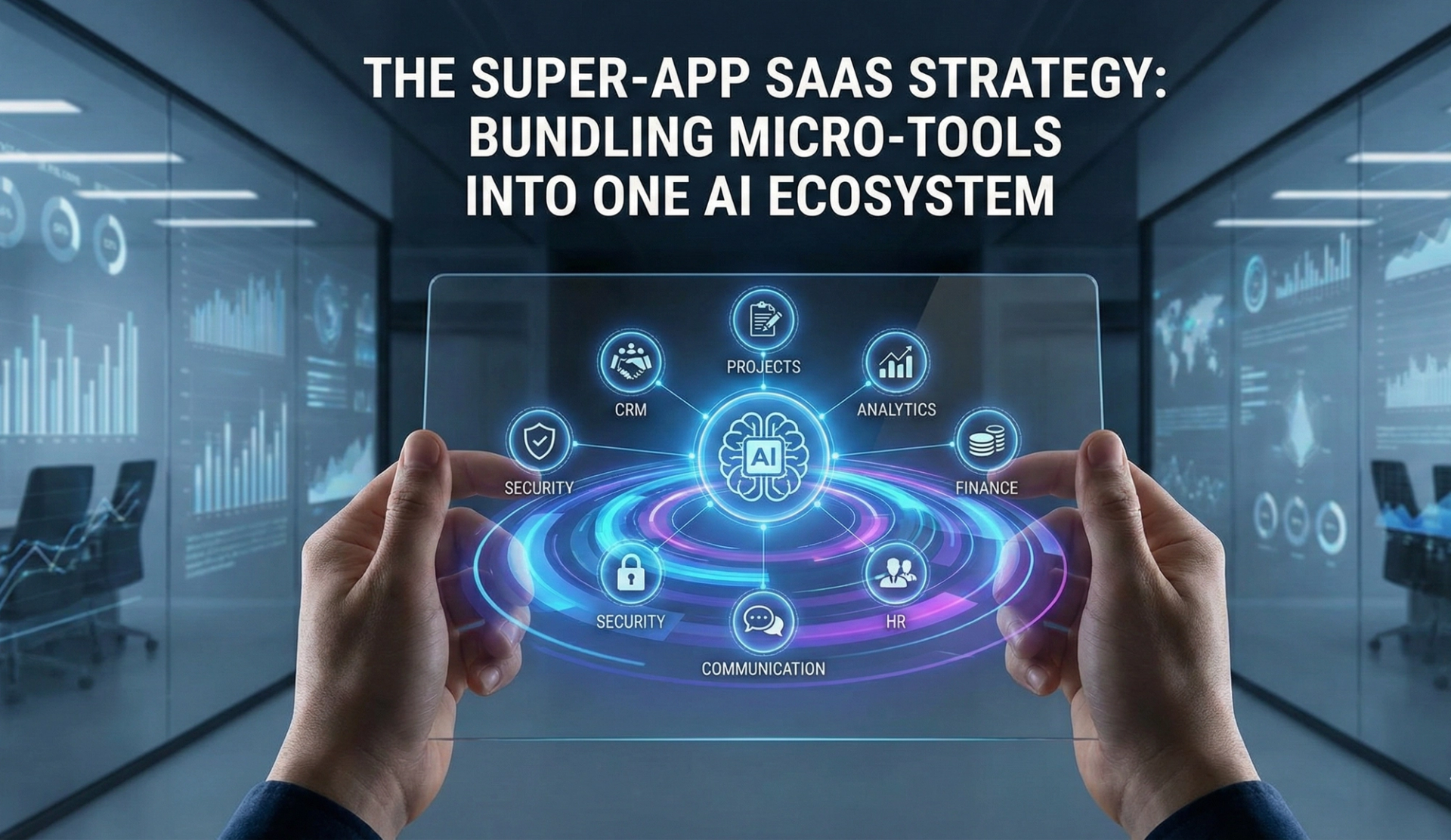
The super app strategy for SaaS means bundling several narrow tools, scheduling, invoicing, CRM, messaging, into one platform built for a single vertical, with an AI assistant wiring them together. It beats selling standalone micro-tools when your users are already paying for four subscriptions that refuse to talk to each other.
That sentence hides a lot of nuance. Bundling is not automatically the right move, and the graveyard of failed "everything apps" is large. This article walks through the economics of the super app strategy, when it wins, when unbundling still beats it, and the platform risks that never make it into the pitch deck.
A super app is a single platform that absorbs jobs its users currently spread across many products. Gartner named superapps a top strategic technology trend, defining them as apps that combine a core product with an ecosystem of mini-services. WeChat did it for Chinese consumers with messaging, payments, and commerce in one place. Grab did it for Southeast Asia with rides, food delivery, and financial services.
The SaaS version is narrower and, frankly, more buildable. You don't try to be everything for everyone. You pick one vertical, say residential plumbing companies, and become the operating system for that business: scheduling, dispatch, invoicing, payments, customer messaging, and reporting in one product. The consumer super app playbook needed hundreds of millions of users. The vertical SaaS version needs a few hundred companies that each pay $300-$2,000 a month because you replaced five tools they hated stitching together.
The 2026 twist is the connective layer. Earlier vertical platforms bundled features side by side; the user still carried data between them. Now an AI assistant sits across the bundle and moves work between modules on its own. That changes the bundling math, which is where we'll start.

Bundling works when the bundle is worth more than the sum of its parts. For SaaS, that surplus comes from four places.
Shared data. When scheduling and invoicing live in the same database, an appointment that runs long can update the invoice automatically. Across five separate tools, that same behavior requires webhooks, a middleware subscription, and someone who maintains the glue. The integration is the product.
One login, one bill. Subscription fatigue is real. A ten-person services business commonly pays for a scheduler, an accounting tool, a chat app, a project tracker, and a forms product. Each renewal is a moment where someone asks "do we still need this?" A bundle turns five churn opportunities into one.
Lower effective CAC. Acquiring a customer for a $29/month point tool and a $500/month platform costs surprisingly similar amounts. The sales conversation, the demo, the onboarding call. Bundling amortizes acquisition cost across more revenue per account.
Pricing power through switching costs. When you hold the schedule, the invoices, and the customer history, leaving you means migrating three systems at once. That's uncomfortable to say out loud, but it's the honest core of the model, and your customers know it too, which is why trust matters so much (more on that below).
Here's how the value stacks against a fragmented setup for a typical field-services company:
| Job to be done | Fragmented stack | Vertical super app |
|---|---|---|
| Scheduling | $30-$50/mo point tool | Included |
| Invoicing and payments | $30-$80/mo + card fees | Included + platform take rate |
| Customer messaging | $25-$50/mo | Included |
| Reporting | Spreadsheets, manual | Automatic, cross-module |
| Integration upkeep | Zapier/Make + owner's evenings | None, it's one database |
Bundling is not a default. There are three situations where a focused micro-tool beats a bundle, and pretending otherwise would be bad advice.
When the category leader is genuinely excellent. You will not out-accounting QuickBooks. If every job in the workflow already has a beloved best-in-class tool, your bundle competes on convenience against five products competing on depth. You'll lose. Bundles win where the incumbents are mediocre and the pain lives in the seams between them.
When you haven't earned distribution yet. A super app is a marathon of surface area. A solo founder or small team should usually ship one sharp wedge first, get 100 customers, and expand from there. We covered that entry path in why micro-SaaS is the right first product for most founders. The micro-tool and the super app aren't opposing strategies. One is the beachhead, the other is the endgame.
When the vertical is too small. Bundling multiplies your build cost. If the total market is 2,000 companies, the LTV expansion may never pay back the surface area you have to build and maintain.
The practical sequence we recommend to clients: launch one module that solves the vertical's most hated task, then bundle outward one module per quarter, in the order your existing users beg for.

This is the part most 2026 bundling articles get backwards. The AI assistant is not another module in the bundle. It's the reason the bundle finally works.
Pre-AI vertical platforms bundled features but not workflows. The data sat in one database, yet a human still noticed the meeting ran over, opened the invoicing screen, and edited the line item. The super app strategy becomes materially stronger when an agent does the noticing.
In the platforms we build, each module exposes its actions to a shared agent layer. The scheduling agent sees an appointment stretch from 60 to 95 minutes, tells the invoicing agent, which drafts the updated bill and queues it for the owner's one-tap approval. Nobody re-keys anything. This kind of agentic workflow across your existing operations is also where hybrid monetization gets interesting: you can price the platform seat and take a small percentage of payment volume, because payments flow through you. Rails like Stripe Connect exist precisely so a vertical platform can embed payments and earn a take rate without becoming a bank.
A warning from the trenches, though. An agent without an evaluation suite is a liability with a chat interface. Cross-module agents touch money and calendars, so every automated action in our builds runs against an eval suite and ships with an approval gate until its error rate earns autonomy. Budget for that engineering. It's also worth knowing the running cost is manageable: production agent inference typically lands between $50 and $2,000 a month, and decent engineering (caching, model routing, tight prompts) cuts it 3-10x.
From the field. A pattern we keep meeting: an ops lead doing triage by hand at 2am because "the tool doesn't talk to the other tool." One client's night shift was manually copying job completions from their scheduler into their billing system before invoices could go out. That gap was one integration and one agent away from gone. Most super app value is exactly this, hundreds of small seams, closed.
An honest version of this strategy prices in the downside. Here's what we flag in scoping calls.
You become the single point of failure. When a customer gives you their schedule, their payment rails, and their client list, your downtime is their downtime. A point tool going down is annoying. The operating system going down stops the business. That means real SLAs, real observability, and security architecture as a first-class feature, not a compliance checkbox. It's also your strongest enterprise selling point if you do it well: one audited platform is easier to trust than seven tools duct-taped together with API keys in a shared doc.
Surface area compounds. Every module you add is a module you maintain forever. Bundles die from mediocrity spread thin more often than from competition.
Platform dependency cuts both ways. If your payments margin depends on one processor and your agents depend on one model vendor, you inherit their pricing decisions. Buy the outcome, not the model. Model names change quarterly; the workflow engine you own compounds.
The glue-stack trap. Some founders try to fake the bundle with a no-code layer: five tools, thirty Zapier scenarios, one brave demo. That stack is great until it becomes load-bearing. Then nobody can debug it, and the person who built the zaps has left. A super app is a data architecture decision, and you can't retrofit one out of webhooks.
Less than you'd guess, if you phase it. Nobody should build six modules before revenue. The pattern that works is wedge first, bundle later, and it maps cleanly onto how we price fixed-scope builds:
| Phase | What ships | Typical cost | Timeline |
|---|---|---|---|
| Wedge | One module + single-purpose agent | $4,000-$10,000 | 3-4 weeks |
| Bundle v1 | 2-3 modules, shared data layer, cross-module agent | $10,000-$22,000 | 5-7 weeks |
| Platform | Full ecosystem, payments take rate, admin, evals | $22,000-$30,000+ | 8-12 weeks, phased |
Those are fixed prices, not estimates that drift. We've shipped 30+ projects to production since 2024 on that model, and the recurring lesson is that the wedge phase teaches you which modules the vertical actually wants, which is knowledge no amount of upfront planning buys.
No. WeChat and Grab needed national-scale consumer bases because their margins per user were thin. A vertical SaaS super app inverts that: a few hundred businesses paying $300-$2,000 a month is a strong company. The strategy scales down because business software monetizes depth of workflow, not breadth of audience.
Start with the wedge in almost every case. One module that kills the vertical's most hated task gets you customers, revenue, and a map of what to bundle next. Founders who build five mediocre modules before their first customer usually run out of money before they run out of roadmap. Bundle from a beachhead, not from a whiteboard.
Each module exposes its actions (create invoice, move appointment, send message) to a shared agent layer with access to the unified database. Agents watch for events in one module and act in another, with approval gates on anything touching money. The critical engineering is the evaluation suite that measures error rates before an action earns autonomy.
Concentration. Your customers concentrate their operations on you, so your reliability and security have to be an order of magnitude better than a point tool's. Internally, the risk is thin mediocrity: every added module is permanent maintenance. Bundles usually lose to neglect of their own modules, not to competitors.
You don't need a six-module platform to test this strategy. You need the one wedge your vertical will pay for and a data architecture that won't fight you when module two arrives. That second part is where most rebuilds come from, and it's cheap to get right on day one.
If you're deciding between a micro-tool and a bundle, we'll give you a straight answer either way on a free 30-minute scoping call. We respond within two business days, we take on two engagements per quarter, and every client keeps 100% ownership of the code. Have a look at how we approach SaaS platform development, or tell us what you're building and we'll scope the wedge with you.
A serial maker of SaaS products and AI agents, I’ve built and launched 10+ tools, grown products to thousands of users, and taken multiple ventures. I share the process what works, what breaks, and how builders can ship faster and smarter. Previously a data scientist at a Big Four consulting firm.


