

Field service app development for US trades: offline-first sync, on-device AI agents, and real costs. What works when the job site has no signal.

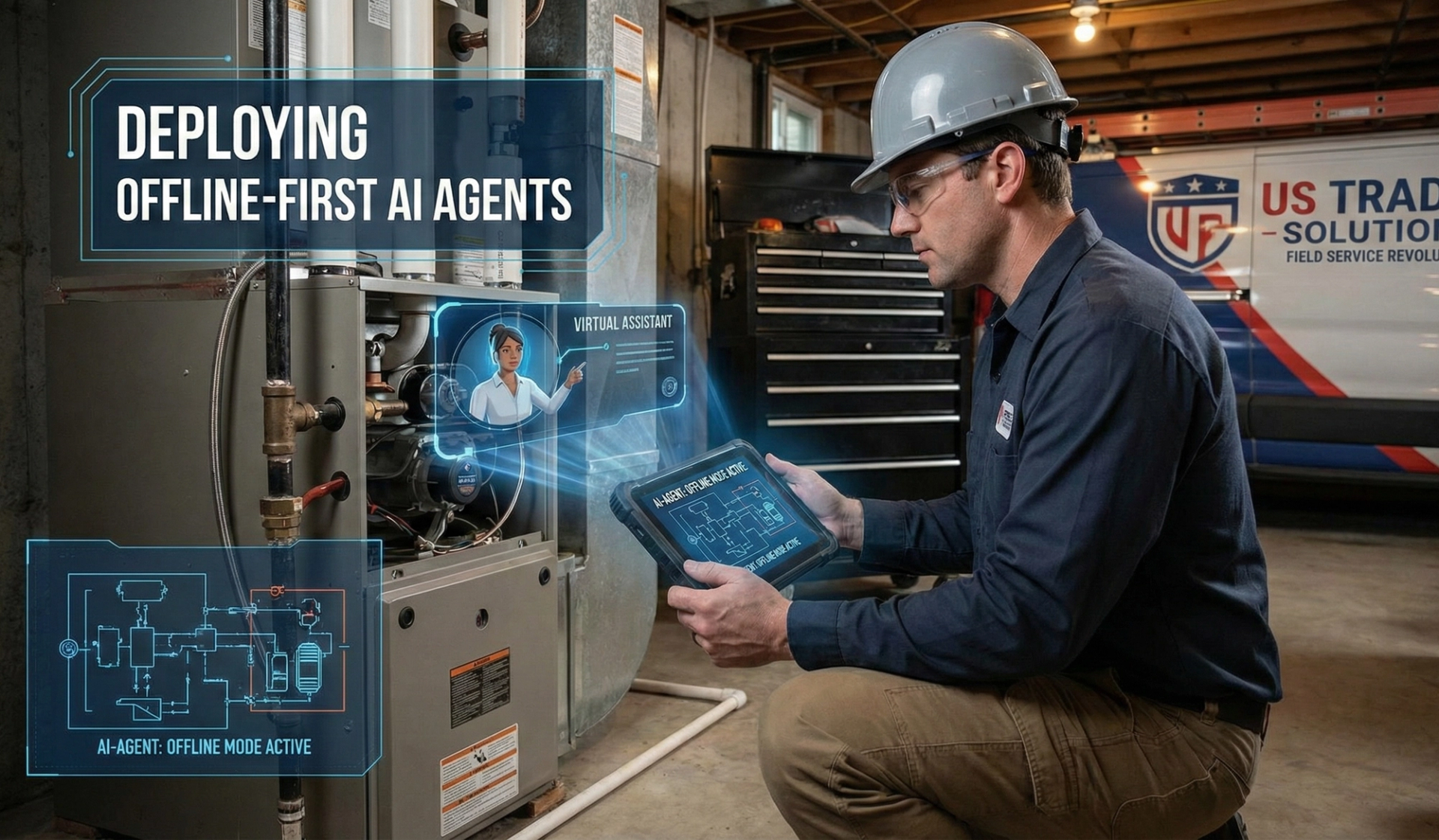
Field service app development for US trades has one non-negotiable requirement: the app must work with no signal. That means offline-first architecture (a local database, a sync queue, conflict resolution) plus on-device AI for diagnostics and paperwork. Built right, one technician closes out jobs in minutes instead of spending evenings on admin.
Most field service management software fails that test. It was designed in an office, on office wifi, for people who sit at desks. The technician under a house in Austin or on a cell tower in Nevada gets a spinning loader and a form with eleven required fields. Then the real record keeping happens later, from memory, in the truck.
Field service app development is not a smaller version of building a SaaS dashboard. The constraints are inverted. A web app assumes connectivity and treats offline as an error state. A field app has to assume disconnection and treat the network as an occasional luxury.
Three things follow from that.
First, the source of truth lives on the device, not the server. Every read and every write hits a local database, so the app is fast and functional in a basement, a crawlspace, or a rural job site. The server's job is reconciliation, not gatekeeping.
Second, sync is a product feature, not an infrastructure detail. When two people edit the same work order while one of them is offline, somebody has to decide what happens. If your architecture doesn't answer that question explicitly, your users will answer it with duplicate invoices and lost job notes.
Third, the hardware is hostile. Gloves, sunlight, dust, one free hand. Interfaces that survive this are built around big targets, voice input, and camera capture, not dense tables. This is the same discipline that drives good IoT mobile app development: the device at the edge has to be self-sufficient, because the edge is where the work is.
The market pressure is real too. The US Bureau of Labor Statistics projects hundreds of thousands of annual openings across installation, maintenance, and repair occupations, and shops cannot hire their way out of the gap. The only lever left is making each technician meaningfully faster. Software that removes 45 minutes of daily admin per tech is not a convenience. At a crew of ten, it's a hire you didn't have to make.

"Works offline" is a checkbox on a lot of vendor sites. Offline-first is an architecture, and the difference shows up the first week in the field.
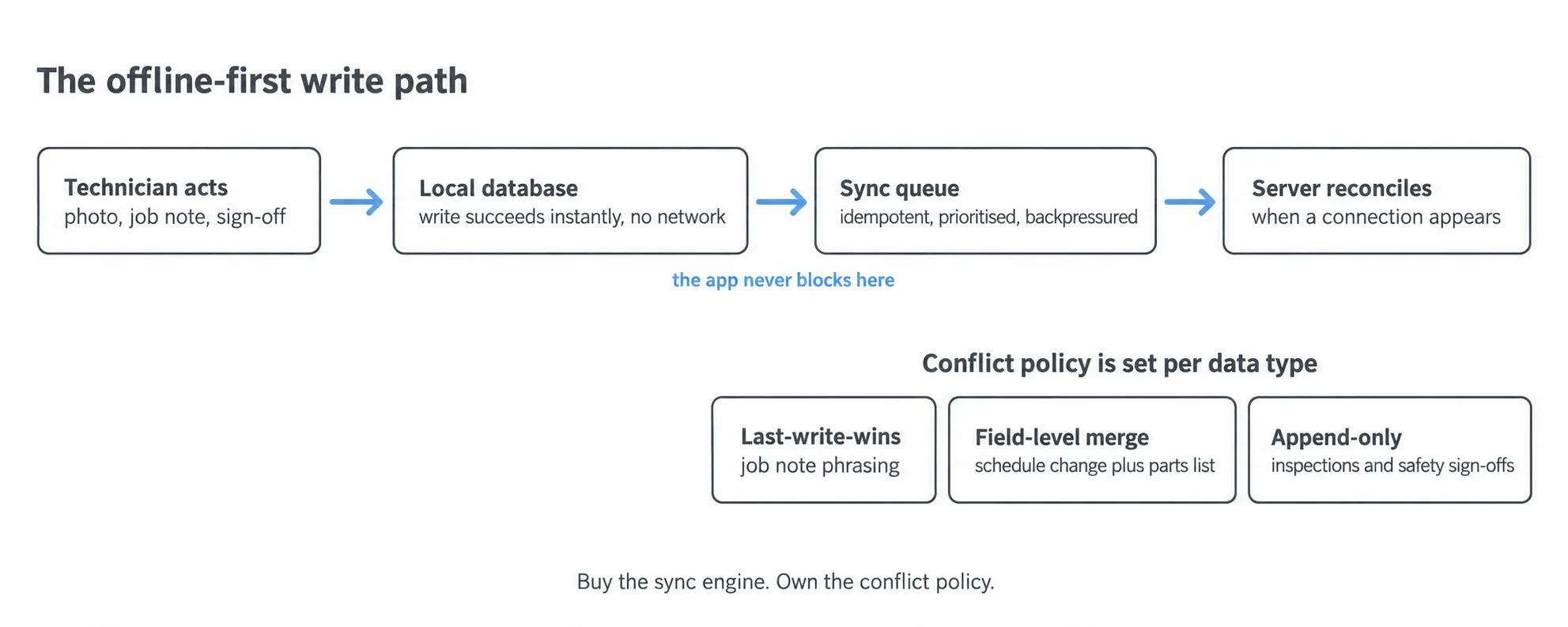
An offline-first app writes every change to a local store immediately, queues those changes, and replicates them to the server when a connection appears. The app never blocks on the network. Apple's Reachability check before an action, the pattern most retrofitted apps use, is the opposite: it makes connectivity a precondition for work.
The hard part is not storing data locally. SQLite has done that reliably for two decades. The hard parts are the sync queue and conflict resolution.
A sync queue is an ordered log of local mutations waiting to replicate. It sounds trivial until you handle the real cases: the upload that dies at 80% on a weak LTE connection, the photo batch that's 200MB because the foreman documented a whole panel swap, the device that comes back online after nine days in a truck. Your queue needs idempotent writes (so retries don't duplicate invoices), prioritization (job status before photo attachments), and backpressure so a big backlog doesn't lock the UI.
Conflicts are inevitable, so pick a strategy per data type instead of one global rule:
You rarely need to build this machinery from scratch anymore. CouchDB's replication protocol has handled multi-master sync with revision trees since before "offline-first" was a term, and newer engines like PowerSync sit on top of Postgres and SQLite so your backend stays boring. Here's how the main options compare for a trades app:
| Approach | Good fit | Watch out for |
|---|---|---|
| CouchDB + PouchDB | Document-shaped data, proven replication | Query model is limiting for relational reporting |
| PowerSync / ElectricSQL | Existing Postgres backend, SQL on device | Newer ecosystem, review sync rules carefully |
| WatermelonDB + custom API | React Native apps, full control | You own conflict resolution end to end |
| Fully custom queue | Unusual data shapes, strict compliance | Highest cost, easiest to get subtly wrong |
Our opinion, having built this more than once: buy the sync engine, own the conflict policy. The replication plumbing is a solved problem. The decision about what happens when a dispatcher and a technician disagree about a work order is your business logic, and no library ships it.
The current wave of field service app development adds a second layer on top of offline-first data: agents that do the paperwork. Not a chatbot in a corner of the screen. Software that completes multi-step admin work the technician used to do by hand.
The use cases that actually hold up:
The offline constraint shapes the AI stack. Cloud calls to a frontier model are fine for the back office, useless in a crawlspace. So the pattern is a small language model or vision model running on the device via Core ML on iOS or LiteRT (formerly TensorFlow Lite) on Android, backed by a local vector index in SQLite for schematic and manual lookup. On-device models are less capable than cloud models, and that's acceptable. Drafting a work order from a voice note doesn't need a genius. It needs to work at the bottom of a basement stairwell, every time.
One warning from our own client pattern: a demo agent that nails five hand-picked photos in a conference room tells you nothing about five thousand real jobs shot in bad light with mud on the lens. Prototypes lie. The distance between a demo and a deployable field agent is evaluation suites, fallback paths, and honest confidence thresholds. We wrote about the same gap for office workflows in our AI automation guide for small business, and it's wider in the field.

Rope access technicians (the people who inspect towers, bridges, and wind turbines while hanging from ropes) log every working hour on paper because their certifications depend on those records. Chad Dubuisson, the founder of Rope Access Logbook, came to us to replace that paper with a digital logbook that had to be trustworthy at height, with no signal, in an industry where a lost record can cost a certification.
We shipped it in 8 weeks. The unglamorous decisions mattered most: append-only entries so a synced record could never silently overwrite a signed one, and local-first storage so a technician on a turbine 200 feet up never sees a spinner. Chad's verdict: "Codestreaks took our rough idea and turned it into a real product in just 8 weeks. The way they built it saved us months of headaches down the road."
That project is why we push back when founders want to start with the AI layer. Get the offline data layer right first. An agent writing into a sync architecture that loses records is a liability with a nice demo.
Honest numbers, based on 30+ projects we've delivered to production since 2024:
| Scope | Typical price | Timeline |
|---|---|---|
| Offline-first field app, core workflows (jobs, photos, sync) | $10,000-$22,000 | 5-7 weeks |
| Above plus a single-purpose AI agent (voice-to-work-order or photo triage) | $30,000-$50,000 | 6-8 weeks |
| Full platform: field app, dispatcher dashboard, agent layer, integrations | $22,000-$30,000+ | 8-12 weeks, phased |
Offline-first adds roughly 20-30% to build cost versus an online-only equivalent, almost all of it in sync and conflict handling. It's the best money in the budget. The apps that skip it are the ones technicians quietly abandon for text messages and paper by month two.
Ongoing AI inference typically runs $50-$2,000/month depending on volume, and pushing inference on-device cuts the marginal cost of most field interactions to zero. Good engineering (model routing, caching, small models for small jobs) routinely cuts cloud inference bills 3-10x.
An offline-first app treats the device as the primary database. Every action (logging a job, capturing photos, drafting an invoice) writes locally and succeeds instantly, whether or not there's signal. A background sync engine replicates changes to the server when connectivity returns and resolves conflicts by policy. The network becomes an optimization, not a requirement.
Yes, within limits. Small language models and vision models run on modern phones and tablets through Core ML and LiteRT, handling photo classification, voice transcription, and document drafting entirely on-device. Heavy reasoning still belongs in the cloud, so well-built field agents split the work: local models for in-the-field tasks, cloud models for back-office analysis after sync.
For a focused offline-first app covering jobs, photos, forms, and sync, expect 5-7 weeks to production with a senior team. Adding one well-scoped AI agent pushes that to 6-8 weeks. Enterprise platforms with dispatcher tooling and ERP integrations run 8-12 weeks, phased. Timelines balloon when sync architecture is retrofitted late, so decide offline-first on day one.
Depends on where state lives today. If your app already routes everything through a clean local store, a sync engine like PowerSync can often be layered in. If every screen calls your API directly (most retrofits we're asked to rescue), the data layer needs rebuilding anyway, and a focused rebuild of the field app is usually faster and cheaper than surgery on the old one.
Written by the Codestreaks team and edited by Arsalan Amin. The write path and the per-data-type conflict policy in the diagram above are ours: it is the architecture we shipped for Rope Access Logbook, the 8-week build described above, where append-only entries and local-first storage were the two decisions that mattered. Chad Dubuisson is a named client and the quote is his. The price bands and timelines in the cost table are our own published figures, and the 30+ projects delivered to production since 2024 is our own count.
Some of it is sourced rather than measured. The hiring pressure across installation, maintenance and repair occupations is US Bureau of Labor Statistics data, linked above. The replication behaviour of CouchDB, PowerSync, ElectricSQL and WatermelonDB comes from their own documentation. Core ML and LiteRT are Apple's and Google's on-device runtimes.
Two numbers here are estimates and should be read as such. The 20-30% that offline-first adds to build cost is our own rule of thumb from quoting these projects, not a benchmark. The 45 minutes of daily admin per technician is an illustration of the arithmetic, not a before-and-after we have measured on a client deployment, and we have not published one.
Drafting is AI-assisted and every draft gets a human editing pass against sources we can point to. This post was updated in September 2026 to add the diagram above and the note you are reading.
If your techs are still finishing jobs on paper, or your current app dies the moment they walk into a mechanical room, the fix is a scoped build, not a platform migration. We take on two engagements per quarter, and every client gets 100% code ownership plus 30 days of post-launch support.
Book a free 30-minute scoping call through start a project and we'll respond within two business days with an honest read on scope, cost, and whether offline-first is worth it for your workflow. You can see how we approach the mobile side in detail on our mobile app development services page.
A serial maker of SaaS products and AI agents, I’ve built and launched 10+ tools, grown products to thousands of users, and taken multiple ventures. I share the process what works, what breaks, and how builders can ship faster and smarter. Previously a data scientist at a Big Four consulting firm.


