

The honest math on restaurant mobile app development: marketplace commissions vs an owned ordering app, loyalty that drives reorders, and three ways to run delivery.


The marketplace statement lands on the first of the month. Gross delivery sales look healthy. Then come the deductions: commission on every order, the marketing fee, the promotion you ran just to stay visible in search. A quarter of your delivery revenue is gone before food costs, and the customers who ordered still are not yours. You don't know their names, you can't reach them tomorrow, and if the platform raises its take next year, your only move is to nod.
That statement is the reason restaurant owners ask us about building their own app. Sometimes the answer is yes. Sometimes it honestly is not. This guide walks through the fee math, the three systems an owned app has to get right (ordering, loyalty, delivery ops), and what a real build costs, drawn from the 30+ projects we've delivered to production since 2024.
Start with the published numbers. The big delivery marketplaces price their partner plans in tiers, typically 15, 25, or 30 percent of every delivery order, and the cheaper tiers buy you less visibility inside their app. Pickup orders take a much smaller cut, which matters later.
Now run a plain scenario. A restaurant doing $15,000 a month in marketplace delivery on the middle 25 percent tier pays $3,750 a month in commission. That's $45,000 a year, every year, and it scales up with your success.
Compare the owned channel. On your own app you pay card processing, roughly 2.9 percent plus 30 cents per transaction. Suppose you move only half of that marketplace volume, $7,500 a month, to your own app. You keep roughly 22 points of margin on it, about $1,650 a month, close to $20,000 a year. Our fixed-price builds run $4,000 to $30,000 depending on scope, so a mid-range ordering app pays for itself in about a year on a half-volume shift. Everything after that is margin you were donating.
The commission isn't even the whole cost. Marketplace customers are anonymous to you. You can't message the person who orders every Friday, you can't see that a regular stopped coming, and the order history that should be your best marketing asset lives in someone else's database.
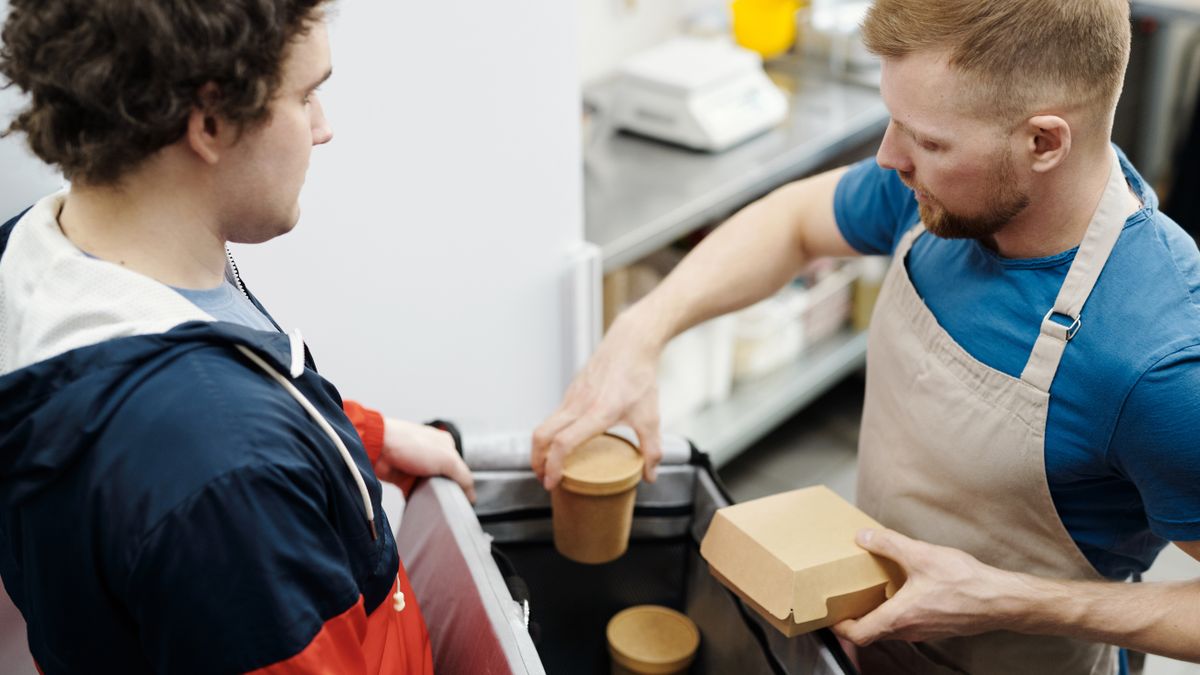
Here's the part most "ditch the marketplaces" articles skip: the marketplaces earn their cut, once. They put your menu in front of people who have never heard of you. That's real distribution, and for a new restaurant it's often the fastest discovery channel available.
The mistake is paying stranger-acquisition prices on people who already love you. Your Friday-night regular doesn't need to be re-acquired for 25 percent of the ticket, fifty times a year. So the strategy isn't leaving the marketplaces. It's using them as a billboard for first orders, then moving repeat business to a channel you own: a card in the bag, a QR code on the receipt, a first-order discount in your app that costs less than a single commission.
An owned ordering app succeeds or dies on operations, not on how the home screen looks. Three things decide it.
Menu truth, from the POS out. Your menu has to live in one place, your point of sale (Square, Toast, and Clover all expose APIs for this), and flow into the app automatically. When the kitchen 86es the salmon at 7pm, it should vanish from the app in seconds. Every restaurant app that staff quietly hate is one where somebody updates two menus by hand.
Modifiers that match your real menu. Extra sauce, no onions, substitute the side, an allergy note that actually reaches the kitchen. Real menu complexity is where template apps fall apart, because their data model assumed a burger with three toppings. If your menu has combos, half-and-half options, or time-of-day pricing, the modifier model is a large share of the build.
Honest throttling. Friday at 7pm the kitchen is at capacity. The app has to know that and stretch quote times, or pause new orders, instead of accepting everything and letting food die under the heat lamp. A quote that's honestly 45 minutes beats a fake 20 every time. One costs you a night, the other costs you the review score.

Points programs are fine. But the loyalty mechanism that actually moves revenue is smaller: remembering the order. "Your usual, ready at 6:30" as a two-tap reorder converts better than any badge, because it removes friction from a decision the customer has already made dozens of times.
The owned app is what makes this possible. You have names, order history, and a push channel that costs nothing per message, versus paying to reach the same person through marketplace ads. Two rules we hold on every build: don't wall the menu behind account creation (let the first order happen as a guest, then invite), and don't send a push that isn't worth interrupting someone for. One well-timed Friday nudge is a service. Three generic promos a week is an uninstall.
Delivery is where scope, and budget, actually forks. Picking the wrong model is the most expensive mistake in food delivery mobile app development.
Model 1: own the pickup, rent the delivery. Your app handles pickup and curbside only; delivery stays on the marketplaces. Lowest complexity, and pickup is your best-margin channel anyway. For a single location, this is often the right first build.
Model 2: white-label fleets. Services like DoorDash Drive and Uber Direct let your app take the order and hand only the driving to their network, for a flat per-delivery fee instead of a percentage of the ticket. On a $60 family order, a flat fee beats 25 percent by a wide margin. Your brand, your customer data, their drivers. This is the sweet spot for most independents doing real delivery volume.
Model 3: your own drivers. Dispatch, live tracking on a map, batching orders headed the same direction, driver payouts. This is real logistics software and it sits at the top of our budget range. It earns its cost at chain volume, or in a dense zone where drivers stay busy all shift, and almost never before that.
From the field. The thing that brings restaurant ops teams to us is rarely "we want an app". It's the counter with five tablets on it. One per marketplace, none talking to the POS, staff retyping every order by hand mid-rush, and someone reconciling it all at midnight. We see the same shape in other industries: ops people doing manual triage at 2am because one tool doesn't talk to the other. That gap is usually one integration away from gone, and it's often worth closing before, or alongside, anything customer-facing.
Across 30+ production launches since 2024, our typical engagement runs 4 to 8 weeks from kickoff to live deployment, at a fixed price between $4,000 and $30,000. For restaurant work the range maps roughly like this: an ordering and loyalty app for pickup with POS sync sits toward the lower half, adding white-label delivery moves it to the middle, and in-house driver dispatch with live tracking pushes toward the top.
Those timelines hold when scope stays on one workflow. Chad Dubuisson, whose Rope Access Logbook we took from rough idea to production in 8 weeks, put it this way: "Codestreaks took our rough idea and turned it into a real product in just 8 weeks. The way they built it saved us months of headaches down the road."
Two things are non-negotiable whoever you hire. First, 100 percent code ownership: the repo, the app store accounts, the backend. If an agency won't give you the repo, walk away. It's the difference between switching vendors in a week and rebuilding from scratch. Second, post-launch support in writing. We include 30 days on every engagement, because the first month of real orders is when the real bug list writes itself.
We take on two engagements per quarter, so we have no incentive to talk you into a build that doesn't pay. Run the math from the top of this article with your own statement. If the commissions you'd claw back over two years don't comfortably cover the build, don't build yet. Use the marketplaces, put a simple web-ordering page behind a QR code, and revisit when volume grows. An app should be a margin decision, not a trophy.
For the full decision on whether a restaurant should build its own app at all, see our restaurant mobile app development guide.
Our fixed-price range is $4,000 to $30,000. Pickup ordering with POS sync and loyalty sits toward the lower half, white-label delivery integration lands mid-range, and in-house dispatch with live driver tracking pushes toward the top. The two biggest cost drivers are menu complexity and how much of delivery ops you own.
Our typical engagement is 4 to 8 weeks from kickoff to live. The schedule holds when version one is a single workflow, usually ordering and pickup, with delivery ops phased in after launch rather than crammed into the first release.
Usually not. Marketplaces are a paid discovery channel, and they're good at it. The goal is to stop paying discovery prices on regulars: let first orders come from anywhere, then move repeat customers into the channel where you keep the margin and the data.
Almost certainly not at first. White-label services like DoorDash Drive and Uber Direct deliver orders placed in your app for a flat per-delivery fee, which beats percentage commissions on most tickets. In-house drivers only make sense at chain volume or in a dense delivery zone.
It has to, or your staff will abandon it. Square, Toast, and Clover expose APIs for menus, orders, and inventory, so app orders print to the kitchen like any other ticket and 86'd items disappear automatically. POS integration should be scoped in week one, not bolted on later.
If you're weighing an owned app against another year of commissions, the fastest route to clarity is 30 minutes with someone who has shipped this before. Bring last month's marketplace statement to a free 30-minute scoping call and we'll run your numbers with you, no deck and no pitch. We reply within two business days.
Book a free scoping call or see how we approach mobile app development.
A serial maker of SaaS products and AI agents, I’ve built and launched 10+ tools, grown products to thousands of users, and taken multiple ventures. I share the process what works, what breaks, and how builders can ship faster and smarter. Previously a data scientist at a Big Four consulting firm.


