

The 2026 trends that map to real user problems: on-device AI, passkeys, offline-first, AI agent workflows, and app store rule changes. Plus the noise list we'd cut.


Somewhere in your planning doc there's a list. On-device AI, passkeys, super apps, foldables, agents, spatial computing. Someone senior asked which of these belong on the 2026 roadmap, and the room went quiet, because nobody wanted to admit the list came from a post written to sell conference tickets.
We sit through that conversation with clients several times a quarter. Codestreaks has shipped 30+ apps and AI systems to production since 2024, and the teams that spend well all use the same filter: a trend earns roadmap space only when you can name the user and the problem it solves. Everything else is content marketing wearing a lab coat.
This post applies that filter to 2026. Five trends pass it. A few loud ones don't.
Before a trend gets a line in your budget, make it survive this sentence: our [user] struggles with [problem], and this fixes it because [mechanism].
"Technicians type incident notes with gloves on, and on-device speech-to-text fixes that because transcription runs locally with no signal required." That survives.
"AI is big this year." That doesn't, and it's the reasoning behind most of the burned app budgets we've seen. Most teams don't need the trend of the quarter. They need a few boring workflows built well. The trends below matter precisely because they make those boring workflows cheaper, faster, or safer to build.
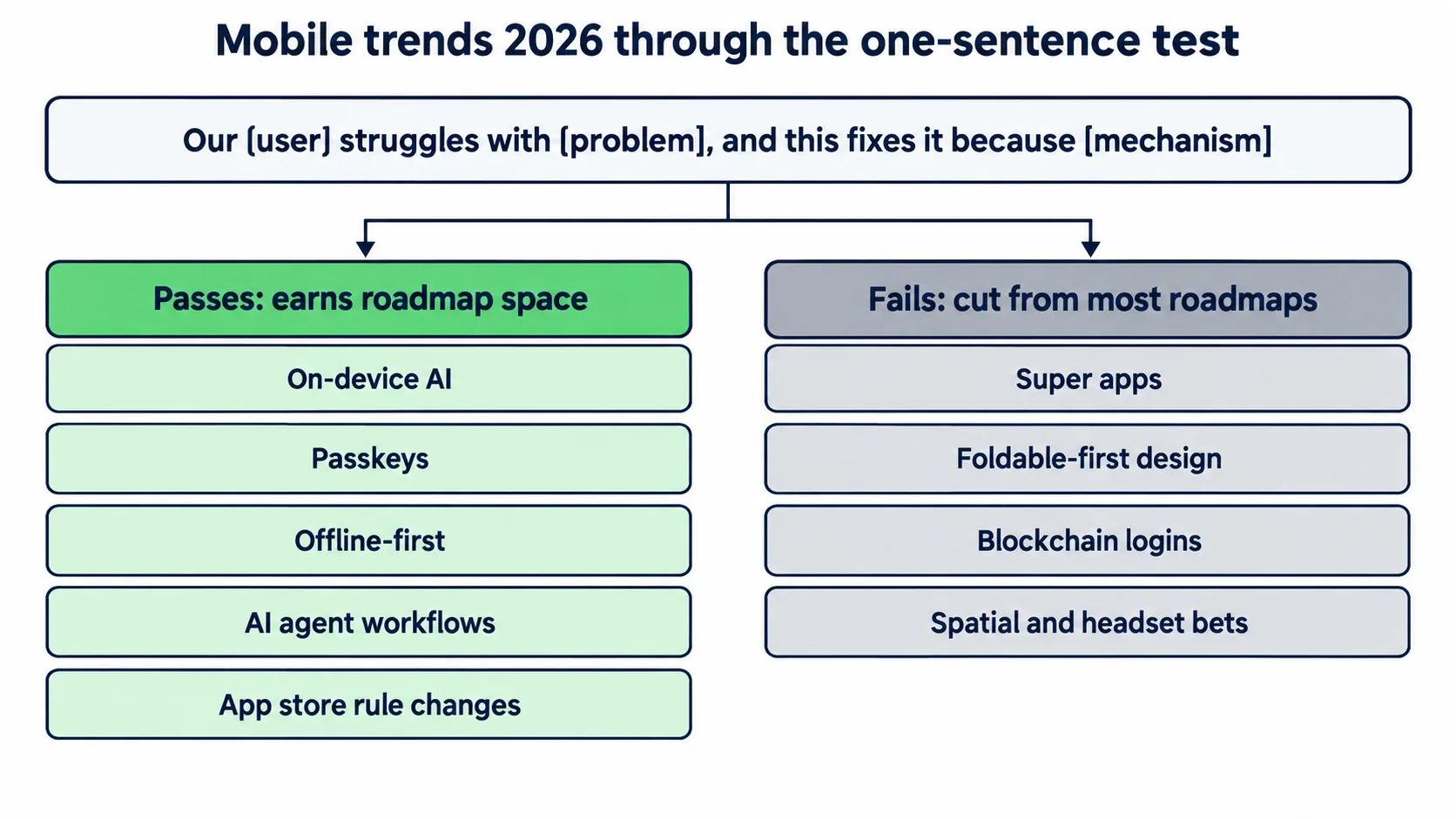
Here is the whole post on one screen. Five trends survive the sentence, four don't, and the sections below explain each call.

For years, putting AI in a mobile app meant a round trip to a cloud API: half a second if you're lucky, a spinner if you're not, and a per-call bill forever. That math changed. Apple's foundation models and Google's Gemini Nano now run directly on the phone, so features respond in tens of milliseconds, keep working in airplane mode, and cost nothing per call.
The cost half matters more than the latency half. Production AI systems typically run $50 to $2,000 a month in inference, and good engineering (caching, model routing, prompt design) cuts that 3-10x. On-device models push the marginal cost of a whole class of features to zero: classifying text, autocompleting a form, summarizing a note, transcribing a voice memo, flagging a blurry photo before upload.
The honest caveat: small on-device models are meaningfully worse at multi-step reasoning than frontier cloud models. The pattern that works is routing. On-device handles the frequent, fast, private tasks. The cloud handles the rare, heavy ones. If a feature fires dozens of times per session or touches sensitive data (health, money, messages), it's an on-device candidate. If it fires once a day and has to be brilliant, keep it in the cloud. We go deeper on that routing pattern in running LLMs locally for privacy-first mobile apps.
Search your support tickets for "reset my password". That's the business case, no trend report required.
A passkey replaces the password with a cryptographic key pair. The private key stays on the user's device behind Face ID or a fingerprint, so there is no shared secret to phish, reuse, or leak in a breach. Apple, Google, and Microsoft all ship support, keys sync across a user's devices, and login becomes tap, glance, done.
The mechanism to care about is friction at two moments: signup and re-login. Every password typed on a phone keyboard is a place users quit. Our advice is boring and it works: offer passkeys at signup and again right after a successful password login, never force-migrate, keep a fallback. The hard design problem in 2026 isn't the passkey, it's account recovery. Decide what happens when a user loses every device before you ship, because that edge case is where your support volume moves next.

Offline-first keeps showing up on 2026 lists, which we find funny, because the users who need it have needed it the whole time. Warehouses, hospitals, job sites, basements, airplanes.
The mechanism is simple to state and expensive to retrofit: writes land in local storage first, queue up, and sync when the connection returns. Bolt it on later and every screen that assumed a live server gets rebuilt, which is why it's a week-one architecture decision, not a feature ticket. We built Rope Access Logbook this way for technicians who log hours on wind turbines and bridges with zero signal. Entries sync cleanly once they're back in coverage instead of vanishing or duplicating, and the app shipped in 8 weeks and replaced paper logbooks from day one.
If your users ever open the app somewhere a spinner can strand them, this belongs above every shinier item on your list. For the field-service version of the same pattern, see offline-first AI agents for the trades.
The loudest version of this trend is a chatbot bolted onto an app. The valuable version is quieter: AI agent workflow automation built into your software, meaning an agent that watches a queue, cross-references systems, drafts the action, and hands a human the approve button.
From the field. A pattern we keep meeting: an ops team doing triage by hand at 2am because "the tool doesn't talk to the other tool". Someone reads alerts from one system, retypes them into another, pages the right person. That gap is usually one integration and one agent away from gone, and it never shows up on a trend list because it isn't glamorous. It's just hours, every night, forever.
Done well, the numbers are not subtle. HrefStack, a martech client, runs an autonomous SEO content agent we built: 300+ leads a month from generated articles, a 60% reduction in customer acquisition cost versus paid channels, zero manual uploads. Built and shipped in 10 weeks.
One hard rule before you fund this trend: an agent without an evaluation suite is a liability with a chat interface. If a proposal doesn't include how the agent gets tested against real data before and after launch, you're buying a demo, not a system.
The least glamorous trend on this list may be worth the most money. Regulators and courts spent the last two years prying the app stores open. In the EU, the Digital Markets Act forced Apple to allow alternative app marketplaces. In the US, the Epic ruling forced Apple to let apps link out to external payment without taking a commission on those purchases.
The mechanism is margin. Store commissions run 15 to 30 percent on digital goods and subscriptions. A web checkout behind a link-out flow pays payment-processor rates instead, low single digits. If subscriptions are your revenue, that difference compounds every month.
The honest caveat: link-outs add friction, and some users will always prefer paying through the store. Don't rebuild your billing stack on a court ruling. Add a link-out path, measure conversion against in-app purchase, and let the data set the mix.
Trends we'd cut from most 2026 roadmaps, with the reason:
None of these are fake. They're just other people's problems.
Numbers from our own engagements, since most trend posts never include any. A typical build runs 4 to 8 weeks from kickoff to live deployment at a fixed price between $4,000 and $30,000. A single-purpose agent lands around $4k-$10k in 3-4 weeks. A multi-step workflow agent runs $10k-$22k over 5-7 weeks. Offline-first architecture costs the least when it's decided on day one and the most when it's retrofitted in month six.
And one buying principle that outlasts every list: buy the outcome, not the model. Model names change quarterly. Owned software compounds. Whatever you build this year, make sure you own the repo when it's done.
Written by the Codestreaks team, drafted with AI assistance and edited by a human. The cost bands, the build window of 4 to 8 weeks and the two named projects come from our own engagements: 30+ apps and AI systems shipped to production since 2024. The pass-or-cut calls in the diagram are our judgement from scoping calls, not a survey. Platform facts link to Apple's and Google's own documentation. The photos are stock. The diagram is ours.
Five, in our view: on-device AI, passkeys, offline-first architecture, AI agent workflow automation, and the app store rule changes around payments and distribution. Each one maps to a concrete user or margin problem, which is the test a trend has to pass.
Yes, for the right features. Frequent, fast, private tasks (classification, transcription, autocomplete) run well on-device today. Multi-step reasoning still belongs in the cloud. Ship a router, not a bet on one side.
Only if you can name the workflow it removes. A chatbot with no job is a cost center. An agent that eliminates a nightly manual triage or an upload queue pays for itself fast, and it needs an evaluation suite before launch, not after.
Not yet. Treat passkeys as the default path, keep a fallback, and put real design time into account recovery. Forcing migration on day one trades a support problem for a lockout problem.
If you sell subscriptions or digital goods, external payment links can move you from 15-30 percent store commission to payment-processor rates on the users who take the link. Test the flow before restructuring anything.
If you're deciding which of these belongs on your 2026 roadmap, the fastest way to find out is to pressure-test the list against your actual users with someone who ships for a living. We offer a free 30-minute scoping call, no deck and no pitch, and you'll leave with an honest read on which trends map to your problems and what they'd cost. We take on two engagements per quarter and reply within two business days.
Book a free scoping call or see how we build at mobile app development.
A serial maker of SaaS products and AI agents, I’ve built and launched 10+ tools, grown products to thousands of users, and taken multiple ventures. I share the process what works, what breaks, and how builders can ship faster and smarter. Previously a data scientist at a Big Four consulting firm.


