

What actually happens between a mobile app idea and a live App Store listing, phase by phase, with the timelines and budgets we've seen hold up on real engagements.
Codestreaks Team

You have a mobile app idea and a rough sense of what it should do. What you probably don't have is a clear picture of what happens between now and the day it's live in the App Store, because most explanations of "the mobile development process" are either a five-step diagram with no numbers attached or a 40-page methodology document nobody reads before signing a contract.
Here's the version with numbers attached, built from how we've actually run mobile engagements: 30+ projects shipped to production since 2024, typical timeline 4-8 weeks from kickoff to live deployment.
This is where most of the risk in a mobile project gets removed or ignored. We write down the exact user flows, the data model, which platform ships first, and what's explicitly out of scope. "App development risk management" isn't a checklist you run in phase four, it's this conversation, upfront, before anyone writes a line of Swift or Kotlin.
Teams that skip this phase don't save time. They spend the saved week in month two, renegotiating scope on a build that's already half-written. We've watched it happen from the outside on client migrations before; it's the single most predictable failure mode in mobile projects.
Wireframes first, then a clickable prototype, then high-fidelity screens. The prototype step matters more than most teams budget for it: a demo that looks right on a Figma canvas and an interaction that actually feels right on a physical device with real network latency are different things. We push client sign-off to happen on device, not on a laptop screen share.
Cross-platform vs. native is usually decided in this phase too, not before. We break down when each makes sense in our cross-platform mobile app development guide rather than defaulting one way for every client.
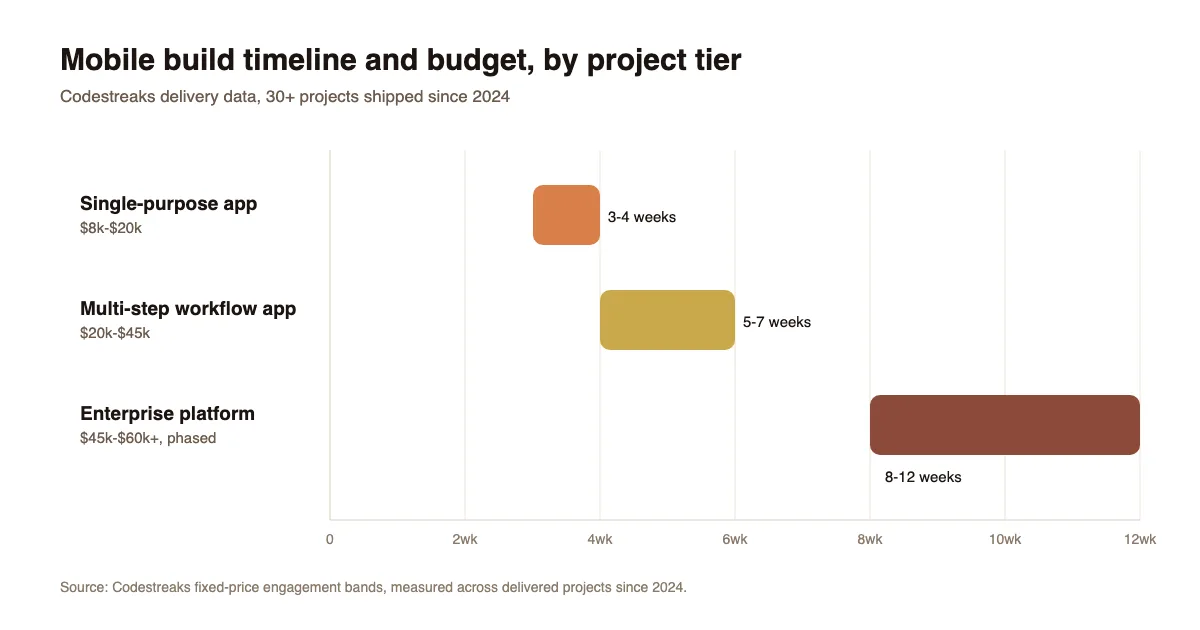
This is where our fixed-price bands come from actual delivered work, not a rate card:
Inside the build phase, the order matters: backend and data layer first, then the screens that touch real data, then the polish. Building UI against mocked data first is the fastest route to a demo that impresses a meeting and falls apart on real data, which is the exact pattern we see most often when a team brings us a stalled build to rescue.
Device-matrix testing, not just simulator testing. Push notification delivery under real OS battery-optimization behavior. Offline and flaky-network states, because "works on office wifi" and "works on a train" are not the same claim. This phase is also where we run store-compliance review: Apple and Google both reject apps for reasons that have nothing to do with whether the code works, and a rejected submission adds 3-7 days you didn't plan for.
Store submission, crash monitoring wired up before launch day (not after the first crash report), and a defined support window. Every engagement we run includes 30 days of post-launch support and 100% code ownership handed to the client, no vendor lock-in on the codebase itself.
A recurring pattern across client rescues: a team hires a cheaper shop, gets a demo that works in the sales call, and six weeks later the app breaks the moment real users touch it with real data and inconsistent network conditions. Rope Access Logbook, an industrial safety client, came to us after exactly this. We rebuilt their digital logbook (replacing a paper process) and shipped it in 8 weeks. Their founder, Chad Dubuisson, put it this way: "Codestreaks took our rough idea and turned it into a real product in just 8 weeks. The way they built it saved us months of headaches down the road." The lesson generalizes past that one project: the build phase isn't where mobile projects fail, the discovery phase is, because that's where the assumptions that later break under real usage get baked in unchallenged.
The same discovery-first discipline applies whether the target device is a phone or something stranger. We ran the same phase structure on a recent wearable app build, where the constraints just moved from "network conditions" to "battery and screen size," not the underlying process.
If you're planning a build, budget slack in three specific places, not evenly across the whole timeline:
For a single-purpose app, 3-4 weeks. For a multi-step workflow app with real backend integration, 5-7 weeks. Enterprise platforms with compliance requirements run 8-12 weeks, usually phased. These are calendar weeks for a focused build, not elapsed time across a stop-start schedule.
Scope ambiguity at discovery, not a technical risk. Most "the build is behind schedule" situations trace back to a user flow or edge case that was never written down before the build started, then surfaces as a renegotiation in month two.
Depends on where your users actually are, not on wanting parity for its own sake. Cross-platform frameworks let you ship both from one codebase for most app types; a small number of use cases (heavy camera/AR work, deep OS-specific integrations) still justify native-first on one platform.
A named owner for third-party integration approvals (payment processors, app store accounts) and an explicit device-testing matrix. Both get treated as afterthoughts in generic templates and both are common sources of the delays listed above.
Realistically: $4,000-$10,000 for a single-purpose app, $10,000-$22,000 for a multi-step workflow app, $22,000-$30,000+ for an enterprise platform delivered in phases. We cover the full cost breakdown in our mobile app development guide.
This post was drafted with AI assistance and edited by a human against Codestreaks' own delivery data: the phase timelines and budget bands come from engagements actually run since 2024, not an industry estimate. The featured image is an original illustration, not a stock photo.
If you're scoping a mobile build and want a straight answer on which phase your project is actually at risk in, we do a free 30-minute scoping call and reply within two business days. See our mobile app development services or start a project.


