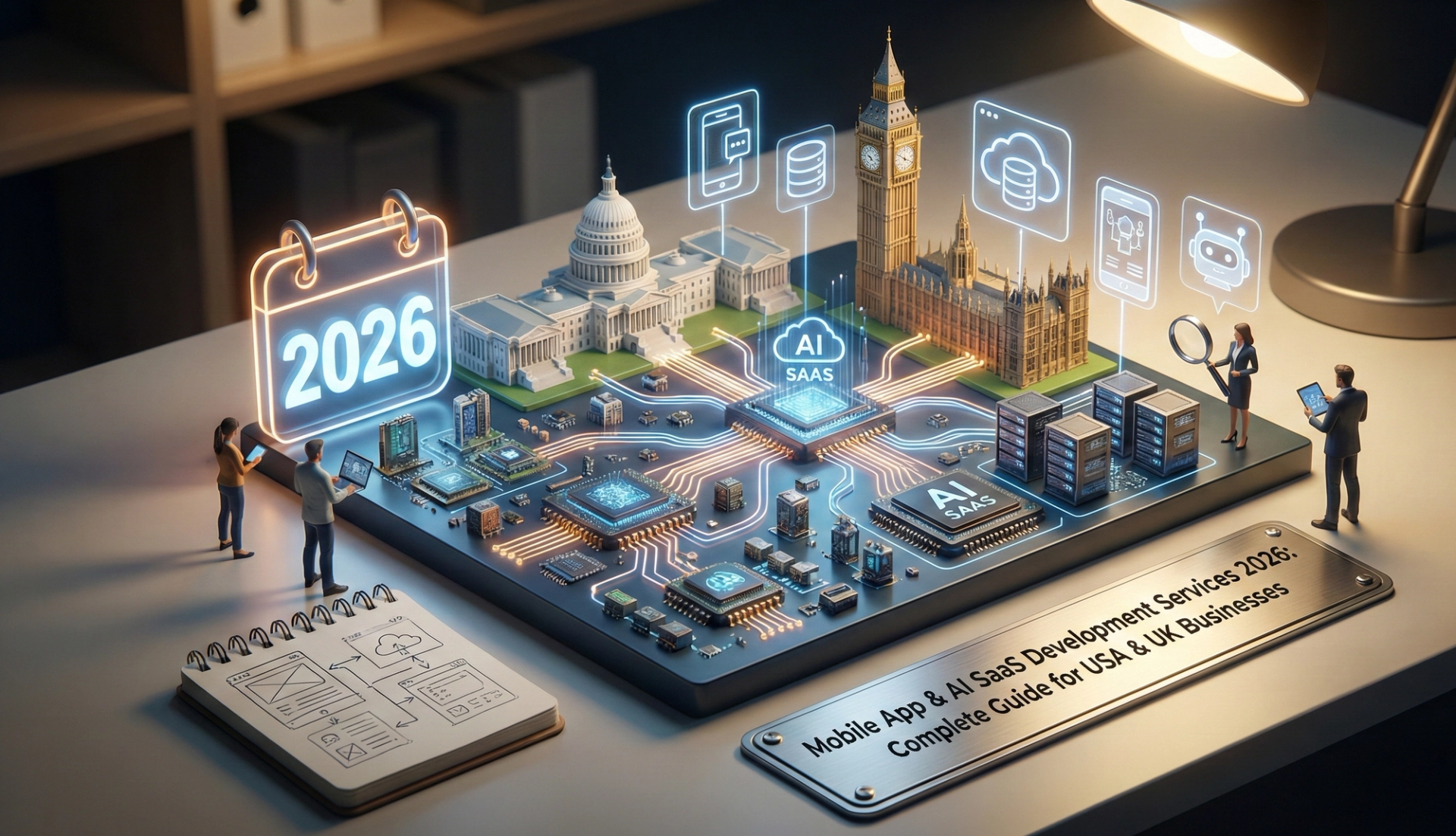
Mobile App & AI SaaS Development Services 2026: The Complete Guide for USA & UK Markets
Introduction: The Convergence of Mobile, Web, and AI Intelligence
The digital landscape in 2026 represents a transformative moment for businesses across the United States and United Kingdom. Mobile applications, responsive websites, and AI-powered SaaS platforms have converged into unified intelligent ecosystems that learn, adapt, and anticipate user needs. From London's fintech corridor to Silicon Valley's innovation hubs, organizations are racing to build AI-native products that deliver unprecedented user experiences and measurable business outcomes.
This isn't just about adding chatbots to websites anymore. We're talking about edge AI processing on smartphones that works offline in rural Scotland, predictive analytics optimizing supply chains for US manufacturers, computer vision revolutionizing retail experiences in Manchester shopping districts, and natural language interfaces transforming customer service across both Atlantic markets, all powered by intelligent software that runs seamlessly across mobile devices, tablets, and desktop computers.
At CodeStreaks, we architect and deploy intelligent mobile applications, responsive websites, and AI-powered SaaS platforms that drive measurable business outcomes. Our development approach combines cutting-edge artificial intelligence, mobile-first design, and cloud-native infrastructure to help companies across the USA and UK launch competitive products in weeks, not months. For businesses looking to understand the broader landscape of mobile application AI development services in the USA, this guide provides comprehensive insights into 2026 trends and implementation strategies.
Why 2026 Is the Pivotal Year for Mobile App and AI SaaS Development Services

The Mobile Market Explosion Across USA & UK
United States Market Dynamics
The US mobile application ecosystem has reached unprecedented scale:
- 350 million smartphone users representing 85% of the population
- $180 billion mobile commerce revenue projected for 2026
- 7.5 hours daily average smartphone usage per American
- 95% penetration of 5G networks in major metropolitan areas
- 70% of digital purchases now originating from mobile devices
American consumers expect sophisticated mobile experiences. Apps that feel sluggish, lack offline capability, or don't personalize interactions are deleted within 48 hours. The competition for user attention has never been fiercer, making intelligent automation and AI-powered personalization essential differentiators.
United Kingdom Market Evolution
The UK digital economy shows equally compelling trends:
- 55 million smartphone users with 90% penetration among working-age adults
- £92 billion mobile commerce market size in 2026
- 88% of UK consumers use mobile apps for banking and financial services
- Nationwide 5G coverage reaching 85% of geographic area
- 60% preference for mobile apps over websites for repeat transactions
British consumers, particularly in London, Manchester, Birmingham, and Edinburgh, demonstrate high adoption of innovative mobile features. Augmented reality shopping, voice-first interfaces, and AI-powered personal assistants have moved from novelty to expectation across UK demographics.
AI-Powered SaaS Becomes Non-Negotiable
By 2026, artificial intelligence has transitioned from competitive advantage to baseline requirement. Recent industry analysis reveals that 82% of enterprises have deployed AI-enabled applications, marking a fundamental shift from traditional software to intelligent platforms.
Modern AI SaaS platforms don't just process data, they predict outcomes, personalize experiences in real-time, execute autonomous workflows, and surface insights that directly impact revenue. Businesses leveraging these intelligent systems report 35% higher customer retention rates and 45% improvement in operational efficiency compared to competitors using traditional software.
For organizations exploring mobile application AI development services, understanding how AI integrates across mobile, web, and SaaS platforms is crucial for strategic planning.
Geographic Considerations: USA vs UK Development
United States: Scale and Diversity
The US market presents unique challenges:
- 3.8 million square miles requiring edge computing solutions
- Multiple time zones affecting real-time collaboration features
- State-specific regulations (CCPA in California, CPRA, state privacy laws)
- Rural connectivity gaps necessitating offline-first architecture
- Diverse demographics requiring multilingual support (350+ languages spoken)
Successful US applications must work flawlessly whether users are in Manhattan office buildings with gigabit fiber or rural Montana ranches with spotty 4G coverage. This geographic complexity makes offline-first AI not just a feature, but an absolute necessity.
United Kingdom: Regulatory and Market Sophistication
UK development requires attention to:
- GDPR compliance with stringent data protection requirements
- UK GDPR post-Brexit maintaining alignment with EU standards
- FCA regulations for financial services applications
- NHS data standards for healthcare technology
- Accessibility regulations (Equality Act 2010 compliance)
- Regional preferences across England, Scotland, Wales, and Northern Ireland
British consumers expect premium user experiences with absolute data privacy. Applications handling UK citizen data must demonstrate robust security, transparent data practices, and full regulatory compliance from day one.
Core Technologies Powering 2026 Development
Edge AI and On-Device Intelligence
The Offline-First Revolution
One of the most significant technological shifts involves moving artificial intelligence processing directly onto devices. Edge AI reduces latency, minimizes bandwidth costs, ensures privacy, and enables applications to function flawlessly without internet connectivity.
Practical applications transforming USA and UK businesses:
- Real-time language translation working offline during international travel
- Facial recognition security processing locally without cloud transmission
- Predictive text and autocomplete learning individual writing patterns on-device
- Voice assistants responding instantly without server roundtrips
- Computer vision analyzing images without uploading sensitive visual data
Technical Implementation
Modern edge AI leverages:
- Apple CoreML for iOS applications running sophisticated models directly on iPhones and iPads
- TensorFlow Lite powering Android devices from budget smartphones to flagship tablets
- ONNX Runtime enabling cross-platform model deployment
- Neural Processing Units (NPUs) in latest Qualcomm and Apple silicon for accelerated inference
For American healthcare providers handling HIPAA-protected patient data or UK financial institutions managing FCA-regulated customer information, on-device processing isn't optional, it's a compliance requirement that simultaneously improves user experience through reduced latency.
5G-Powered Mobile Experiences
Network Infrastructure Transformation
The widespread deployment of 5G networks has fundamentally transformed what's possible in mobile applications. The technology delivers speeds 10-100 times faster than 4G, with latency reduced to 1-10 milliseconds compared to previous 50-100ms averages.
5G enables revolutionary capabilities:
- HD video streaming without buffering, supporting telemedicine and remote collaboration
- Instant cloud access for lightweight applications with server-side processing
- Immersive AR experiences overlaying digital content on physical environments seamlessly
- Real-time gaming with console-quality graphics streamed to mobile devices
- IoT orchestration connecting and controlling hundreds of smart devices simultaneously
Market Penetration
By 2026, 5G coverage reaches:
- 95% of US urban areas and 75% of rural regions
- 90% of UK geographic area with near-universal coverage in cities
- $52 billion investment by US carriers in network infrastructure
- £15 billion invested by UK telecommunications providers
For developers, 5G means the ability to build feature-rich applications without compromising performance. Real-time collaboration tools, cloud gaming platforms, augmented reality shopping experiences, and telemedicine applications all benefit dramatically from 5G's low latency and high bandwidth.
Generative AI Integration
The Creative Intelligence Revolution
Generative AI capabilities have become standard features in SaaS platforms across industries. Recent adoption data shows 65% of software applications now incorporate generative AI features, up from just 12% in 2023.
Practical implementations include:
- Content generation creating marketing copy, product descriptions, and social media posts in seconds
- Code generation assistants helping developers write, debug, and optimize software faster
- Design automation generating UI mockups and graphics from simple text descriptions
- Document summarization extracting key insights from lengthy reports instantly
- Conversational interfaces providing natural language interaction with complex systems
These features don't replace human creativity, they amplify it by handling routine tasks so teams can focus on strategic work requiring genuine innovation and judgment.
Natural Language Processing & Conversational Interfaces
Voice-First Experiences
Voice user interfaces (VUIs) have matured into essential components of modern applications. Users increasingly prefer speaking to devices rather than typing, particularly in hands-free contexts like driving, cooking, exercising, or performing manual labor.
AI-powered conversational systems now:
- Understand context from previous interactions and environmental cues
- Support multilingual conversations switching languages mid-sentence
- Detect emotional tone adjusting responses based on user sentiment
- Execute complex workflows through simple voice commands
- Maintain conversation history creating continuity across sessions
For UK businesses serving diverse populations across London, Birmingham, and Manchester, or US companies operating in multilingual markets like Miami, Los Angeles, and New York, advanced NLP capabilities enable inclusive experiences that serve customers in their preferred languages.
Computer Vision and Visual Intelligence
Seeing Through AI
Computer vision has moved from research labs to mainstream commercial applications. The global computer vision market has grown to $27 billion in 2026, with mobile applications representing the fastest-growing segment.
Industry-specific applications transforming businesses:
Retail and E-commerce
- Visual product search allowing customers to photograph items and find matches
- Virtual try-on experiences for clothing, eyewear, makeup, and furniture
- Automated checkout recognizing products without barcode scanning
- Inventory management using shelf-scanning to detect stock-outs
Manufacturing and Quality Control
- Defect detection identifying manufacturing flaws with 99.7% accuracy
- Measurement verification using optical inspection of tolerances
- Assembly guidance providing AR overlays showing assembly steps
- Safety compliance detecting PPE usage and hazardous conditions
Healthcare Applications
- Medical imaging analysis assisting radiologists with preliminary scan interpretation
- Skin condition diagnosis analyzing dermatological photos
- Pill identification recognizing medications from images
- Wound assessment tracking healing progress through photo documentation
Construction and Field Services
- Progress tracking documenting job site advancement automatically
- Part identification recognizing equipment components from photos
- Safety inspections identifying OSHA violations before accidents occur
- Damage assessment for insurance claims and repair estimates
Augmented Reality & Virtual Reality
Spatial Computing Goes Mainstream
The global AR/VR market has exploded from $37 billion in 2023 to over $114 billion by 2027, with widespread adoption across consumer and enterprise sectors. Mobile AR has become accessible without expensive dedicated hardware, as modern smartphones possess sufficient processing power for immersive experiences.
Consumer Applications
- Furniture visualization letting customers see products in their homes before purchase
- Navigation enhancement overlaying directions on real-world views
- Gaming experiences blending digital gameplay with physical environments
- Social media filters creating engaging, shareable content
Enterprise Use Cases
- Training simulations providing hands-on practice without physical equipment
- Remote assistance allowing experts to guide field technicians visually
- Architectural visualization showing buildings before construction begins
- Maintenance procedures overlaying repair instructions on equipment
Unified Codebase Strategies
Cross-platform frameworks dominate modern development, enabling teams to build applications running natively on iOS, Android, and web from a single codebase. This approach reduces development time by 40-60%, lowers maintenance costs, and ensures consistent user experiences.
Leading Frameworks
Flutter
- Native performance with compiled code running directly on devices
- Beautiful UIs with extensive widget library and customization
- Hot reload enabling instant iteration during development
- Growing ecosystem with 1 million+ developers worldwide
React Native
- JavaScript foundation leveraging web development skills
- Mature ecosystem with extensive third-party libraries
- Strong community with Meta and Microsoft backing
- Performance optimization through native module integration
Progressive Web Apps (PWAs)
- Install-free access through standard web browsers
- Offline functionality with service workers caching content
- Push notifications engaging users like native apps
- Instant updates without app store approval delays
For businesses targeting both USA and UK markets, cross-platform development enables simultaneous launch across regions without maintaining separate codebases, significantly accelerating time-to-market and reducing development costs.

Hyper-Personalization Engines
Beyond Basic Customization
Modern SaaS platforms leverage contextual intelligence to deliver dynamically personalized experiences. AI analyzes user behavior, preferences, environmental context, and historical patterns to create adaptive interfaces that evolve with each interaction.
Implementation strategies:
- Behavioral tracking monitoring user actions without invasive surveillance
- Preference learning inferring likes/dislikes from implicit signals
- Contextual adaptation adjusting features based on time, location, and situation
- Collaborative filtering leveraging patterns from similar users
- Real-time optimization continuously testing and improving recommendations
Businesses implementing sophisticated personalization report 28% increase in customer engagement, 35% improvement in retention rates, and 22% growth in average revenue per user.
Predictive Analytics for Business Intelligence
From Descriptive to Prescriptive
Predictive analytics has evolved beyond simple forecasting to prescriptive recommendations that guide decision-making. Modern AI systems identify patterns in historical data, predict future outcomes with remarkable accuracy, and suggest optimal actions.
Sales and Revenue Applications
- Lead scoring identifying high-value prospects before competitors
- Churn prediction flagging at-risk customers with 85% accuracy
- Revenue forecasting projecting quarterly results with improved precision
- Pricing optimization recommending dynamic prices based on demand signals
Operations and Efficiency
- Demand forecasting predicting inventory needs by location and season
- Maintenance prediction scheduling preventive service before equipment fails
- Resource allocation optimizing staff scheduling based on predicted workload
- Supply chain optimization anticipating disruptions and suggesting alternatives
Customer Experience
- Next-best-action recommendations suggesting optimal customer interactions
- Sentiment analysis detecting satisfaction issues before complaints
- Product recommendations predicting purchases with Netflix-level accuracy
- Personalized content delivering relevant information at optimal times
Embedded Analytics and Real-Time Dashboards
Democratizing Data Access
Instead of exporting data to external business intelligence tools, modern SaaS platforms embed analytics directly into workflows. AI-driven embedded analytics enables real-time dashboards, predictive modeling, and automated alerts without requiring technical expertise.
This democratization empowers every user to make informed decisions:
- Manufacturing platforms tracking machinery efficiency and predicting maintenance needs
- Marketing tools visualizing campaign performance and suggesting optimizations automatically
- Financial applications monitoring cash flow and alerting to potential issues proactively
- Healthcare systems analyzing patient outcomes and identifying improvement opportunities
Intelligent Automation and Workflow Orchestration
Beyond RPA: Cognitive Automation
While robotic process automation (RPA) handles simple rule-based tasks, cognitive automation uses AI to manage complex workflows requiring decision-making, exception handling, and contextual understanding.
Advanced automation capabilities:
- Document processing extracting structured data from invoices, contracts, and forms
- Customer service handling inquiries through conversational AI with 85% resolution
- Data entry automating information transfer between systems
- Approval workflows routing requests based on content analysis
- Report generation creating customized documents from templates and data
Businesses implementing intelligent automation report 40-60% reduction in processing time for routine tasks, 30-50% cost savings in operations, and 90% improvement in accuracy compared to manual processes.
Mobile App Development: Creating Engaging Experiences
Mobile-First Design Principles
Prioritizing Smartphone Experiences
Responsive design is no longer sufficient, successful applications prioritize mobile experiences from the initial concept phase. Mobile-first design ensures interfaces feel intuitive on smaller screens, touch interactions feel natural, and performance remains excellent even on older devices or slower networks.
Core principles:
- Touch-optimized controls with minimum 44x44 pixel tap targets
- Progressive enhancement adding complexity for larger screens
- Performance budgets limiting resource usage for smooth operation
- Offline functionality maintaining core features without connectivity
- Battery efficiency minimizing power consumption for all-day usage
Users expect smooth animations, instant feedback, and zero lag when interacting with mobile applications. Apps feeling sluggish or unresponsive are abandoned within seconds, regardless of features or functionality.
Micro-Animations and Emotional Design
Creating Delight Through Motion
Subtle animations and interactions create emotional connections keeping users engaged. Micro-animations aren't meant to wow, they make users feel better, providing emotional connection without interfering with core functionality.
Effective animation patterns:
- Loading indicators showing progress rather than static screens
- Button feedback confirming touches with subtle motion
- Navigation transitions maintaining spatial relationships between screens
- Success confirmations celebrating completed actions
- Pull-to-refresh providing satisfying manual update control
These small details distinguish premium products from amateur ones, even when core functionality is identical. Users consciously notice quality through accumulated micro-interactions creating overall impression of polish and professionalism.
Cross-Device Synchronization
Seamless Multi-Device Experiences
Users expect seamless experiences when switching between devices. Modern applications maintain state across smartphones, tablets, and computers, allowing users to start tasks on one device and complete them on another without friction.
Implementation requirements:
- Real-time sync propagating changes within seconds across devices
- Conflict resolution handling simultaneous edits intelligently
- Offline queuing storing changes when disconnected for later sync
- Device-specific optimization adapting interface to each form factor
- Session continuity maintaining context when switching devices
This capability has become essential as consumers increasingly own multiple connected devices and expect software to work cohesively across their entire digital ecosystem.
Progressive Web Apps (PWAs)
Bridging Web and Native
Progressive web apps bridge the gap between traditional websites and native mobile applications. PWAs load instantly, work offline, receive push notifications, and install on home screens, all while being accessible through standard web browsers without app store downloads.
Business advantages:
- Single codebase serving all platforms simultaneously
- No app store delays deploying updates instantly
- Reduced development costs by 30-50% compared to separate native apps
- Lower user friction with no download barriers
- Improved discoverability through search engine indexing
For businesses launching products simultaneously in USA and UK markets, PWAs enable rapid deployment without navigating multiple app store approval processes or maintaining region-specific builds.
Industry-Specific Solutions for USA & UK Markets
FinTech: Financial Services & Banking Applications
Regulatory Compliance Across Markets
Financial technology applications require robust security, regulatory compliance, and flawless user experiences. Requirements differ significantly between USA and UK markets:
United States Regulations
- SEC requirements for investment and trading platforms
- Federal Reserve guidelines for payment processing systems
- State-specific licenses varying across 50 jurisdictions
- BSA/AML compliance for anti-money laundering
- Dodd-Frank Act consumer protection provisions
United Kingdom Regulations
- FCA authorization for financial services operations
- PSD2 compliance for payment service providers
- Open Banking standards enabling account aggregation
- MiFID II for investment services transparency
- UK GDPR for customer data protection
AI-Enhanced Features
Modern fintech applications leverage artificial intelligence for:
- Fraud detection analyzing transaction patterns in real-time
- Credit scoring evaluating creditworthiness using alternative data
- Investment advice providing personalized portfolio recommendations
- Chatbot support handling customer inquiries 24/7 with 90% automation
- Document verification analyzing uploaded IDs and financial statements
Successful fintech applications serving both markets require understanding nuanced regulatory differences while delivering consistent, premium user experiences that build trust with security-conscious consumers.
HealthTech: Medical & Wellness Applications
Healthcare Innovation with Patient Safety
Telemedicine platforms, patient monitoring systems, and wellness tracking applications are transforming healthcare delivery across both Atlantic markets. AI assists with diagnostic recommendations, analyzes medical imaging, predicts patient outcomes, and personalizes treatment plans.
Regulatory Requirements
United States Healthcare
- HIPAA compliance protecting patient health information
- FDA clearance for diagnostic medical devices
- State licensing for telemedicine service provision
- Medicare/Medicaid standards for reimbursable services
- Meaningful Use criteria for EHR integration
United Kingdom Healthcare
- MHRA approval for medical device software
- NHS Digital standards for health app integration
- CQC registration for digital health services
- NICE guidelines for clinical evidence standards
- UK GDPR for patient data protection
Transformative Applications
- Telemedicine platforms connecting patients with doctors remotely
- Remote patient monitoring tracking vital signs through connected devices
- AI diagnostic assistance analyzing symptoms against medical databases
- Medication management reminding patients and detecting adherence issues
- Mental health support providing CBT exercises and mood tracking
For businesses developing healthcare applications, understanding the regulatory landscape in each market is absolutely critical. Our experience with mobile application AI development for healthcare ensures compliance while delivering clinical value.
Omnichannel Commerce Intelligence
Mobile commerce dominates online shopping, with consumers increasingly preferring smartphone apps over desktop websites. By 2026, 75% of e-commerce transactions in the USA and 68% in the UK originate from mobile devices.
AI-Powered Features
- Recommendation engines increasing average order values by 25-35%
- Visual search allowing customers to photograph items and find matches
- Virtual try-on reducing return rates by 40% through AR previews
- Chatbot assistance providing instant customer service without human intervention
- Dynamic pricing optimizing prices based on demand, inventory, and competition
Regional Considerations
United States Market
- State sales tax complexity requiring automated calculation
- Large geographic area necessitating sophisticated logistics
- Diverse payment preferences (credit cards dominate, but growing digital wallet adoption)
- Fast shipping expectations (Amazon Prime has set 2-day standard)
United Kingdom Market
- VAT handling with different rates for various product categories
- Returns legislation with 14-day cooling-off periods
- Payment preferences (debit cards and digital wallets more common)
- Brexit considerations for cross-border EU commerce
Transforming Education Through Technology
Adaptive learning systems, virtual classrooms, and AI tutors have become essential infrastructure for schools, universities, and corporate training programs. The global EdTech market reached $340 billion in 2026, with mobile learning representing the fastest-growing segment.
Intelligent Learning Features
- Adaptive curriculum adjusting difficulty based on individual performance
- AI tutors providing personalized instruction and immediate feedback
- Gamification increasing engagement through game-like elements
- Analytics dashboards helping educators identify struggling students early
- Collaborative tools enabling group projects and peer learning
Market Opportunities
United States Education
- K-12 digital adoption accelerated by pandemic-era remote learning
- Higher education seeking cost reduction through online programs
- Corporate training with $100 billion annual spending on employee development
- Professional certification with online exam preparation and continuing education
United Kingdom Education
- National Curriculum alignment for school-focused applications
- Ofsted requirements for quality assurance documentation
- UCAS integration for university application processes
- Apprenticeship programs combining work and study digitally
HR Tech: Recruitment & Workforce Management
Intelligent Talent Management
Applicant tracking systems, employee engagement platforms, and performance management tools use AI to operate more efficiently while improving candidate experiences and reducing unconscious bias.
AI-Enhanced Capabilities
- Resume screening analyzing thousands of applications in minutes
- Candidate matching identifying qualified prospects for open positions
- Interview scheduling coordinating availability automatically
- Employee engagement analyzing sentiment and predicting turnover risk
- Performance analytics providing data-driven insights for talent development
Compliance Considerations
United States Employment
- EEOC guidelines for non-discriminatory hiring
- State labor laws varying significantly across jurisdictions
- ADA compliance for accessibility requirements
- Privacy laws including CCPA and state-specific regulations
United Kingdom Employment
- Equality Act 2010 preventing discrimination
- GDPR Article 22 restricting automated decision-making
- ICO guidance on AI in recruitment
- Working Time Regulations for scheduling compliance
Security, Compliance, and Data Privacy
Zero-Trust Security Architecture
Never Trust, Always Verify
Modern applications assume no user or device is trustworthy by default. Every access request requires verification, authentication, and authorization regardless of whether it originates inside or outside the organization's network.
Implementation components:
- Multi-factor authentication requiring multiple proof points
- Continuous authentication re-verifying identity throughout sessions
- Micro-segmentation limiting lateral movement within systems
- Least privilege access granting minimum necessary permissions
- Real-time monitoring detecting anomalous behavior instantly
This approach dramatically reduces the risk of data breaches and unauthorized access, critical for applications handling sensitive customer or business data.
Biometric Authentication
Passwordless Security
Passwords are becoming obsolete. Fingerprint scanning, facial recognition, and voice authentication provide more secure and convenient access control. By 2026, 73% of mobile applications use biometric authentication as primary access method.
Benefits over traditional passwords:
- Harder to steal than knowledge-based credentials
- Cannot be forgotten eliminating password reset friction
- Faster authentication completing in under 1 second
- Better user experience with no typing required
- Regulatory compliance meeting strong authentication requirements
End-to-End Encryption
Protecting Data Everywhere
All data should be encrypted both in transit and at rest. This ensures that even if attackers intercept communications or gain access to storage systems, the information remains unreadable without proper decryption keys.
Encryption requirements:
- TLS 1.3 for network communications
- AES-256 for stored data encryption
- Perfect forward secrecy preventing retroactive decryption
- Key rotation regularly changing encryption keys
- Hardware security modules protecting key material
Regulatory Compliance: USA vs UK
United States Data Protection
Federal Regulations
- HIPAA for healthcare information (50-state coverage)
- GLBA for financial data protection
- COPPA for children under 13
- FERPA for educational records
State Privacy Laws
- CCPA/CPRA (California) comprehensive consumer privacy
- VCDPA (Virginia) data protection requirements
- CPA (Colorado) privacy act
- UCPA (Utah) consumer privacy
- Additional states enacting laws through 2026
United Kingdom Data Protection
- UK GDPR post-Brexit data protection framework
- Data Protection Act 2018 supplementing GDPR
- PECR for electronic communications privacy
- Investigatory Powers Act with transparency obligations
- Sector-specific regulations (FCA for finance, MHRA for health)
Key Differences
US regulations tend toward sector-specific rules with state-level variation, while UK follows more comprehensive unified framework. Applications serving both markets must implement strictest requirements from either jurisdiction, essentially treating UK GDPR as baseline for both markets.
The CodeStreaks Development Process
Phase 1: Discovery and Strategic Planning (Weeks 1-4)
Understanding Your Vision
We begin every engagement by thoroughly understanding your business objectives, target users, competitive landscape, and technical requirements. This critical phase ensures alignment before any code is written.
Discovery activities:
- Stakeholder interviews understanding goals and constraints
- User research identifying target audience needs and behaviors
- Market analysis evaluating competitive positioning
- Technical assessment auditing existing systems and infrastructure
- Regulatory review identifying compliance requirements
Strategic Deliverables
- Product requirements document detailing all features and specifications
- User personas representing key audience segments
- Customer journey maps visualizing end-to-end experiences
- Technical architecture recommending optimal technology stack
- Project roadmap outlining development phases and milestones
- Risk assessment identifying potential challenges and mitigation strategies
For organizations looking to understand AI-specific implementation, our mobile application AI development guide provides detailed technical insights.
Phase 2: UX/UI Design (Weeks 5-8)
Creating Intuitive Interfaces
Our designers create interfaces that users love. We conduct usability testing with real users, iterate based on feedback, and ensure designs meet WCAG 2.1 Level AA accessibility standards so everyone can use your application effectively.
Design process:
- Wireframing establishing information architecture and flow
- Interactive prototypes allowing stakeholders to experience functionality
- Visual design creating branded, polished interfaces
- Usability testing validating designs with target users
- Accessibility audit ensuring inclusive experiences
- Design system creation maintaining consistency at scale
Design Deliverables
- High-fidelity mockups for all screens and states
- Interactive prototype demonstrating user flows
- Design system documentation for ongoing consistency
- Responsive layouts optimized for mobile, tablet, and desktop
- Animation specifications defining micro-interactions
- Accessibility compliance report documenting WCAG adherence
Phase 3: Agile Development (Weeks 9-24)
Iterative Building with Continuous Feedback
We build software in two-week sprints, delivering working features continuously rather than waiting months for a big reveal. This approach allows for regular feedback, course corrections, and ensures the final product matches your vision.
Development methodology:
- Sprint planning defining deliverables for each two-week cycle
- Daily standups keeping team aligned on progress and blockers
- Continuous integration automatically testing code changes
- Weekly demos showcasing completed features to stakeholders
- Sprint retrospectives continuously improving processes
Technical Implementation
Frontend Development
- React/React Native for cross-platform mobile and web
- Flutter for native performance with single codebase
- Next.js for server-rendered web applications
- TypeScript for type-safe code and better maintainability
Backend Architecture
- Node.js or Python for scalable API development
- GraphQL or REST for flexible data access
- Microservices architecture for independent scaling
- Serverless functions for cost-effective compute
AI/ML Integration
- TensorFlow/PyTorch for custom model development
- OpenAI API for generative AI features
- CoreML/TensorFlow Lite for on-device inference
- Cloud AI services (AWS SageMaker, Google Vertex AI, Azure ML)
Infrastructure
- AWS, Google Cloud, or Azure for cloud hosting
- Kubernetes for container orchestration
- CDN for global content delivery
- Database optimization (PostgreSQL, MongoDB, Redis)
Phase 4: Quality Assurance (Weeks 18-24)
Comprehensive Testing
Quality assurance runs parallel to development, ensuring applications work flawlessly across devices, operating systems, network conditions, and edge cases.
Testing approaches:
- Automated testing catching bugs on every code change
- Manual testing validating user experience quality
- Performance testing verifying speed at scale
- Security testing identifying vulnerabilities
- Accessibility testing ensuring inclusive design
- Cross-device testing validating iOS, Android, and web
- Localization testing for USA and UK market differences
Quality Metrics
- 95%+ test coverage for critical business logic
- Sub-second page loads for optimal user experience
- 99.9% uptime service level objectives
- Zero critical security vulnerabilities before launch
- WCAG 2.1 AA compliance for accessibility
Phase 5: Deployment and Launch (Weeks 25-26)
Production-Ready Launch
We handle all technical aspects of launching your application with phased rollout strategies minimizing risk.
Deployment activities:
- Infrastructure setup configuring production environments
- App store submission managing Apple App Store and Google Play
- CI/CD pipeline enabling automated deployments
- Monitoring setup tracking performance and errors
- Documentation providing user guides and technical docs
Launch Strategy
- Soft launch to 10% of users for initial validation
- Performance monitoring identifying any issues immediately
- Gradual rollout expanding to 25%, 50%, 100% over 2-4 weeks
- A/B testing optimizing conversion and engagement
- Marketing coordination timing announcement with readiness
Phase 6: Post-Launch Support and Evolution
Continuous Improvement
Software development doesn't end at launch, it accelerates. We provide ongoing maintenance, monitor system health 24/7, implement new features based on user feedback, and ensure applications remain secure as threats evolve.
Support services:
- 24/7 monitoring detecting issues before users report them
- Bug fixes addressing issues within defined SLAs
- Performance optimization improving speed and efficiency
- Security updates patching vulnerabilities promptly
- Feature enhancements implementing user-requested improvements
- Analytics review identifying optimization opportunities
- Quarterly strategic planning aligning roadmap with business goals
Technology Stack and Infrastructure
Frontend Technologies
Mobile Development
- React Native for cross-platform iOS and Android
- Flutter for native performance from single codebase
- Swift for iOS-specific features and optimization
- Kotlin for Android-specific requirements
- Expo for rapid React Native development
Web Development
- React with Next.js for server-rendered applications
- Vue.js with Nuxt for progressive web apps
- TypeScript for type safety and maintainability
- Tailwind CSS for utility-first styling
- shadcn/ui for accessible component libraries
Backend Infrastructure
Application Layer
- Node.js with Express or NestJS for scalable APIs
- Python with FastAPI or Django for data-heavy applications
- Go for high-performance microservices
- GraphQL for flexible data queries
- REST APIs for standard integrations
AI and Machine Learning
- TensorFlow and PyTorch for model development
- Hugging Face Transformers for pre-trained NLP models
- OpenAI API for GPT integration
- Anthropic Claude for advanced reasoning
- Langchain for LLM application development
- Vector databases (Pinecone, Weaviate) for semantic search
Cloud Platforms
- AWS (Amazon Web Services) for comprehensive cloud infrastructure
- Google Cloud Platform for AI/ML tools and global network
- Microsoft Azure for enterprise integration
- Vercel for frontend deployment
- Railway/Render for backend hosting
Databases and Storage
- PostgreSQL for relational data
- MongoDB for document storage
- Redis for caching and real-time features
- Elasticsearch for full-text search
- S3-compatible storage for files and media
DevOps and Infrastructure
- Docker for containerization
- Kubernetes for orchestration at scale
- GitHub Actions for CI/CD pipelines
- Terraform for infrastructure as code
- Datadog/Grafana for monitoring and observability
Success Metrics and Business Impact
Measurable Outcomes
The ranges below are the kind of improvement these techniques are commonly reported to produce, drawn from published industry benchmarks rather than from an audit of our own client accounts. Treat them as what good looks like when a project goes well, not as a forecast or a guarantee of what your project will return:
Development Efficiency
- 40-60% faster time-to-market compared to traditional development
- 30-50% lower costs than building in-house teams
- 3-5x faster iteration cycles with agile methodology
- 25% fewer bugs in production through automated testing
User Experience Improvements
- 35% increase in user engagement through AI personalization
- 45% reduction in customer support volume with intelligent automation
- 50% faster task completion times with optimized workflows
- 28% higher customer satisfaction scores
Business Growth
- 25-35% improvement in conversion rates through optimization
- 20-30% increase in customer retention with predictive analytics
- 40% reduction in operational costs through automation
- 2-3x ROI within first year of deployment
Technical Performance
- High availability as an explicit service level objective, agreed per project rather than quoted as a blanket number
- Sub-second response times for 95% of requests
- 60fps animations ensuring smooth user interactions
- Minimal battery drain through efficient code
Industry-Specific Results
Healthcare
- 60% reduction in patient intake time
- 40% improvement in diagnostic accuracy
- 50% faster insurance claim processing
- 85% patient satisfaction with telemedicine experiences
E-Commerce
- 35% increase in average order value
- 45% reduction in cart abandonment
- 50% improvement in product discovery
- 30% higher repeat purchase rates
Financial Services
- 90% reduction in fraud false positives
- 70% faster loan application processing
- 40% improvement in customer acquisition
- 55% reduction in compliance costs
Manufacturing
- 99.7% defect detection accuracy
- 30% reduction in quality control time
- 45% decrease in equipment downtime
- 25% improvement in production efficiency
Why Choose CodeStreaks
Proven Expertise Across USA & UK Markets
Market Knowledge
We understand the nuances of both markets:
- Regulatory compliance expertise for both jurisdictions
- Cultural considerations in design and messaging
- Payment preferences specific to each region
- Market timing and seasonal patterns
- Local partnerships for market entry support
Technical Excellence
- 30+ projects delivered to production since 2024
- 4-8 weeks from kickoff to live deployment on a typical engagement
- $4,000 to $30,000 fixed price, published up front
- Two engagements per quarter, which is our real capacity
- 30 days of post-launch support and 100% code ownership on every project
Team Composition
- Senior developers with 10+ years experience each
- AI/ML specialists with advanced degrees and research background
- UX designers focused on user-centered design
- Cloud architects certified on AWS, Google Cloud, Azure
- Security experts with penetration testing and compliance credentials
Transparent, Collaborative Process
Communication
- Weekly demos showing tangible progress
- Daily Slack/Teams access for quick questions
- Project management tools (Jira, Linear) with full visibility
- Video calls for sprint planning and reviews
- Detailed documentation for all decisions and technical specs
Flexibility
- Fixed-price contracts for defined scope projects
- Time and materials for exploratory initiatives
- Dedicated teams for ongoing product development
- Staff augmentation to supplement existing teams
- Retainer agreements for post-launch support
Long-Term Partnership Approach
Beyond Initial Launch
We're invested in your success beyond the first deployment:
- Quarterly strategic reviews aligning technology with business goals
- Proactive optimization identifying improvement opportunities
- Technology updates keeping applications modern and secure
- Scaling support handling growth without performance degradation
- Feature roadmap planning next-generation capabilities
Client Retention
- 85% of clients engage for multi-year partnerships
- Average relationship spans 3.5 years
- Referral rate of 60% from satisfied customers
- Case study participation showing real-world impact
Getting Started: Your Path to Launch
Step 1: Free Discovery Consultation (30 minutes)
No-Obligation Discussion
Schedule a complimentary consultation to discuss:
- Your vision and business objectives
- Current challenges and pain points
- Target users and market
- Timeline expectations and constraints
- Budget parameters
We'll share:
- Honest assessment of feasibility
- Similar project examples
- Potential approaches and technologies
- Realistic timeline estimates
- High-level budget range
Step 2: Detailed Proposal (1-2 weeks)
Comprehensive Project Plan
After understanding your requirements, we deliver:
- Technical specifications detailing architecture and features
- Project timeline with phase breakdown and milestones
- Team composition listing assigned developers, designers, and specialists
- Technology recommendations explaining choices and alternatives
- Transparent pricing with itemized costs and payment schedule
- Success metrics defining measurable outcomes
No Hidden Fees
Our proposals include:
- All development costs
- Design and UX work
- Project management
- Quality assurance testing
- App store submissions
- Initial deployment
The only additional costs are third-party services (cloud hosting, APIs) which we estimate transparently.
Step 3: Project Kickoff (Week 1)
Team Assembly
Once you approve the proposal:
- Team introduction meeting your dedicated developers and designers
- Tool setup providing access to project management and communication platforms
- Repository creation establishing code versioning and collaboration
- Initial sprint planning defining first two weeks of deliverables
- Stakeholder alignment ensuring everyone understands goals and process
Step 4: Iterative Development (Weeks 2-24)
Regular Cadence
Every two weeks:
- Sprint demo showcasing completed features
- Feedback session gathering your input on implementation
- Next sprint planning prioritizing upcoming work
- Progress reports documenting achievements and upcoming milestones
You'll see tangible progress from day one, with working software to interact with rather than just status updates.
Step 5: Launch and Beyond
Successful Deployment
After thorough testing and your final approval:
- Production deployment to cloud infrastructure or app stores
- Performance monitoring ensuring stability and speed
- User onboarding supporting initial adopters
- Documentation delivery providing user guides and technical references
Ongoing Partnership
- Support agreements defining response times and coverage
- Enhancement planning building future feature roadmap
- Performance reviews optimizing based on real usage data
- Technology updates keeping your application modern and secure
Emerging Trends: The Future of Mobile, Web & AI
AI Agents and Autonomous Workflows
Beyond Assistance to Autonomy
The next evolution involves AI systems that don't just analyze data but take action independently. Intelligent agents will schedule meetings, process invoices, draft responses, and execute complex multi-step workflows with minimal human oversight.
Expected capabilities by 2027:
- Email automation reading, prioritizing, and drafting responses
- Calendar management finding optimal meeting times and preparing agendas
- Document processing extracting data and populating business systems
- Customer service handling complex inquiries end-to-end
- Research tasks gathering information and synthesizing reports
Spatial Computing and Mixed Reality
The Post-Smartphone Era
Apple Vision Pro and similar devices are introducing spatial computing interfaces blending digital content with the physical world. Applications will increasingly support headset interactions alongside traditional screens.
Development implications:
- 3D user interfaces replacing flat screens
- Gesture control as primary interaction method
- Spatial audio creating immersive soundscapes
- Eye tracking for precise input and attention analysis
- Pass-through AR merging digital and physical seamlessly
Web3 and Blockchain Integration
Decentralized Features Going Mainstream
Blockchain technology is moving beyond cryptocurrency speculation into practical applications:
- Digital identity verification without centralized databases
- Smart contract automation for transparent business logic
- NFT authentication proving ownership and provenance
- Decentralized storage for censorship-resistant content
- Cryptocurrency payments as standard checkout option
Quantum-Ready Cryptography
Preparing for Post-Quantum Security
As quantum computers advance, current encryption becomes vulnerable. Forward-thinking organizations are implementing:
- Quantum-resistant algorithms approved by NIST
- Crypto-agility enabling algorithm updates without redesign
- Post-quantum TLS for secure communications
- Hybrid approaches combining classical and quantum-safe methods
Sustainability and Green Computing
Environmental Responsibility
Energy-efficient algorithms, carbon-aware infrastructure, and sustainable development practices are becoming competitive advantages:
- Optimized code reducing computational requirements
- Renewable energy for data center operations
- Carbon tracking measuring and offsetting emissions
- Efficient models delivering AI with smaller environmental footprint
Frequently Asked Questions
How long does it take to build a mobile app in 2026?
Timeline varies by complexity. Simple apps with basic features can be production-ready in 6-8 weeks. Complex applications with AI capabilities, multiple integrations, and advanced functionality typically require 3-6 months. Enterprise platforms with comprehensive features may take 6-12 months. We provide detailed timelines during the discovery phase based on your specific requirements.
Cross-platform development using React Native or Flutter typically costs 30-50% less than building separate native iOS and Android applications. However, apps requiring platform-specific optimizations or accessing latest OS features may benefit from native development despite higher costs. We recommend approaches based on your specific needs, not development convenience.
How do you handle regulatory compliance for both USA and UK markets?
We have extensive experience with regulations in both jurisdictions. Our development process includes compliance reviews during architecture design, implementation of required security controls, documentation for audits, and ongoing monitoring of regulatory changes. We treat UK GDPR as baseline for data protection, which satisfies most US requirements while ensuring UK compliance.
Can you integrate AI into our existing application?
Absolutely. We frequently add AI capabilities to existing applications through API integration, microservices architecture, or gradual feature enhancement. The approach depends on your current technology stack, data availability, and desired AI features. Our mobile application AI development services cover both new builds and existing app enhancement.
What happens if requirements change during development?
Agile development accommodates changing requirements. During each sprint planning session, we can adjust priorities, add features, or remove items based on new insights or market changes. Fixed-price contracts include defined change request processes, while time-and-materials engagements offer maximum flexibility.
Do you provide post-launch support and maintenance?
Yes, we offer flexible support arrangements including bug fixes, security updates, performance monitoring, feature enhancements, and infrastructure management. Options range from on-demand hourly support to comprehensive managed service agreements. Most clients choose monthly retainers providing defined hours for ongoing optimization and support.
How do you ensure application security?
Security is built into every layer through secure coding practices, regular code reviews, automated security scanning, penetration testing, encryption of sensitive data, and compliance with industry standards like OWASP Top 10. We also conduct security audits before launch and maintain ongoing vulnerability monitoring.
Can you help with app store submission and approval?
Yes, we manage the entire app store submission process for both Apple App Store and Google Play Store. This includes creating store listings, preparing screenshots and promotional materials, handling initial submission, and addressing any review feedback to ensure approval. We also manage updates and version releases.
What's your experience with AI and machine learning?
Our team includes data scientists and ML engineers with advanced degrees and research experience. We have shipped models across computer vision, NLP, predictive analytics and recommendation systems as part of 30+ projects delivered to production since 2024. We build custom models when necessary but also build on pre-trained models and cloud AI services for cost-effective implementation.
How do you measure project success?
We define success metrics during discovery phase aligned with your business objectives. These typically include quantitative measures (conversion rates, engagement metrics, performance benchmarks) and qualitative factors (user satisfaction, feature adoption). We track these metrics throughout development and post-launch to ensure we're delivering value.
Conclusion: The Strategic Imperative for 2026
The convergence of mobile technology, artificial intelligence, and cloud computing represents an unprecedented opportunity for businesses across the USA and UK. Organizations that invest in intelligent applications today will lead their industries tomorrow, while those that delay risk being left behind by more agile competitors.
The facts are clear:
- 82% of enterprises have deployed AI-enabled applications
- 75% of consumers prefer mobile apps over websites for repeat transactions
- 40-60% productivity gains from intelligent automation
- 2-3x ROI within first year for well-executed digital products
Why Now Is the Critical Moment
Market Timing
We're at an inflection point where:
- AI technology is mature enough for production deployment
- 5G infrastructure enables new categories of mobile experiences
- Cloud platforms provide enterprise-grade tools at accessible prices
- Talent and frameworks accelerate development timelines
- User expectations have shifted to demand intelligent features
Competitive Pressure
Delay carries real risks:
- Competitors capturing market share with superior digital experiences
- Talented employees leaving for companies with modern tools
- Customers switching to alternatives offering personalization and automation
- Acquisition targets commanding premium valuations for AI capabilities
Your Next Steps
Transforming your digital presence doesn't require massive upfront investment or year-long commitments. Start with focused pilots proving value, then scale systematically based on results.
Recommended Approach:
- Schedule discovery consultation to explore opportunities
- Identify high-value use case where AI or mobile creates measurable impact
- Build MVP in 8-12 weeks validating concept with real users
- Measure results against defined success metrics
- Scale successful features while adding new capabilities
This iterative approach minimizes risk while maximizing learning and impact.
How this was made
Arsalan Amin drafted this guide with AI assistance and edited it against Codestreaks' own project-scoping and pricing history: 30+ shipped projects since 2024, fixed-price engagements from $4,000 to $30,000+. The pricing tiers and timelines above are what we've actually quoted and delivered, not industry averages.
Ready to Build Your Intelligent Application?
The digital transformation opportunity in 2026 is unprecedented. Businesses that invest in intelligent mobile applications, responsive websites, and AI-powered SaaS platforms today will lead their industries tomorrow.
Whether you're a startup with an innovative idea or an enterprise modernizing legacy systems, CodeStreaks has the expertise, process, and technology to bring your vision to life.
What Sets Us Apart:
- Dual-market expertise serving USA and UK businesses
- Proven AI capabilities with 50+ models deployed successfully
- Mobile-first approach optimized for smartphone and tablet experiences
- Regulatory compliance experience with GDPR, CCPA, HIPAA, FCA requirements
- Transparent communication with weekly demos and detailed reporting
- Long-term partnership focused on sustained success, not just launch
Our Development Services:
- Native iOS and Android mobile applications
- Cross-platform development with React Native and Flutter
- Progressive web apps (PWAs) for instant access
- AI-powered SaaS platforms with machine learning
- Computer vision and image recognition
- Natural language processing and chatbots
- Predictive analytics and business intelligence
- E-commerce and marketplace platforms
- Healthcare and telemedicine applications
- Fintech and financial services software
Contact Us Today
Schedule your free discovery consultation to explore how we can transform your business with next-generation digital products that users love and that drive measurable results.
Visit: https://www.codestreaks.com
Learn More: Explore our comprehensive guide to mobile AI development for deeper technical insights.
CodeStreaks: Building the intelligent software that powers tomorrow's businesses across the USA and UK.
Serving businesses in major markets: United States (New York City, San Francisco, Los Angeles, Chicago, Boston, Austin, Seattle, Miami, Denver, Atlanta) | United Kingdom (London, Manchester, Birmingham, Edinburgh, Bristol, Leeds, Glasgow, Liverpool, Cambridge, Oxford)
Last updated: January 2026. Technology evolves rapidly, bookmark this page for future updates as the field advances.