

Licence route, double-entry ledger, KYC review path, and reconciliation. What actually gets added to a normal build, and the mistake that costs the most to unwind.

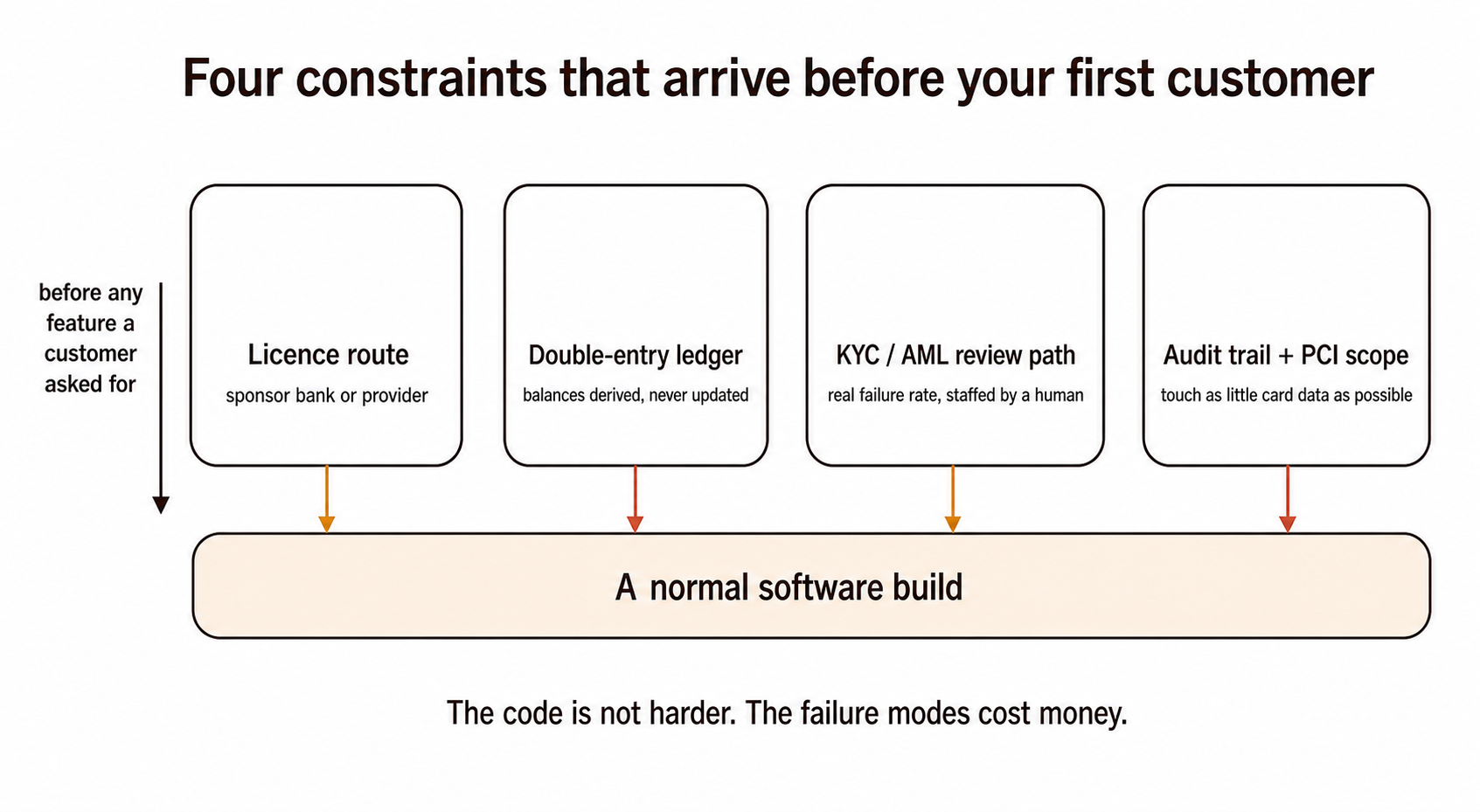
Fintech product development is normal software development plus four constraints that arrive before your first customer does. Nobody prices those four properly the first time, including teams who have shipped good software elsewhere.
This is about the startup end specifically: you are building a financial product, you do not have a compliance department, and you need to know what the extra work actually is. If you are on the enterprise side of finance, our custom financial software guide covers that shape instead.
Money movement is regulated, and you probably are not licensed. Nearly every fintech startup solves this by sitting on someone else's licence, usually a sponsor bank or a licensed payments provider. That decision constrains your product more than your tech stack ever will, and it happens before you write code.
You need a ledger, and your database is not one. More on this below, because it is the mistake that costs the most.
KYC and AML are product surface, not a checkbox. Identity verification is a step in your onboarding flow with a real failure rate. Some percentage of legitimate users will fail it and need a manual review path. That path is a product you have to build, staff, and support.
Data handling changes your architecture. PCI scope if you touch card data, encryption at rest, audit trails on anything that moves money. The cheapest decision here is to touch as little of it as possible.
The single most common architectural error we see in early fintech products is treating a balance as a number in a users table and updating it.
It works in testing. It fails in production, in ways that are painful to unwind:
Two requests process at once and the balance is wrong, with no record of how.
A transfer half-completes and you cannot tell which half.
Support asks why a customer's balance is $40 lower than expected and there is no way to answer, because you stored the current state and not how it got there.
The fix is a double-entry ledger. Balances are derived by summing immutable entries, never updated in place. Every movement writes at least two entries that sum to zero. This is a solved problem, it is boring, it is 200 years old, and it is the thing that turns "why is this number wrong" from an investigation into a query.
Build it first. Retrofitting a ledger into a live product with real customer money is genuinely one of the worst engineering jobs available.
Our fixed-price band is $4,000 to $30,000 and our engagements run four to eight weeks. Fintech work sits at the upper end for a specific reason, and it is not that the code is harder.
It is that the integrations are unforgiving and the failure modes are real. A workflow app with real integrations runs $10,000 to $22,000 over five to seven weeks. Platform work runs $22,000 to $30,000 and up, phased across eight to twelve weeks. Fintech products land in the second and third bands almost by definition, because a payment provider, an identity provider, a bank feed, and a ledger is four integrations before you have built a single feature anyone asked for.
The other thing that stretches timelines is not engineering at all. It is the sponsor bank or provider onboarding, which takes weeks and runs on their calendar, not yours. Start it before you think you need to. Teams routinely finish a build and then wait.
Cut features aggressively. Do not cut the ledger, the audit trail, or the manual review path.
Concretely, a first version that works: one money movement type, one user type, one currency, one funding source. Resist multi-currency until someone is paying you. Resist the second product entirely.
The instinct is that a financial product needs to look complete to be credible. It does not. It needs to be correct. A narrow product that always reconciles is more credible to both customers and partners than a broad one that occasionally cannot explain a balance. This is the same discipline we described in our MVP scoping guide, with higher stakes on getting it wrong.
Every fintech product needs a process that checks your ledger against the external source of truth, daily, and alerts a human when they disagree.
They will disagree. Providers have settlement windows, reversals arrive late, and occasionally something genuinely goes wrong. The question is whether you find out from a report or from a customer.
This job is not glamorous, it takes about a week to build properly, and it is the difference between a small discrepancy caught the same day and a compounding one discovered in month four. It belongs in version one.
A client came to us with a working product and a problem they described as "a rounding issue".
It was not rounding. They had built balances as a mutable column, and a retry in their payment webhook handler was occasionally applying the same credit twice. Small amounts, infrequent, easy to miss. The reason it had gone unnoticed for months was precisely the reason it was hard to fix: with no immutable entries, there was no way to reconstruct which transactions had been double-applied and which had not.
Fixing forward was straightforward. Working out what the correct balances should have been meant reconstructing history from the payment provider's records, which we could only partly do. Some of it ended up as a business decision rather than an engineering one, which is not a conversation anybody wants to have about customer money.
The demo had worked perfectly. It always does. A demo that runs clean on five hand-picked transactions tells you nothing about the five thousand real ones, and the gap between those two is where the engineering actually lives. In fintech that gap has a dollar value attached.
Four things, in this order:
Steps 1 and 4 are the ones teams skip, and they are the two that cost the most later.
Four constraints that arrive before your first customer: a licence arrangement you probably do not hold yourself, a double-entry ledger, KYC and AML as real product surface with a manual review path, and audit and PCI obligations that shape the architecture. The code is not harder. The failure modes cost money.
Realistically the upper part of our $4,000 to $30,000 fixed-price band: $10,000 to $22,000 for a workflow product over five to seven weeks, or $22,000 and up for a platform phased over eight to twelve. A payment provider, an identity provider, a bank feed, and a ledger is four integrations before any feature a customer asked for.
Yes, and building it first is much cheaper than retrofitting it. Storing a balance as a mutable number fails under concurrency and partial failures, and leaves you unable to explain how a balance got where it is. Derive balances from immutable entries instead.
One money movement type, one user type, one currency, one funding source, plus the ledger, the audit trail, the KYC review path, and daily reconciliation. Cut features hard; do not cut those four.
Sponsor bank or payment provider onboarding. It runs on their timeline, takes weeks, and teams routinely finish a build and then sit waiting on it. Start it before you think you need to.
Written by the Codestreaks team. Arsalan Amin, our co-founder, is an ex-data-scientist with Big Four consulting experience, which is where a good deal of our financial-systems work comes from. The price bands and the four-to-eight-week delivery window are our own published terms across 30+ projects delivered to production since 2024. The mutable-balance double-credit story is from a real client engagement, retold without naming them, and the partial reconstruction of correct balances is what actually happened. Drafting is AI-assisted with a human editing pass against our own project record. Nothing here is legal or regulatory advice; the licence question needs a lawyer, not an engineer.
If you are early enough that the ledger and the licence route are still open decisions, that is the best possible time to talk. Free 30-minute call, reply within two business days.
More on how we build on our SaaS development service page, or start a project.
A serial maker of SaaS products and AI agents, I’ve built and launched 10+ tools, grown products to thousands of users, and taken multiple ventures. I share the process what works, what breaks, and how builders can ship faster and smarter. Previously a data scientist at a Big Four consulting firm.