

Most proposals mean design through build and stop there. The four gaps that always appear at the back end, and the questions that reveal which version you are buying.

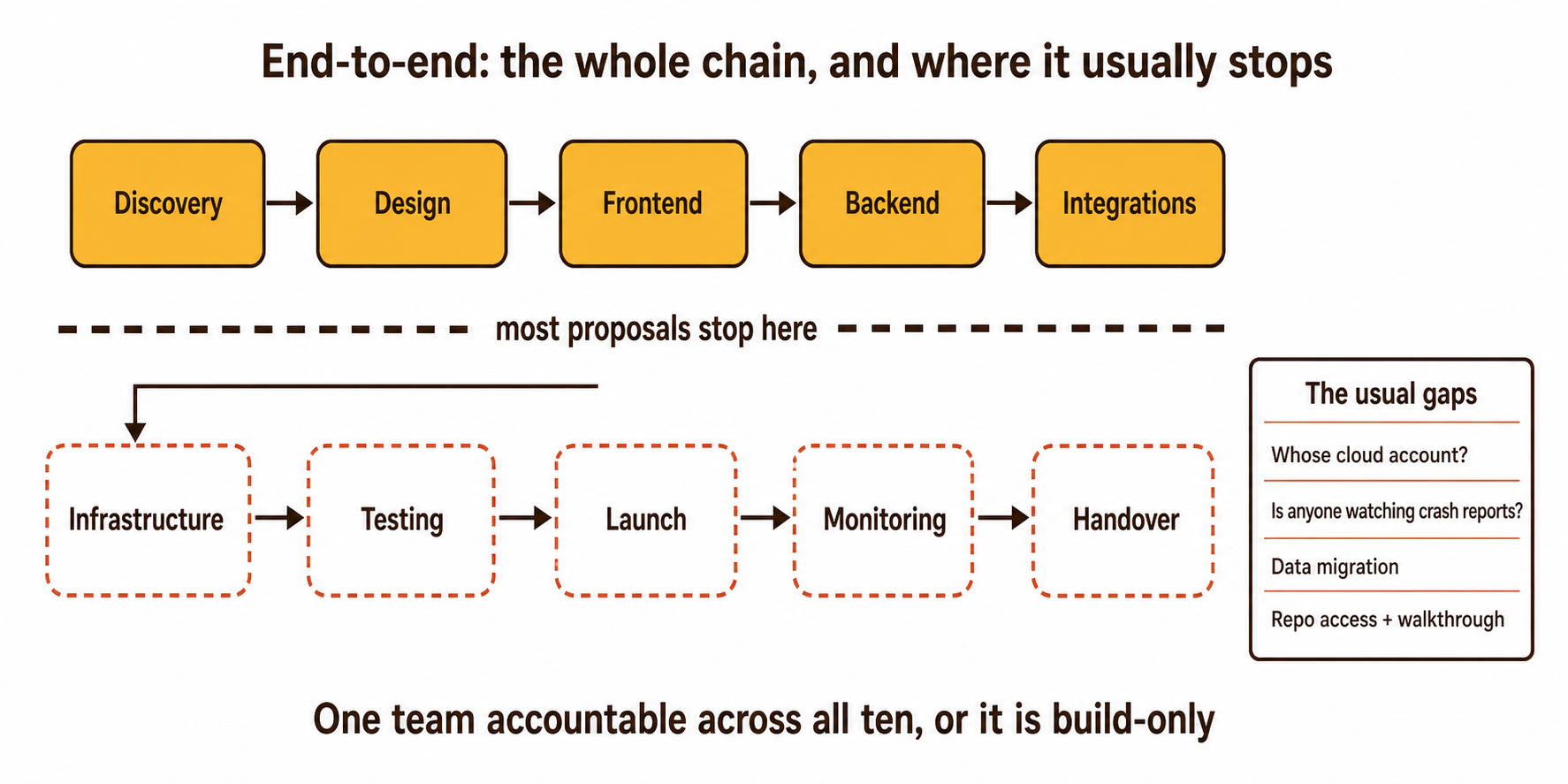
"End-to-end development" appears on almost every agency site, including ours. It is one of those phrases that sounds like a commitment and is almost never defined, which means two proposals can both claim it and mean genuinely different things.
Here is what it should mean, what it usually means, and the four questions that tell you which one you are buying.
End-to-end means one team owns the whole path from a problem statement to working software running in production, and stays accountable when something goes wrong in any part of it.
That path has more pieces than most briefs account for:
Discovery and scoping. Interface design. Frontend. Backend and data model. Third-party integrations. Infrastructure and deployment. Testing. Store submission or launch. Monitoring. Handover. Support after launch.
A genuinely end-to-end engagement covers all of those with one point of accountability. The value is not that one company does everything. The value is that when the app is slow, nobody can tell you it is the other vendor's fault.
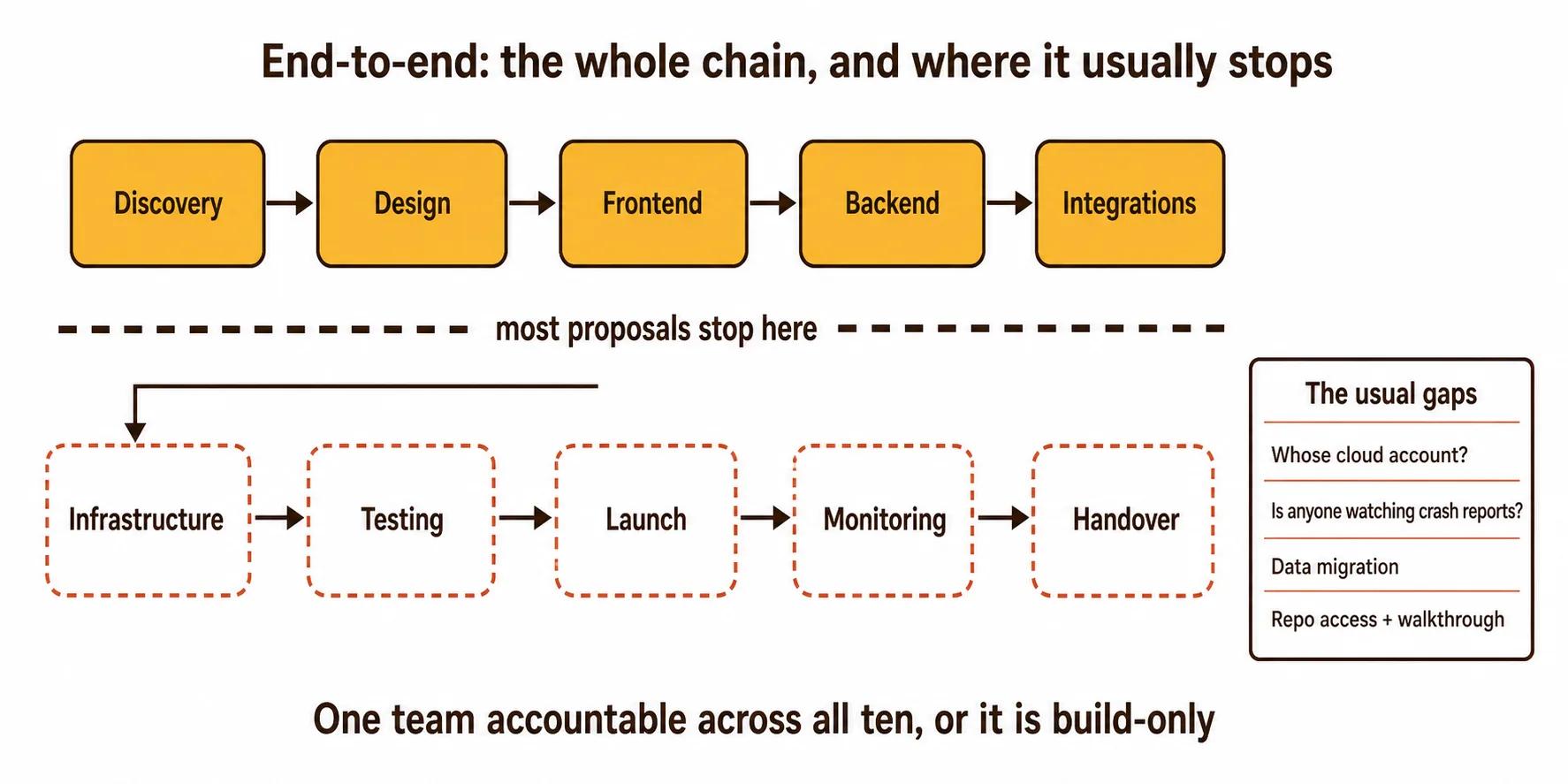
In most proposals, end-to-end covers design through launch and quietly stops there. The gaps are consistent, and they are all at the same end.
Infrastructure. Who owns the cloud account? If the agency deployed into their own, you have a problem that will surface at the worst time.
Monitoring. Is there crash reporting? Is anyone actually looking at it? Shipping without it means your feedback loop is app store reviews, which is a feedback loop measured in weeks and filtered through people angry enough to write.
Data migration. Getting your existing records into the new system is a project of its own, and it is the single most underestimated line in this whole industry. We wrote about why in our SaaS implementation guide, where migration turned out to be the project rather than a step in it.
Handover. Repo access, documentation, and a walkthrough with a named person on your side.
None of those are exotic. They are just past the point where the demo looks finished, which is where attention tends to stop.
Ask these of any proposal claiming end-to-end. They take a minute and they are hard to answer vaguely.
1. Whose cloud account does this run in? The answer must be yours, from day one. Anything else is a hostage situation waiting for a renewal negotiation.
2. What happens on day 31? Most agencies include some support window. Ask what specifically stops. We give 30 days post-launch support and say plainly what it covers, which is fixing what we built, not building new things.
3. Who is on the call when it breaks at 2am? Frequently nobody, and that is an acceptable answer if it is stated up front so you can plan for it. It is not acceptable to discover it at 2am.
4. Show me the handover checklist. If there is not one written down before the project starts, handover is going to be a rushed email in the last week. We have seen that email. It is usually a link to a repo and a sentence wishing you luck.
Two situations where paying for the whole chain is clearly worth it.
When the integrations are the project. If the software has to be correct across four systems that disagree with each other, splitting frontend and backend across two vendors guarantees that reconciliation bugs become a jurisdiction argument. One team, one throat to choke, and the bug gets fixed instead of relayed.
When you have no internal engineering. If there is nobody on your side to own the seams, the seams have to be owned by the vendor or by nobody. Nobody is the usual outcome.
Where it is not worth it: if you have a capable platform team and you need one specialised piece, buy the piece. Paying for discovery and infrastructure work you already do well is just paying twice.
A client asked us to review why their app had been "finished" for five weeks and still was not live.
Everything had been built. Design, frontend, backend, all done, all working in a staging environment. What had not happened was any of the last mile. There was no production environment. Nobody had enrolled in the developer program, which takes days and needs a business entity verification. No privacy policy existed, and the store will not accept a submission without one. No crash reporting was wired up.
That project was sold as end-to-end. It was genuinely end-to-end for design and build, and it stopped precisely where the interesting part starts. Nobody was lying. The phrase had just never been pinned down, and both sides had filled in the blank differently.
We now write the launch checklist into the scope document before kickoff, and it has removed that whole category of surprise. Our engagements run four to eight weeks from kickoff to live deployment, and "live" in that sentence has to mean live or the number is meaningless.
Since we use the phrase, here is what it binds us to. Discovery and scoping. Design. Build. Integrations. Deployment into your infrastructure. Testing on real devices. Launch, including store submission where relevant. Monitoring wired up and confirmed working. Documentation and a live walkthrough. 30 days of support. 100% code ownership from day one, not at the end.
Anything outside that gets named in the scope document as outside it. The list of what we are not doing is the more useful half of a proposal, and the half most proposals leave out. If you are comparing quotes, ask each one for that list. The differences will tell you more than the prices do, and the pricing question itself is usually downstream of scope anyway.
One team owning the full path from problem statement to software running in production, and staying accountable across all of it: discovery, design, build, integrations, infrastructure, testing, launch, monitoring, handover, and a support window. In practice many proposals use it to mean design through build only.
Almost always the same four things, and all at the back end: infrastructure ownership, monitoring, data migration, and a real handover. They sit just past the point where a demo looks finished.
Per project, often yes. Across two years, usually not, because the alternative is you coordinating the seams between vendors, and the seams are where the expensive bugs live. It stops being worth it when you already have a capable platform team and only need one specialised piece.
Four questions: whose cloud account does this run in, what stops on day 31, who is reachable when it breaks outside hours, and can I see the handover checklist. Vague answers to any of them tell you where the engagement will actually end.
It should not. Ownership is yours regardless. Ask for repository access from day one rather than a handover at the end. An agency that will not give you the code is selling you a rental with no renewal terms written down.
Written by the Codestreaks team. The four-to-eight-week delivery window and the 30-day support and code-ownership terms are our own standing engagement terms across 30+ production projects since 2024. The five-weeks-finished-but-not-live story is a real client review, retold without naming them, and it is why our scope documents now carry a launch checklist. We use the phrase "end-to-end" ourselves, so the commitments section above is what we will be held to. Drafting is AI-assisted with a human editing pass over our own delivery record.
If you have a proposal in front of you and want a second read on what it actually covers, we are happy to look. Free 30-minute call, reply within two business days.
More on how we scope on our web development service page, or start a project.
A serial maker of SaaS products and AI agents, I’ve built and launched 10+ tools, grown products to thousands of users, and taken multiple ventures. I share the process what works, what breaks, and how builders can ship faster and smarter. Previously a data scientist at a Big Four consulting firm.