

Build versus buy is the wrong framing. The third option solves most cases, and the question that tells you which one you actually need.

Almost nobody should build a CRM from scratch, and the people who ask us to usually do not want one either. What they want is the two or three things their current CRM cannot do, without the twelve months of pain that switching would cost.
That distinction is the whole decision, and it has three answers rather than two.
The conversation is usually framed as build versus buy. There is a third option in the middle that solves most cases better than either.
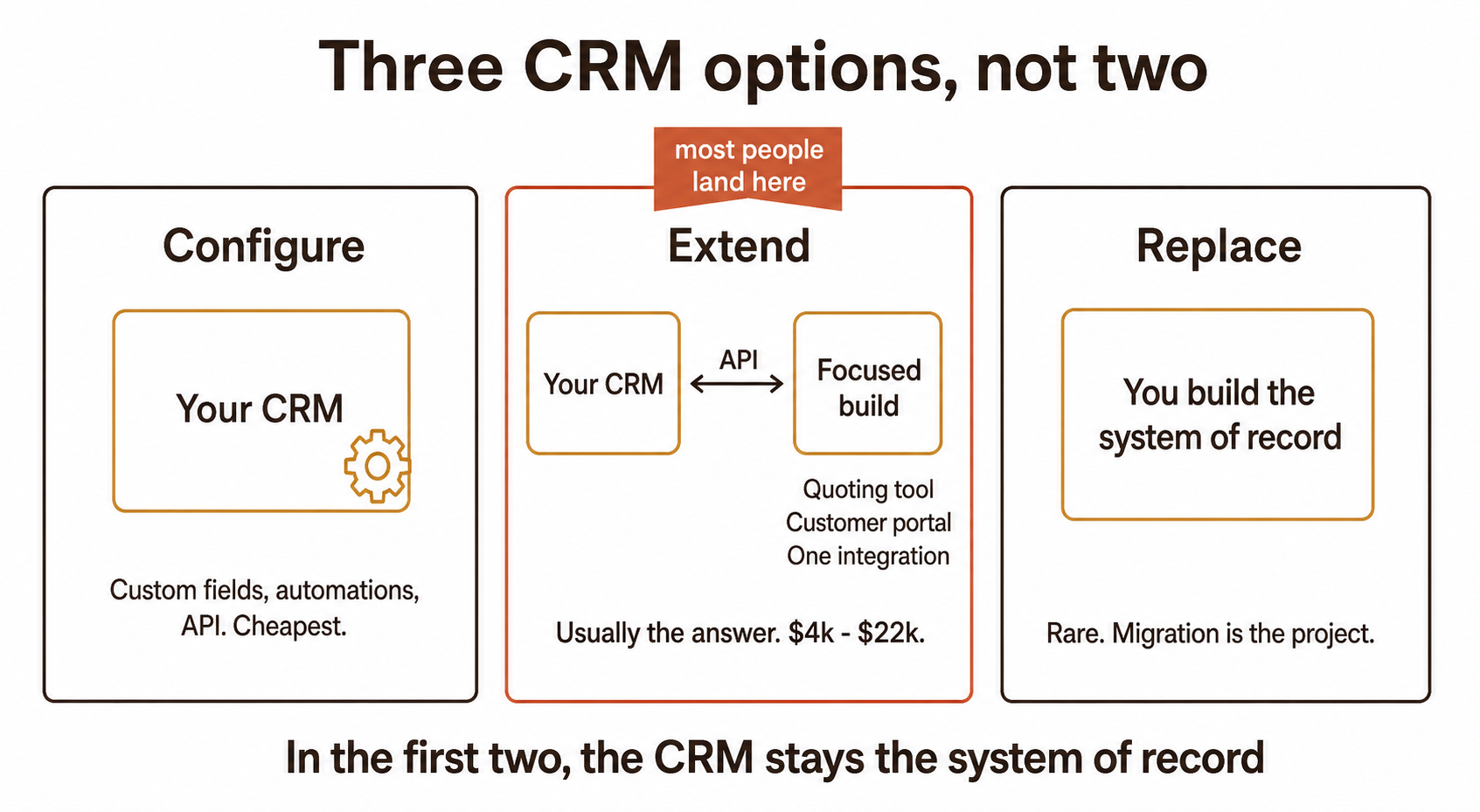
Configure. Take the CRM you have, or a flexible one, and use custom fields, automations, and its API. Cheapest, fastest, and the answer more often than agencies like us admit.
Extend. Keep the CRM as the system of record and build a focused piece alongside it that does the thing it cannot. A quoting tool, a dispatch board, a customer portal, reading and writing through the CRM's API. This is where most of our CRM-adjacent work actually lands: $4,000 to $10,000 for a single-purpose build over three to four weeks, or $10,000 to $22,000 once several integrations are involved.
Replace. Build the system of record yourself. Rare, expensive, and correct in a narrow set of cases.
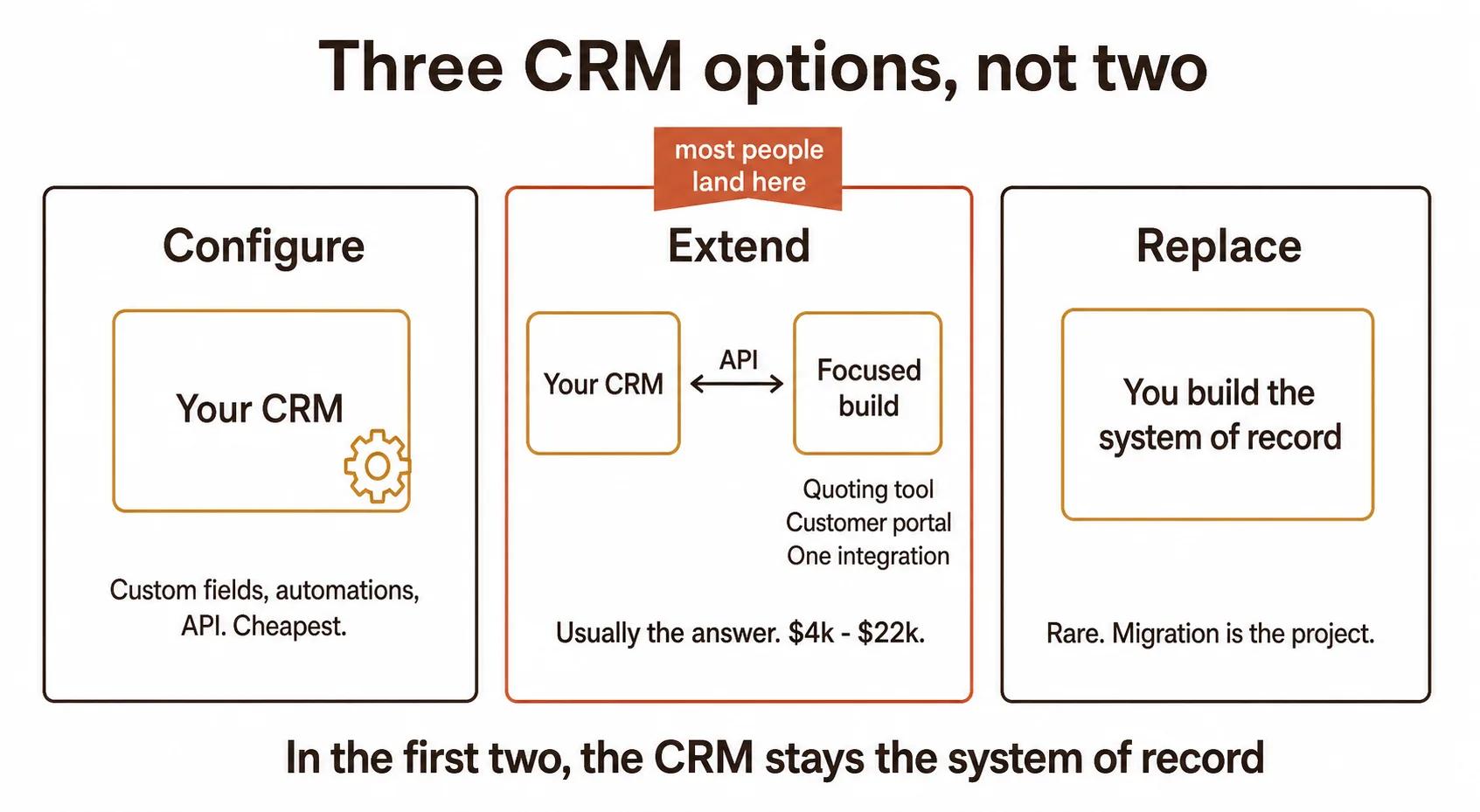
Most people arrive asking about the third and leave doing the second.
Three cases, and they are narrower than the enthusiasm suggests.
Your sales process is the product. If how you qualify, route, and price is genuinely your commercial advantage, a generic pipeline flattens it toward the industry average. That is a real cost that never shows up as a line item.
Per-seat pricing has broken the model. Not "it's expensive". Broken, as in you are actively restricting who gets access because of cost, and that restriction is damaging the process. If half your staff work from screenshots someone else exports, your CRM is not being used.
The data model does not fit and never will. Some businesses are not companies-contacts-deals shaped. Anything with recurring service against a physical asset, or multi-party transactions, fights that model forever. You can bend most CRMs, but the bending shows up as workarounds everyone has to remember.
If none of those apply, extend rather than replace.
It is not the build. It is the migration.
Your existing CRM contains years of records, and a meaningful share of them are wrong. Duplicates, contacts at companies that no longer exist, deals that were never closed out, custom fields three people used differently over four years. That mess is invisible while it sits there, and becomes extremely visible the moment you try to move it into a schema that enforces rules.
We have written before that on a SaaS implementation, the data migration is the project, and CRM is the sharpest example. Budget for it as a real phase, not a step. Expect to discover during it that nobody agrees what a "qualified lead" has meant historically, and expect that conversation to take longer than writing the import script.
The other half is adoption. A CRM nobody updates is worse than the one you replaced, because now the data is split between two systems and neither is trusted. If your sales team does not currently keep the CRM current, a better CRM will not fix that. The reason is almost always that updating it costs the rep time and returns them nothing.
The pattern that works: leave the CRM as the system of record, and build the thing that removes work from whoever has to keep it updated.
Concretely, the builds we see pay off:
A quoting tool that reads product and pricing data, produces the document, and writes the outcome back. Reps stop rebuilding quotes in spreadsheets.
A customer portal so clients update their own details, which is the single cheapest data-quality improvement available to most businesses.
A dispatch or scheduling view for field teams, because CRM mobile apps are generally built for salespeople and not for a technician in a van.
One integration to whatever system currently gets data re-keyed into it by hand. Usually accounting. Usually the highest-value thing on this list.
Every one of those keeps the CRM as the record and removes friction around it. None requires migrating anything.
A client asked us to scope a custom CRM. Their complaint was that their CRM "did not fit how they work" and they had a list of grievances to prove it.
We asked what their team actually did in it each day. The answer was that reps logged calls, and then separately re-entered the same job details into their accounting system after each one, because the two did not talk. Everything else about the CRM was fine. The grievance list was mostly cosmetic.
The real project was one integration, at the bottom of our range. They kept the CRM. The complaints stopped, because the complaints had never really been about the CRM.
That is the pattern. Frustration attaches to the interface people stare at, and the actual cost sits in a handoff nobody looks at directly. Asking where the hours go, rather than what feels worst, is most of the work in scoping this.
We would rather ship the small integration than sell the platform rebuild. Two engagements a quarter is real capacity, and spending one of them on a rebuild that did not need to happen is a bad trade for both sides.
Ask your team: if this CRM did exactly one more thing, what would it be?
If everyone names roughly the same thing, extend. Build that one thing.
If you get five unrelated answers, the CRM is not the problem. Something about the process is unclear, and encoding an unclear process into custom software makes it permanent. Sort the process first. We covered the same trap from the buyer's side in our CEM vs CRM guide.
Use an existing one and extend it, in almost every case. Replacing the system of record is justified when your sales process is genuinely your commercial advantage, when per-seat pricing is forcing you to restrict access in damaging ways, or when your data genuinely is not companies-contacts-deals shaped. Otherwise, build alongside it.
A focused piece alongside an existing CRM (a quoting tool, a portal, one integration) runs $4,000 to $10,000 over three to four weeks, or $10,000 to $22,000 once several systems are involved. Replacing the system of record entirely is a platform project and priced accordingly, which is why we push back on it.
Data migration, by a wide margin, followed by adoption. Years of duplicates, dead records, and custom fields used inconsistently only become visible when you move them into a schema that enforces rules. Budget for it as a phase, not a step.
Usually because the team was not keeping the old CRM current either, and nobody addressed why. Updating a CRM costs a rep time and returns them nothing. If a new system does not change that trade, adoption fails the same way, only now the data is split across two systems.
Usually a single integration to whatever system currently receives hand-copied data, most often accounting. After that, a customer portal, because letting clients maintain their own details is the cheapest data-quality gain available to most businesses.
Written by the Codestreaks team. The price bands are our own published fixed-price tiers, from 30+ projects delivered to production since 2024, and the two-engagements-a-quarter capacity is real. The custom CRM scoping story is from a real engagement, retold without naming the client, and it ended as one integration rather than the platform build the client came in asking for. We are an agency arguing against the larger version of a project here, which is worth weighing accordingly. Drafting is AI-assisted with a human editing pass over our own project record.
If you can tell us the one thing your CRM cannot do, we can usually tell you on a call whether that is a configuration, an integration, or a real build. Free 30 minutes, reply within two business days.
More on how we scope on our SaaS development service page, or start a project.
A serial maker of SaaS products and AI agents, I’ve built and launched 10+ tools, grown products to thousands of users, and taken multiple ventures. I share the process what works, what breaks, and how builders can ship faster and smarter. Previously a data scientist at a Big Four consulting firm.