

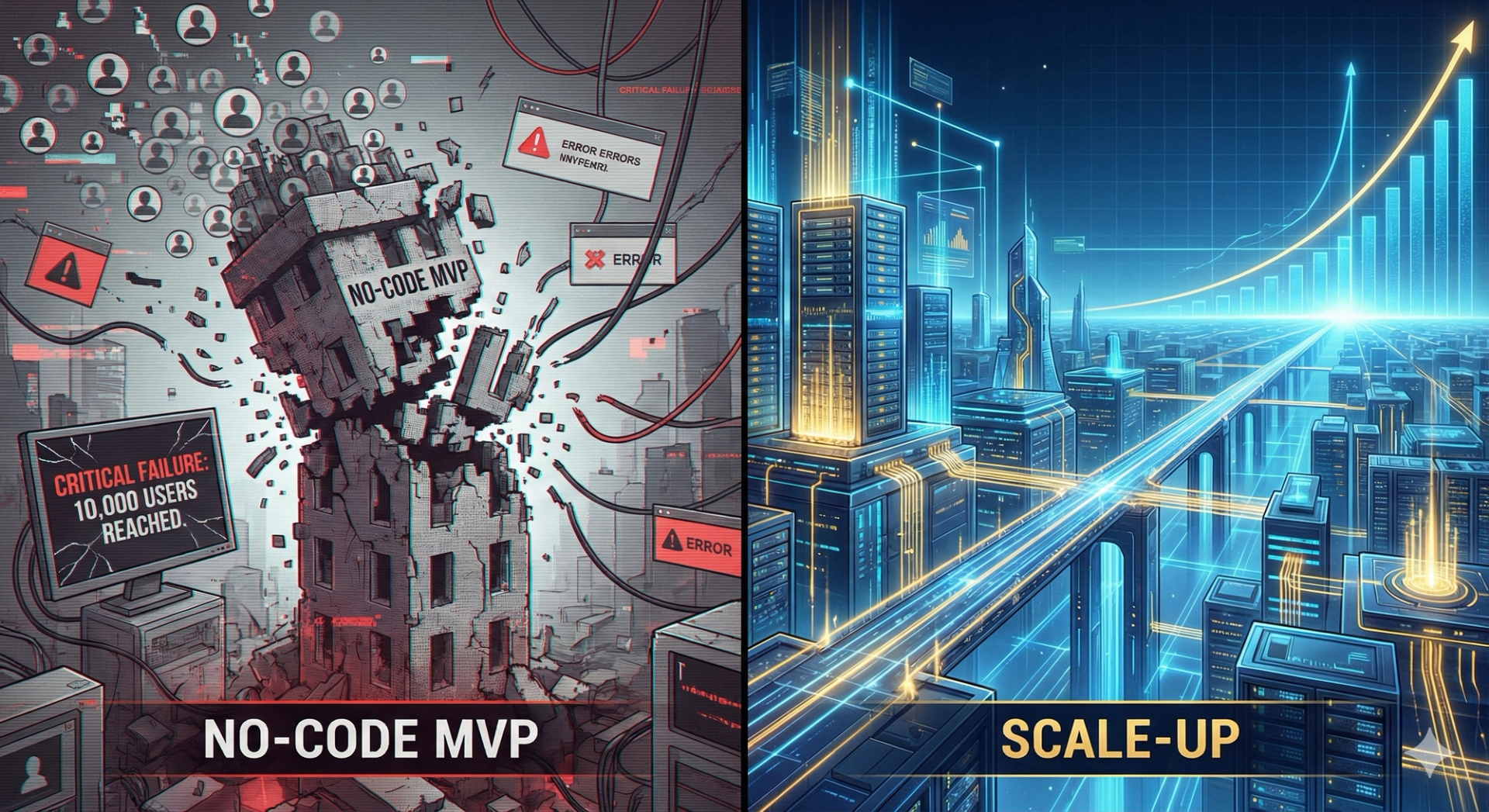
Bubble and Webflow are great for day one, but terrible for day one hundred. We break down the technical debt of No-Code and the roadmap to migrating your SaaS to Next.js.

By Arsalan Amin | Founder, CodeStreaks | Updated: January 2026
We see the same tragedy almost every week at our Austin headquarters.
It’s usually a Tuesday morning. A founder walks in, exhausted, anxious, and frustrated. They have a brilliant product. They have found true Product-Market Fit. They have $10k or even $20k in Monthly Recurring Revenue (MRR).
By all traditional metrics, they are a massive success. But they are terrified.
Why? Because their app crashes every time more than 50 people log in at once. Their database queries take 4 seconds to load. Their "Feature Roadmap" has been frozen for three months because every new feature breaks two old ones. And their investors are asking for a technical audit that they know they will fail.
The culprit? They are stuck in the "No-Code Trap."
In the rush to launch in 2024 or 2025, they built their entire business on a platform like Bubble, Adalo, or FlutterFlow. It worked like magic... until it didn't.
In this deep dive, we are going to explore the lifecycle of a No-Code startup, the mathematical "ceiling" where these tools break, and the Rescue Migration Playbook we use at CodeStreaks to port high-growth startups to scalable custom architectures without downtime.
To understand why you are stuck, you have to understand the three phases of the No-Code lifecycle. No-code tools are not "bad", they are just tools. But using a hammer to build a skyscraper is a recipe for disaster.
This phase feels amazing. You have an idea on Monday, and by Friday, you have a working app. You didn't have to hire expensive engineers or set up AWS servers. You are paying Bubble $30/month, and you feel like a genius. You launch, you get your first users, and everything is fast.
The Lie: You believe that "Development is easy" and that you have "hacked" the system.
You start getting feature requests that the templates don't support.
Suddenly, the drag-and-drop builder isn't enough. You start installing "Plugins" created by random developers. You start writing weird "hacky" workarounds to make the database do things it wasn't designed to do. The app gets a little slower. You ignore it.
This is where the tragedy happens. You get a spike in traffic, maybe a viral tweet or a TechCrunch article.
Instead of celebrating, your server crashes. The No-Code platform imposes rate limits. Your database, which is shared with thousands of other apps, chokes.
Your users churn because the app feels "unprofessional" and laggy. You try to fix it, but you realize you can't optimize the code because you don't have access to the code.
You have hit The Ceiling.

Why exactly do these platforms fail at scale? It isn't magic; it's computer science. When you build on a No-Code platform, you are renting an apartment in a massive building. When you build custom code, you are buying your own land.
In a custom Postgres database (which we use with Next.js), if a query is slow, we can index it. We can write a custom SQL query to fetch exactly the data we need and nothing else.
In a No-Code tool, you are often forced to fetch "The Whole Object."
SELECT name FROM users;. This is 100x faster.At 10,000 users, this inefficiency compounds until the app becomes unusable.
We work with many VCs in the US market. When they look at a startup to invest Series A ($5M+), they look for "Assets."
If your entire product is built on a 3rd party platform:
Investors discount the valuation of No-Code startups because the "Moat" is weak. Anyone can drag-and-drop the same app in a weekend.
This is the dealbreaker in 2026. If you are building an AI app, you cannot just "wrap" the OpenAI API anymore. To be competitive, you need:
You cannot run a heavy Python script inside Bubble. You have to use "Cloud Functions" or "Zaps" (Zapier), which adds latency and complexity. It becomes a Frankenstein monster of disconnected services that breaks constantly.
So, you are at 10,000 users and you are hitting the wall. What do you do? Do you shut down for 6 months to rewrite? No. That is suicide.
At CodeStreaks, we execute what we call a "Strangler Fig Migration." We slowly replace the old system with the new one, piece by piece, without the users ever noticing downtime.
We don't just export a CSV. We set up a real-time sync between your No-Code database and a new, enterprise-grade PostgreSQL database on Supabase or AWS. Now, your data lives in your house, even if the users are still visiting the rental.
We rebuild your most critical, laggy page (usually the Main Dashboard) using Next.js.
We point a subdomain (app.yourdomain.com) to this new, super-fast Next.js page.
The user logs in. They don't know they have switched platforms. They just know the dashboard suddenly loads in 100ms instead of 4 seconds.
We move your logic from "Zapier" to a dedicated Python/FastAPI backend. This is where we unlock true power.
Once all pages are migrated, we flip the DNS switch. The No-Code app is turned off. You are now running on a scalable, proprietary stack. You own the code. You own the data. You own the future.

Why do we move everyone to Next.js? Why not Ruby on Rails or PHP?
We built our own internal product, Airwrite.pro, on Next.js from Day 1 for three specific reasons.
Next.js (hosted on Vercel) allows us to cache your content at the "Edge." This means if a user is in Tokyo, they download your app from a server in Tokyo, not Texas. Result: Airwrite loads instantly, globally. No-Code tools usually host everything on one central server in Virginia, making the app slow for anyone outside the US.
With Next.js, we use "Serverless Functions." You don't pay for a server running 24/7 waiting for users. You only pay when a user actually clicks a button. Result: For many startups, their hosting bill drops when they migrate off expensive No-Code enterprise plans.
Next.js is built on React. This means you have access to the world's largest library of pre-built components.
npm install react-calendar.npm install recharts.On No-Code, you have to wait for someone to build a plugin. In React, if it exists on the internet, you can use it immediately.
Founders often tell us, "But custom development is expensive."
Is it? Let's look at the ROI.
Staying on No-Code feels cheap today but costs you a fortune tomorrow in lost customers. Moving to custom code is investing in your Intellectual Property. It is the difference between a "Side Project" and a "Technology Company."
Is your MVP hitting the ceiling?
Do not wait for the crash. By the time the server goes down during your biggest sales week, it is too late.
Book a Migration Audit with the CodeStreaks engineering team today. We will look at your Bubble app, assess your data structure, and give you a fixed-price roadmap to freedom.
We don't just preach this; we live it. Check out our high-performance SaaS products built entirely on the stack described above:
A serial maker of SaaS products and AI agents, I’ve built and launched 10+ tools, grown products to thousands of users, and taken multiple ventures. I share the process what works, what breaks, and how builders can ship faster and smarter. Previously a data scientist at a Big Four consulting firm.


