

Build a workout app that survives real gyms: offline-first logging, HealthKit and Health Connect done right, and retention that runs on progress, not guilt streaks.


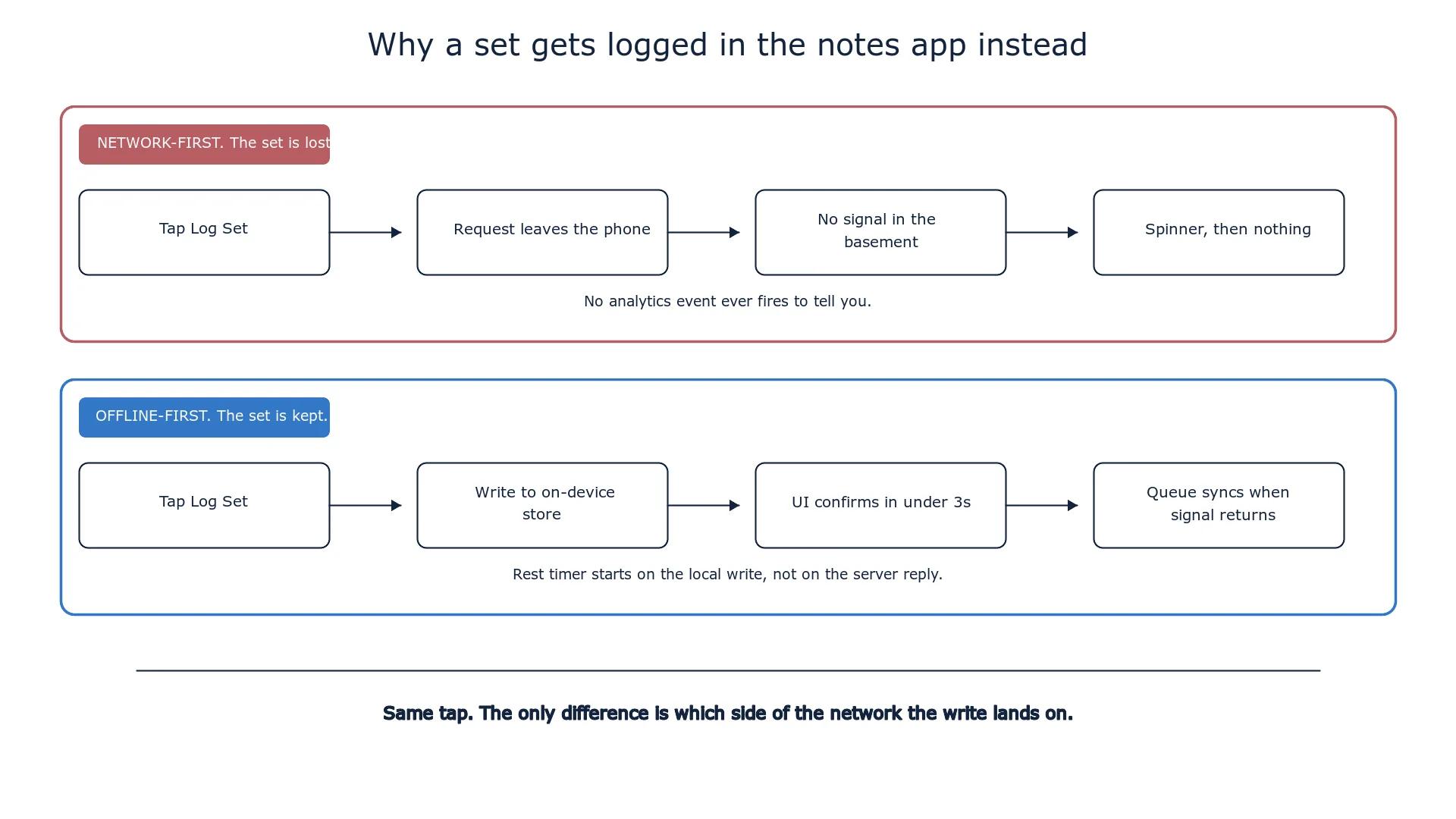
Third set of squats. Your user's phone sits on the floor in a cracked case, there is chalk on their thumbs, and there are zero bars of signal because the free-weights area is a concrete box two floors underground. They rack the bar, pick up the phone, and your app shows a spinner. Logging a set apparently needs a network round trip. So they type "5x5 at 225" into their notes app instead, and no analytics event ever fires to tell you that you just lost them.
That moment is where fitness mobile app development is won or lost. Not the onboarding flow, not the app store screenshots. The mid-workout moment, offline, with sweaty hands and 90 seconds of rest on the clock. We have shipped 30+ projects to production since 2024, and one pattern holds across every product that lives in a physical environment: demo conditions are a lie, and real conditions are hostile. This article covers the four things that decide whether a workout app survives contact with a real gym: offline-first architecture, wearable integration through Apple HealthKit and Android Health Connect, logging UX fast enough for a rest timer, and retention built on progress instead of guilt.
Gyms are concrete boxes full of steel. Signal dies past the front desk, the wifi is a captive portal nobody logs into, and the user's attention arrives in 90-second windows between sets. The OS may kill your app while the phone sits locked on a bench. Hands are chalked, sweaty, or gloved.
Each of those facts is an architecture requirement, not a nice-to-have:
None of this is exotic engineering. It is deciding, before the first line of code, that the basement is the primary environment and the demo room is the edge case.

A fitness app that ignores the watch on the user's wrist is competing with it, and the watch wins. Integration runs through two platform layers, and they behave differently enough to plan for separately.
Apple HealthKit on iOS grants permissions per data type, read and write separately. Two things matter beyond the API calls. First, write workouts back to HealthKit, because a session logged in your app that also closes the user's Activity rings borrows the strongest habit loop Apple ever built. Second, App Store guideline 5.1.3 prohibits using HealthKit data for advertising or selling it to data brokers, and review teams check. Keep ad SDKs away from anything health-shaped.
Android Health Connect is the on-device health datastore, built into Android 14 and later and installable back to Android 9. It replaced the Google Fit APIs, which Google shut down in 2025, so if a vendor pitches you a Google Fit integration in 2026, that is a tell. The gotcha teams miss: by default an app can only read data from the 30 days before the user granted permission. Older history needs a separate permission the user can decline, so design your progress charts to start strong with 30 days and get richer over time, rather than promising a five-year history you may never be allowed to read.
Then there is deduplication, the unglamorous part. The phone counts steps. The watch counts steps. A treadmill app writes a workout covering the same 30 minutes. Read everything naively and your user walked 40,000 steps on Tuesday, which they will notice, and trust in every other number you show drops to zero. You need per-source priority rules keyed on data origin, tested against real multi-device setups.
This is where our oldest opinion bites hardest: prototypes lie. The wearable demo runs on the founder's own Apple Watch and looks perfect. Real users show up with a Garmin syncing through a third-party bridge, a five-year-old Wear OS watch, or no wearable at all. Handling the five thousand real configurations, not the five in the demo, is where the engineering actually lives.
Between sets, your user has one thumb and a countdown. The logging flow earns its keep or gets replaced by the notes app, which has no onboarding, no login, and never shows a spinner.
What we build toward:
Speed here is retention. Every second of friction in the log-a-set loop gets paid dozens of times a week, and the exit is always one gesture away.
Here is an opinion we hold strongly: streak mechanics are borrowed from games, and they poison workout apps. Real training has deload weeks, sick days, travel, and life. A fragile chain converts every one of those into a small failure, and a user who feels judged by an app deletes the app. We went deeper on guilt-free engagement in our healthcare app development article, and every rule there applies here.
But fitness has an advantage most wellness products would love to have: progress is real and measurable. A lifter adds weight to the bar. A runner's pace drops. Estimated one-rep max trends up across a twelve-week block. The retention loop is progressive overload itself, and the app's whole job is to make that progress visible and the next session obvious. Show the personal record next to the one it beat, with dates. Chart volume per muscle group over months, not days. Frame a comeback week as a comeback, not a broken chain. Evidence, not judgment. People stay with a mirror that shows them getting stronger.
Rope Access Logbook is a product we shipped for industrial safety: technicians who hang off wind turbines and high-rise facades, logging certified work hours that used to live in a paper book. The field conditions are a gym basement multiplied. No signal, gloves, weather, and entries that cannot be lost, because logged hours are how a technician keeps certification.
We built it local-first, writes landing on the device and syncing when the world returns, and shipped it in 8 weeks. Chad Dubuisson, the founder: "Codestreaks took our rough idea and turned it into a real product in just 8 weeks. The way they built it saved us months of headaches down the road."
The transfer to fitness is direct. If your logging architecture holds up on a rope 90 meters above the ground, a concrete gym is the easy case.
A direct-to-consumer workout tracker usually sits outside HIPAA, since no healthcare provider or health plan handles the data. Outside HIPAA is not outside the rules. The FTC's Health Breach Notification Rule covers consumer health apps, state laws like Washington's My Health My Data Act reach further, and both app stores police health data handling in review. Heart rate, body weight, and workout history are health data.
Our posture is the same one we take on healthcare builds: no advertising SDKs near health data, deletion that actually deletes, and one plain-language screen that says what is collected and what stays on the device. Privacy is a feature users can verify. A competitor can copy your exercise library in a quarter; they cannot copy a reputation for handling data well.
Real numbers from our own engagements. Our projects run $4,000 to $30,000 fixed price, and most ship in 4 to 8 weeks from kickoff to live deployment. A focused workout tracker with offline-first logging and HealthKit or Health Connect integration sits in the middle of that range. Add the second platform, a coach-facing dashboard, or subscription infrastructure and you move toward the upper band.
Every engagement includes 30 days of post-launch support and 100% code ownership. The repo is yours from day one. That matters the day an investor runs technical diligence or a store review escalation asks who controls the code touching health data.
Our fixed-price range is $4,000 to $30,000, and most fitness builds land mid-range. The main cost drivers are wearable integration depth, whether you launch on one platform or two, and backend features like coach dashboards or subscriptions. Get a fixed quote against a written scope before anyone writes code.
Only if your first hundred users are genuinely split across platforms. Most fitness products should launch on one platform, get the logging loop and wearable sync right there, and port second. A great iOS app beats two mediocre ones, and the sync architecture you harden on platform one transfers.
Usually not. HIPAA attaches to healthcare providers, health plans, and their business associates, not to health data in general, so a consumer workout app is typically outside it. The FTC Health Breach Notification Rule, state health privacy laws, and app store policies still apply. If a clinic, physical therapist, or insurer is in the loop, talk to a healthcare attorney before you build.
Deduplicate by data origin. Both HealthKit and Health Connect tag every record with its source, so you set priority rules (watch beats phone for heart rate, one writer wins per overlapping workout window) and test them with real multi-device users. Naive summing across sources is the most common wearable bug we see in inherited codebases.
Written by the Codestreaks team, drafted with AI assistance and edited by a human against our own delivery history. The offline-first write path in the diagram is the architecture we actually shipped for Rope Access Logbook, an industrial safety product delivered in 8 weeks, and the founder quote is used with permission. The three-second logging target and the 2.5 kg / 5 lb stepper increments are our own design rules from mobile work, not an industry standard. We have shipped 30+ projects to production since 2024 and take on two engagements per quarter. The diagram is ours. No fitness client is named, per our client confidentiality practice.
If you are scoping a fitness app, we offer a free 30-minute scoping call. Bring the idea; we will bring the offline questions and the wearable questions. We respond within two business days, and we take on two engagements per quarter, so if the timing fits, get in touch or see how we build on our mobile app development page.
A serial maker of SaaS products and AI agents, I’ve built and launched 10+ tools, grown products to thousands of users, and taken multiple ventures. I share the process what works, what breaks, and how builders can ship faster and smarter. Previously a data scientist at a Big Four consulting firm.


