
Blue-collar workers don't have free hands. Discover how OpenAI's Realtime API is enabling voice-controlled mobile SaaS for manufacturing and logistics.

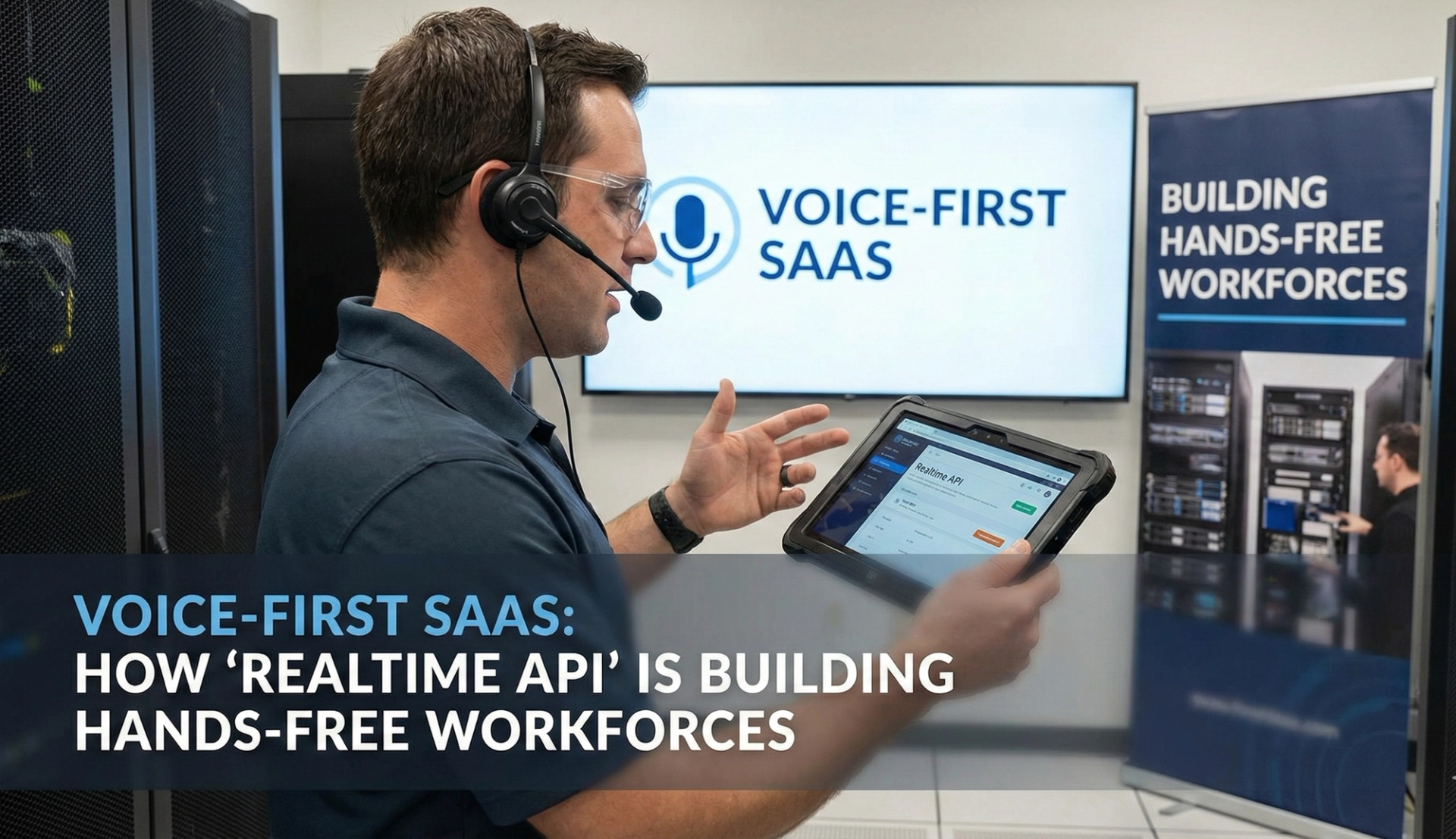
If your SaaS targets logistics, manufacturing, or healthcare, requiring a keyboard is a UX failure. These users have gloves on; their hands are busy carrying loads or operating machinery. The insight behind The End of Latency: What OpenAI's 'Realtime API' Means for Your SaaS is that we can now build 'Voice-First' mobile apps that actually understand context, rather than just transcribing text.
Imagine a warehouse worker saying, 'Hey Agent, log 50 units of SKU-X as damaged and reorder from supplier B.' In the past, this was a pipe dream requiring complex state machines. Today, RIP Chatbots: Why 2026 Belongs to 'Agentic AI' proves it's reality. The AI parses the intent, executes the database update via a unified Flutter for Enterprise backend, and confirms the action in sub-100ms.
Industrial environments are loud. Building these apps requires advanced audio processing pipelines that filter background noise before the audio stream hits the LLM. We implement 'Voice Isolation' layers in our mobile builds to ensure high accuracy. This attention to detail is what separates a prototype from a venture-grade product.
This isn't just cool tech; it's also about ADA Compliance for Mobile Apps. Voice interfaces make your SaaS accessible to users with motor impairments or situational disabilities. By building this 'hands-free' moat, you secure long-term contracts with US enterprises that prioritize safety and efficiency over raw cost. This is the definition of value-based positioning.
The best UI is no UI. By removing the screen from the workflow, you increase safety and speed. This is the frontier of Mobile App Development for 2026.
A serial maker of SaaS products and AI agents, I’ve built and launched 10+ tools, grown products to thousands of users, and taken multiple ventures. I share the process what works, what breaks, and how builders can ship faster and smarter.