

The era of passive chatbots is over. Users don't want to talk; they want action. Learn how 'Agentic AI' is replacing customer support teams and how we build them at CodeStreaks.

By Arsalan Amin | Founder, CodeStreaks
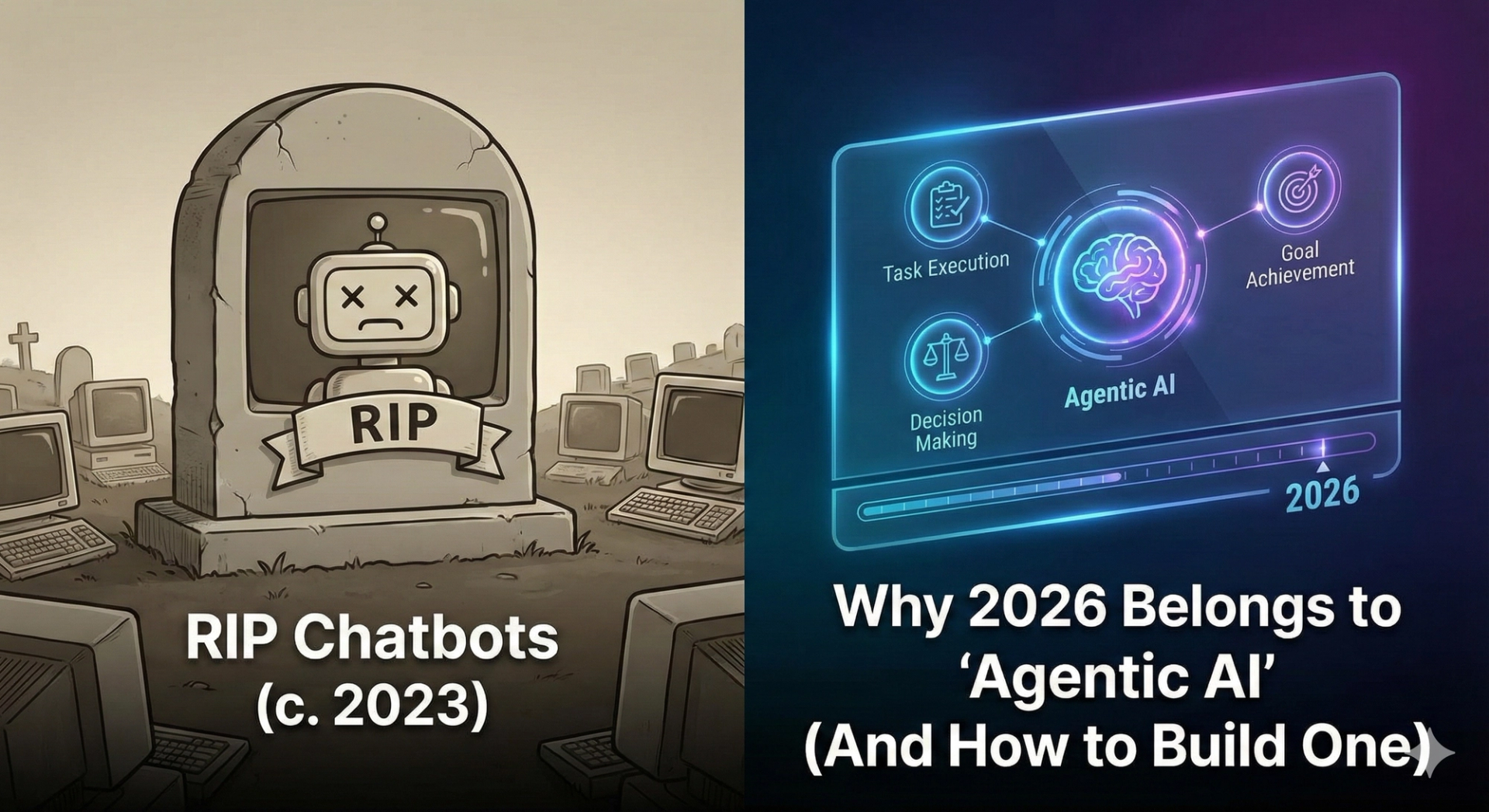
If you are still building "Chatbots" in 2025, you are essentially building a fax machine in the era of email. You are building a legacy product.
For the last three years, the tech industry has been obsessed with "Generative AI", machines that can create text and images. But the hype cycle around "chatting with AI" is fading. Users are suffering from "Chat Fatigue." They don't want to have a 20-minute conversation to solve a simple problem. They don't want a therapist; they want a servant.
The new value unlock, and the massive opportunity for US startups in 2026, is Agentic AI.
In this deep dive, we will explore why the market is shifting, the specific engineering breakthroughs that make Agents possible today (specifically OpenAI's Realtime API), and the exact architecture we use at CodeStreaks to build autonomous digital employees.
To understand why Chatbots failed the enterprise test, we have to look at the fundamental difference in architecture.
A chatbot is a retrieval engine. It is a librarian.
An agent is an execution engine. It is an employee.
Agents don't just talk. They have hands.
The economic implication here is massive. A chatbot creates more work for the user (reading instructions). An agent removes work. In the US market, where labor costs for support staff are high, the ability to replace a Tier-1 Human Agent with an AI Agent is the holy grail of SaaS unit economics.

Until recently, building a true Agent was incredibly difficult. The latency was too high, and the tools were too clunky.
That changed with the General Availability (GA) of OpenAI's Realtime API. We have been testing the beta at CodeStreaks Labs, and three specific features have completely changed how we architect voice and text agents.
In previous models, "Function Calling" (using tools) was a blocking operation. If an Agent needed to query a database, the conversation would freeze. The user would sit in awkward silence.
The new Realtime API introduces Asynchronous Function Calling. This allows the client to continue the session while a function call is pending.
A major risk with Agents is security. You don't want to expose your database credentials to the client.
OpenAI now supports Sideband Connections. This allows us to architect a dual-channel system:
This means we can keep your business logic and API keys secure on the server, while still giving the user a realtime, low-latency voice experience.
Nothing is worse than a voice bot that goes silent and you don't know if it crashed.
We now use Server VAD (Voice Activity Detection) with a configured idle_timeout_ms. If the user stops talking or the conversation stalls, the server triggers a timeout event. This allows the Agent to instinctively say, "Are you still there?" or "Did you want me to proceed with that?", just like a human would on a phone call.
We don't use generic "No-Code" wrappers to build Agents. They are too fragile for enterprise use. At CodeStreaks, we build custom Orchestration Layers using Next.js and Python.
Here is the blueprint we use for our internal products like Castmunk.com and Airwrite.pro.
We use the gpt-4o-realtime-preview model as the central decision maker. Its job is not to generate the final answer, but to decide which tool to pick up.
This is a set of secure API endpoints that the Brain is allowed to access.
getUserProfile, checkInventory, searchKnowledgeBase.processRefund, updateAddress, scheduleMeeting.Crucial Step: We implement a "Guardrail Logic" middleware. Before the Agent can execute a "Write" tool (like deleting a file), our code intercepts the request and checks for permissions. If the confidence score is low, we force the Agent to ask the user for confirmation: "I am about to delete this file. Are you sure?"
For voice agents, we process audio directly. The new model supports native "Audio-to-Audio" processing, which removes the need for a separate transcription step. This cuts latency from 3 seconds down to ~300ms.

We believe in "Eating Your Own Dog Food." We applied this architecture to Castmunk, our podcast management SaaS.
The Problem: Podcasters struggle with technical RSS feed errors. They would email support saying, "My podcast isn't updating on Spotify." The Old Way: A human support rep would open the XML file, validate it, find the missing tag, and email the user back. Cost: $15 per ticket. The Agentic Way: We built a "Fixer Agent."
validateRSS(url) script in background.itunes:image tag is too small (1400x1400 required). I have resized it for you. Do you want me to push the fix?"patchFeed().Result: Zero human intervention. Instant resolution. The customer is happier, and our margins remained 100%.
Why is the US market going all-in on this? It’s simple math.
Cost of a Human Support Rep (US)
Cost of a CodeStreaks AI Agent
For a startup, this is the difference between burning cash and being profitable. For an enterprise, this is the difference between flat growth and exponential efficiency.
The window to be an "Early Adopter" of Agentic AI is closing fast.
Right now, having an AI that can actually do things is a "Wow" factor. In 18 months, it will be the minimum standard. Users will stop tolerating dumb chatbots. If your software can't fix their problem automatically, they will switch to a competitor whose software can.
Do you want to build a bot, or do you want to build a workforce?
At CodeStreaks, we specialize in the hard engineering required to make this work. We move you off No-Code wrappers and onto robust, scalable Next.js architectures that handle real enterprise workloads.
Ready to deploy your first Agent? Book a Technical Strategy Call with Arsalan and let's map out your automation roadmap.
A serial maker of SaaS products and AI agents, I’ve built and launched 10+ tools, grown products to thousands of users, and taken multiple ventures. I share the process what works, what breaks, and how builders can ship faster and smarter. Previously a data scientist at a Big Four consulting firm.


