

Learn how to build AI agents: architecture, frameworks, testing, security, and real costs ($8k-$60k), from a team with 30+ production projects shipped.


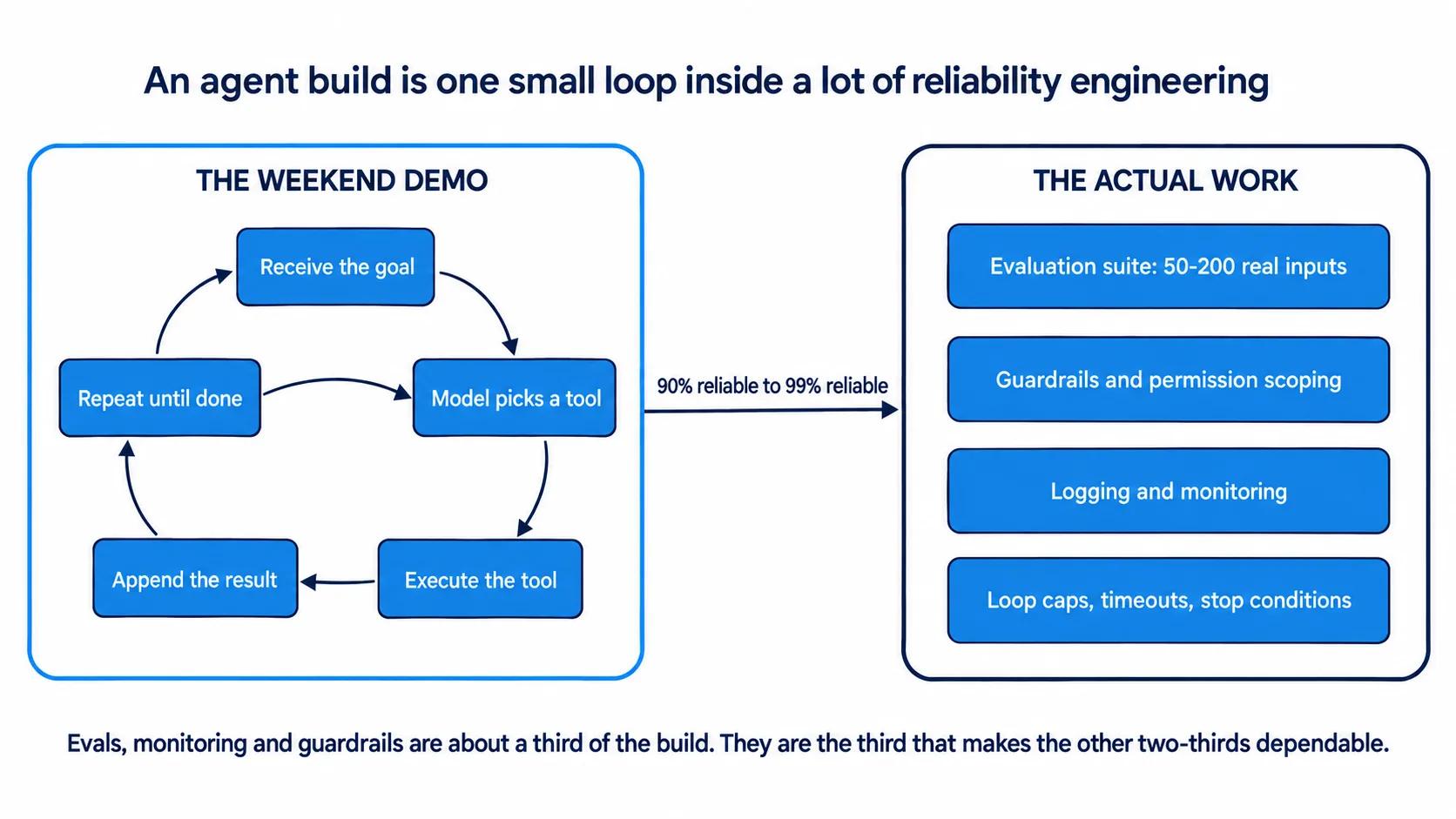
To build an AI agent, you connect an LLM to a set of tools (functions it can call), run it in a loop where it plans, acts, and observes results, then wrap that loop in evaluation, logging, and guardrails. The model is the easy part. The reliability engineering around it is the actual work.
We have shipped 30+ projects to production since 2024, and a growing share of them are agents: software that does the task instead of describing it. This guide covers the parts most tutorials skip, which is everything after the demo works.
Strip away the branding and every agent is the same construct. A chatbot answers questions. An agent makes decisions, calls tools, checks the results, and keeps going until the goal is met or a boundary stops it.
The core components:
The loop itself is short enough to sketch on a napkin:
1. Receive the goal
2. Model picks a tool (or decides it is done)
3. Execute the tool
4. Append the result to context
5. Repeat until done, or until the iteration cap hits
If you build AI agents with just this loop and nothing else, you will get a convincing demo in a weekend. Everything else in this guide is what separates that weekend demo from software a business can rely on.
Two practical rules before you write a line of code. Keep the first version to 3-5 tools, because tool selection accuracy drops as the menu grows. And treat tool descriptions as production code, since the model chooses tools based entirely on those descriptions. A vague description produces a vague agent.

The primitive underneath every agent framework is the same: structured tool calling, where the model returns a JSON payload naming a function and its arguments, and your code executes it. OpenAI's function calling docs and Anthropic's tool use docs both explain the pattern in an afternoon's reading.
Our default advice: build your first agent directly against the provider API. A raw loop is maybe 150 lines, you understand every one of them, and when something breaks at 2am the stack trace points at your code, not at five layers of abstraction.
Reach for a framework when the workflow genuinely needs one. LangGraph earns its complexity when you have multi-step workflows with branching, retries, human approval steps, and state that must survive a crash. It models the agent as a graph with checkpoints, which is what you want for anything long-running. For a survey of what else is worth your time, we keep an updated guide to open source AI agent frameworks.
One opinion we hold strongly: buy the outcome, not the model. Model names change quarterly. Architect so that swapping the underlying LLM is a config change, and put your effort into the tools, evals, and data plumbing that compound over time.
An agent is only as useful as the data it can reach. Across our projects, the sources cluster into five groups:
HrefStack, a martech product we built, is a concrete example. Its autonomous SEO content agent pulls from keyword APIs, search performance data, and the client's own content corpus, then publishes without manual uploads. It runs 24/7, generates 300+ leads per month from its articles, and cut customer acquisition cost by 60% versus paid channels. The agent logic took weeks; getting the data plumbing right took most of the 10-week engagement.
The rule that keeps you out of trouble: least privilege from day one. Every data source the agent touches should have the narrowest credentials that still let it do the job.

You test AI agents with an evaluation suite: a fixed set of real inputs, a scoring method for each output, and a habit of re-running the whole set on every prompt or model change. Not unit tests alone, because the failure modes are probabilistic, and not vibes alone, because vibes do not catch regressions.
A working eval setup has three layers:
From the field: the most common client pattern we see is a team arriving with a demo that impressed everyone in a meeting and fell apart on real data. A demo that works on five hand-picked examples tells you nothing about the five thousand real ones. Moving from 90% to 99% reliability is where the engineering lives, and it is most of what we actually do.
We wrote up our full scoring approach in how to evaluate an AI agent. The blunt version: an agent without an evaluation suite is a liability with a chat interface.
Securing AI agents means assuming the model can be manipulated and designing so that manipulation cannot cause damage. The threat model is different from ordinary web security, because your attack surface now includes every piece of text the model reads.
The controls that matter, in order:
The OWASP Top 10 for LLM applications is the reference list worth reading in full before launch. Prompt injection has held the number one spot for a reason.
The first wave of business AI generated text. The current wave acts: the support agent that does not just explain the refund policy but checks the order, applies the policy, and processes the refund through Stripe with an audit trail.
Most teams do not need an "AI transformation". They need three boring workflows automated well. The pattern we see repeatedly is an ops team doing triage by hand at 2am because one tool does not talk to another tool. That gap is usually one integration and one agent away from gone.
Picking the first workflow is most of the strategy. Good candidates share three traits: high volume, clear success criteria, and low blast radius when the agent gets one wrong. Ticket triage, data entry between systems, report generation, and lead qualification all fit. Anything involving irreversible money movement or legal commitments should come later, after the evals prove reliability on safer ground.
Start narrow, instrument everything, and expand the agent's autonomy as the numbers earn it. That sequencing sounds slow and ships faster than the alternative, which is a broad agent that nobody trusts enough to turn on.
Custom AI agent development typically runs $4,000-$30,000 fixed price, depending on scope. These are our real published tiers:
| Agent type | Typical price | Timeline |
|---|---|---|
| Single-purpose agent (one workflow, few tools) | $4,000-$10,000 | 3-4 weeks |
| Multi-step workflow agent (integrations, approvals) | $10,000-$22,000 | 5-7 weeks |
| Enterprise platform (multiple agents, phased) | $22,000-$30,000+ | 8-12 weeks |
Then there is the running cost. Production agent inference typically lands between $50 and $2,000 per month depending on volume. Good engineering moves that number more than model choice does: caching, routing easy requests to cheaper models, and tighter prompt design routinely cut inference spend 3-10x.
Budget for the unglamorous parts too. The eval suite, monitoring, and guardrails are usually a third of the build, and they are the third that makes the other two-thirds dependable.
You can assemble one with no-code stacks like Zapier, Make, or n8n, and for a low-stakes prototype that is a fine way to validate demand. Our caution: no-code automations are great until they become load-bearing. Then nobody can debug them, and the person who built the zap has left. For anything customer-facing or revenue-touching, custom code with tests wins.
A focused single-purpose agent takes 3-4 weeks to reach production, including the evaluation suite and guardrails. Multi-step workflow agents run 5-7 weeks. Our typical engagement overall is 4-8 weeks from kickoff to live deployment. A demo takes a weekend; the gap between those numbers is the reliability work.
Start with a frontier model from Anthropic or OpenAI for the core reasoning, then route simpler steps to cheaper models once your evals tell you where quality holds. The more durable answer is architectural: keep the model swappable behind a config flag, because rankings change quarterly and your tools and evals should outlive any of them.
Usually not. Tool calling, retrieval, and careful prompt design cover the large majority of business agents we build. Fine-tuning earns its cost when you need a very specific output style at high volume or want a small model to match a large one on a narrow task. Treat it as a late optimization, not a starting point.
Written by the Codestreaks team, drafted with AI assistance and edited by a human against our own delivery history. The price bands and timelines here are our real published tiers rather than estimates, drawn from 30+ projects shipped to production since 2024 at two engagements per quarter. The 50-200 input eval-set range, the 3-5 tool starting cap and the "about a third of the build" split for evals, monitoring and guardrails are our own working numbers from agent projects, not an industry benchmark, and they are ranges because scope moves them. The diagram is ours. No client names appear here, and the demo-that-fell-apart pattern is described without identifying details per our client confidentiality practice.
If you would rather have a production-grade agent built for you, that is what our AI agent development services cover: the loop, the tools, the evals, and the guardrails, delivered with 100% code ownership so the repo is yours from day one.
We take on two engagements per quarter, and every project includes 30 days of post-launch support. Book a free 30-minute scoping call and we will respond within two business days with an honest read on whether an agent is the right fix for your workflow.
A serial maker of SaaS products and AI agents, I’ve built and launched 10+ tools, grown products to thousands of users, and taken multiple ventures. I share the process what works, what breaks, and how builders can ship faster and smarter. Previously a data scientist at a Big Four consulting firm.


