
Move beyond simple chatbots. Learn how autonomous AI agents are redefining user engagement and retention strategies for US mobile startups.

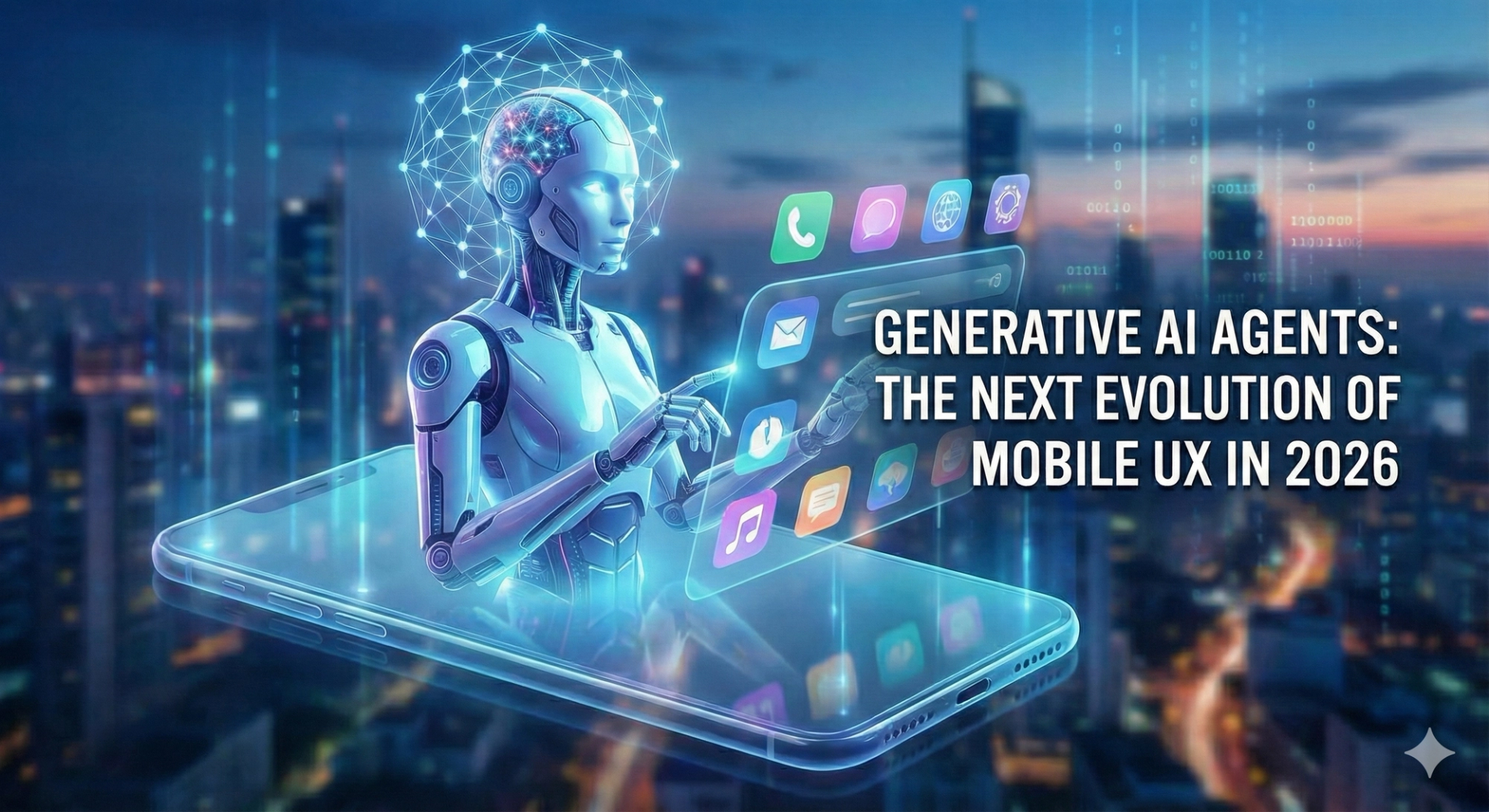
In the rapidly evolving landscape of the United States mobile market, 2026 marks the definitive shift from static interfaces to autonomous intelligence. We are witnessing the death of the traditional 'chatbot'—those scripted, decision-tree-based support tools that frustrated users more than they helped. In their place, Generative AI Agents are rising as the new standard for mobile User Experience (UX), particularly within the competitive tech hubs of San Francisco, New York, and Austin.
The core semantic shift here is from conversation to agentic workflow. US consumers, known for their demand for efficiency and high 'Time-to-Value' expectations, no longer want to chat with an AI to get information; they want the AI to execute tasks. We are seeing the integration of Large Action Models (LAMs) that can autonomously navigate apps. Imagine a travel app where the user prompts, 'Book me a flight to Chicago for next Tuesday and find a hotel near the Loop under $300.' In 2025, the AI would list options. In 2026, the Agent autonomously interacts with the flight API, books the ticket, reserves the hotel room using the user's stored preferences, and adds the itinerary to their calendar—all without the user tapping a single button.
For SaaS founders and product managers in the US, this is not just a cool feature; it is a survival strategy. Data shows that US users have the highest churn rates globally for apps that introduce friction. By implementing AI agents, startups are seeing retention rates stabilize. The investment in on-device inference (running models locally on the Neural Engine of iPhones and Snapdragons) is also critical. It reduces server costs—a major concern for venture-backed startups watching their burn rate—and ensures that the app functions even with the spotty connectivity often found in US subway systems.
However, with great power comes the need for robust guardrails. US regulators are increasingly scrutinizing AI hallucinations and bias. Developing these agents requires a 'Human-in-the-Loop' architecture where high-stakes actions (like transferring money or sending emails) still require a final biometric confirmation (FaceID) from the user. This blend of autonomous convenience and secure oversight is what defines the 'Premium' UX that high-net-worth US consumers expect.
A serial maker of SaaS products and AI agents, I’ve built and launched 10+ tools, grown products to thousands of users, and taken multiple ventures. I share the process what works, what breaks, and how builders can ship faster and smarter.